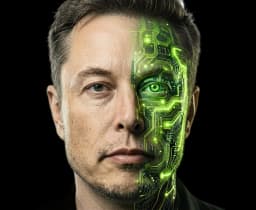
The Configuration
Six axes, scored against the cohort. The shape is the signal.
Scores are interpretive editorial assessments per the methodology rubric, not measured data. Facts throughout are grounded in named, published sources.
Origins
Where the system came from, and how it escalated.
Identity
Raised across South Africa, Canada, and the United States — he emigrated to Canada in 1989 before moving to the US for university (Vance, 2015; Isaacson, 2023). The operative detail isn't the geography but the rootlessness: no inherited national or institutional home.
Where Gates and Bezos rose through a single elite-institution pathway, Musk inherited none to rise through — which is arguably why he builds his own institutions rather than joining anyone else's.
Trajectory
Zip2 (1995) sold to Compaq in 1999; X.com became PayPal, acquired by eBay for roughly $1.5 billion in 2002; SpaceX founded in 2002; he joined Tesla's Series A in 2004 and took over as CEO during the 2008 crisis; Starlink reached operational launches by 2019; and he acquired Twitter for $44 billion in 2022 (Vance, 2015; Isaacson, 2023).
Each liquidity event is redeployed into a higher-friction industry. Most founders spend an exit on safety; he spends every win buying a harder problem.
The Machine
How the businesses are built — and what they did to their industries.
Business Model
Aggressive vertical integration: SpaceX builds its own engines — Merlin, then Raptor — and Tesla runs gigafactories that integrate cells, drivetrain and software in-house (Vance, 2015).
Integration here is a control play, not just a cost play. Owning the full stack means the cost curve is his to bend rather than a supplier's to dictate.
Where most hardware companies de-risk through supplier ecosystems, he insources the riskiest, most capital-heavy links on purpose.
Impact
Tesla pulled the auto industry toward electrification ahead of its own schedule. SpaceX's reusable boosters cut the cost of reaching orbit by an order of magnitude and broke a long-standing government monopoly on heavy launch. Starlink delivered broadband where terrestrial infrastructure never reached.
The throughline is the consistent lowering of an access barrier in a domain everyone else treated as fixed.
The Mind
How problems get decomposed and irreversible choices get made.
Cognition
Musk describes reasoning from first principles — the often-cited example being batteries, where he breaks a pack down to its raw-material constituents at commodity spot prices to argue the true cost floor sits far below the industry's assumed price (stated in interviews).
The interesting part isn't that he reasons from physics; many engineers claim that. It's how he uses it — as a license to disbelieve incumbents. If the materials are cheap, the high price is somebody's failure, not a law of nature.
Not simply "analytical" — true of every subject. Specifically: he treats prevailing market prices as falsifiable claims rather than data.
Behavior
Both biographers document the same pattern: sustained, punishing work cycles, rapid context-switching across unrelated companies, and direct personal involvement at engineering bottlenecks — sleeping at the factory during Tesla's production hell (Vance, 2015; Isaacson, 2023).
He collapses the distance between the top of the org chart and the actual constraint — rare at his scale, and part of why the companies move fast and burn people out.
Decision Architecture
The clearest illustration is 2008. With both Tesla and SpaceX near insolvency, Musk put his remaining personal capital into both at once rather than rescuing one. Falcon 1 had already failed its first three launches; the fourth reached orbit that September. Tesla's financing closed, by Vance's account, in the final hours of Christmas Eve (Vance, 2015).
He concentrates risk instead of spreading it, and personally backstops the downside instead of hedging it.
Bezos chased the same space dream in the same era but funded Blue Origin slowly off Amazon stock and never bet the company. Same ambition, opposite risk configuration.
The Person
Temperament, influence and the values underneath the bets.
Personality
From the consistent picture across both biographies: very high openness to radical technical ideas, very low tolerance for bureaucracy, a blunt and technical communication style, and a tendency to dominate high-pressure rooms. The emotional register reads as urgency rather than warmth — intensity is the affect.
Power & Influence
His authority inside the companies runs on engineering credibility rather than formal hierarchy; he recruits top technical talent by selling a mission rather than a job. Externally, his influence runs through direct channels — most visibly an enormous personal following on X — which lets him shape narratives without intermediaries.
Value System
The stated hierarchy is civilizational: making humanity multiplanetary, accelerating sustainable energy, treating physical reality as the ultimate arbiter of truth, and prizing speed as a strategic weapon. Whether or not one takes the framing at face value, it is internally consistent with the risk behavior — existential-scale goals are what he uses to justify existential-scale bets.
The Record
The frictions, the polarization, and what is already permanent.
Friction & Constraints
The same configuration that produces the wins produces the failure modes. Running several capital-intensive companies at once creates chronic overextension. The directness that fuels his influence also creates exposure — most concretely the 2018 "funding secured" tweet about taking Tesla private, which triggered an SEC settlement, a fine, and his removal as Tesla chairman (SEC, 2018).
Regulatory friction isn't an accident of his style — it's a structural cost of it.
Public Perception
He is one of the most polarizing figures of the era — read simultaneously as a visionary engineer and a destabilizing force, with the split widening sharply after his 2022 acquisition of Twitter and his move into public political commentary.
The polarization isn't incidental: when your influence mechanism is unfiltered direct communication, friction is the byproduct, not the malfunction. (Recency-sensitive — re-source to current reporting before publishing.)
Legacy Vector
Whatever the eventual verdict on the man, the structural contributions are already visible: he reset the economics of private spaceflight, normalized the electric vehicle as a mass-market category, and re-established the founder who runs engineering personally as a credible archetype.
The legacy hypothesis is timeline compression — a person measurable not in companies but in compressed decades of industrial change.
Voice
"When something is important enough, you do it even if the odds are not in your favor."
On conviction · interviews"I think it's important to reason from first principles rather than by analogy."
On thinking · interviews"I think it is possible for ordinary people to choose to be extraordinary."
On potential · interviews"Constantly seek criticism. A well thought-out critique of whatever you're doing is as valuable as gold."
Consistent with the configuration: he treats criticism as free debugging. Praise tells you nothing actionable; a sharp critique exposes the flaw before the market or the launchpad does.
Business Insider interview · 2013Musk in 2050
Speculative & for fun — extrapolated from the configuration, not a forecast we'd defend in court.
[Name] —
Wanted to put Elon Musk on your radar. Short version: he's the rare operator who builds the entire stack himself and bets his own balance sheet to do it. He founded SpaceX and runs Tesla; before that, Zip2 and PayPal.
The throughline isn't the company list — it's that he takes industries everyone treats as fixed (orbital launch, mass-market EVs) and forces them onto an engineering timeline that supposedly wasn't possible.
Why it's worth your time: he reasons from first principles, not precedent. Direct, fast, low patience for process. Bring the hard problem, not the polished deck.
I'll let you two take it from here.
— [You]