Breaking the Clutter, Part 2: From Sight to Grip
Part two of Breaking the Clutter. Perception taught robots to read the mess; execution is where collision physics, force feedback, and fleet-scale learning decide whether the bin actually gets emptied.
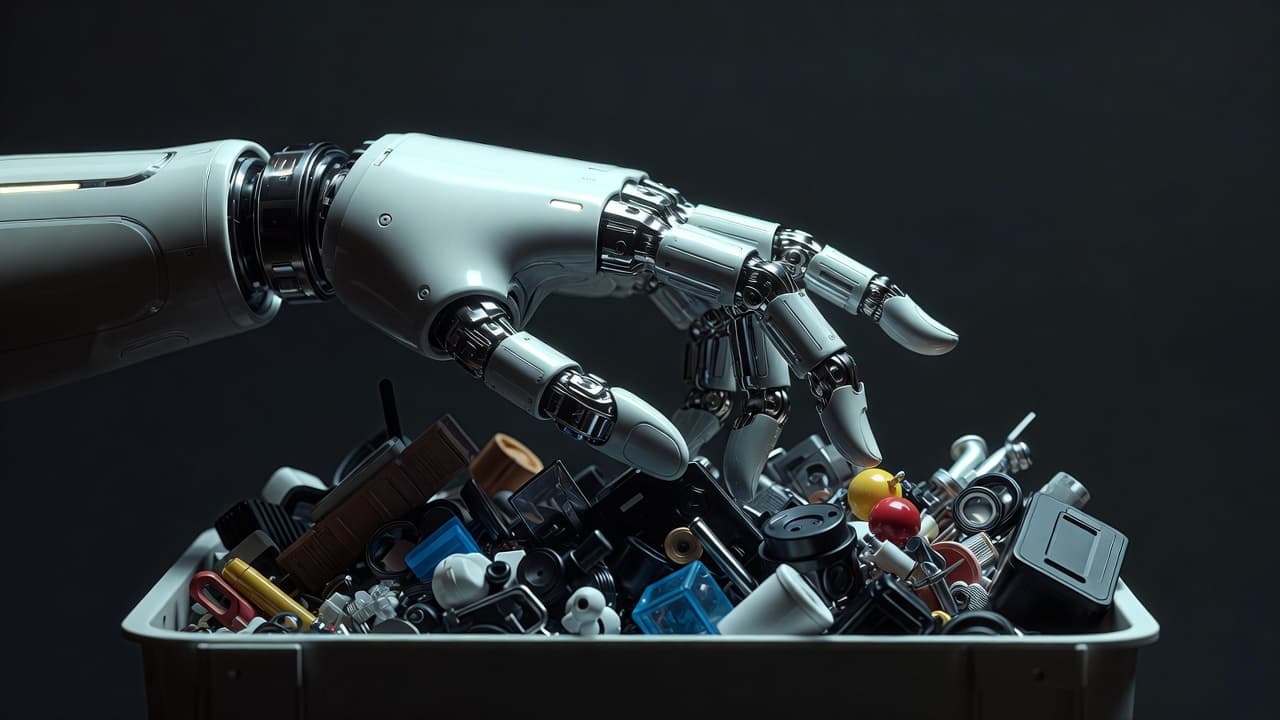
In Part 1, a robot learned to look at a bin of jumbled objects and understand the mess — which item to try, which angle to approach, which grasp is most likely to hold. That is the perception half of the problem, and it is the half that gets the headlines. The harder, quieter half is execution: the instant a gripper drops past the rim of the bin, the task stops being a vision problem and becomes a physics problem, with walls to avoid, forces to manage, and no second chance if it crushes the product or jams the line. This is the part of robotic bin-picking that separates a lab demo from a system that actually runs a shift.
THE EXECUTION STACK
Perception reads the mess. Three more systems decide whether the bin actually gets emptied — and stays emptied without a human standing by.
WHY A MILLION PERFECT PICKS FAIL
A policy trained in a flawless simulator meets a floor full of noise, friction, and imperfect contact. The fix is to make the simulation messy on purpose.
FINDING “JUST RIGHT”
Too soft and the object slips on the way up; too hard and it cracks. Closed-loop sensing keeps the grip inside a narrow band — and corrects it mid-lift.
FROM CLOUD FLEET TO REAL-TIME GRASP
Slow shared learning in the cloud; fast reflexes at the edge. The fleet gets smarter overnight while each arm decides in milliseconds.
Sources: domain randomization, Tobin et al. (2017); large-scale pooled grasping, Levine et al. (2016).
The gap between the simulator and the floor
Part 1 noted that most of this practice happens in simulation, where a robot can attempt millions of grasps in days rather than years. The problem is that a simulator is too well-behaved. Lighting is even, surfaces have perfect friction, the camera is noiseless, and contact between gripper and object is mathematically clean. A policy that masters that world can still fall apart on a real warehouse floor, where a smear of dust, a glare off a plastic wrapper, or a fractionally slicker surface is enough to make a confident grasp miss. Engineers call this the sim-to-real gap, and it is the first thing standing between a trained model and a working machine.
The dominant fix is counterintuitive: make the simulation worse on purpose. Domain randomization, formalized by Tobin and colleagues in a 2017 paper, scrambles the simulator's parameters during training — randomizing lights, textures, colors, and physics from one episode to the next. A model forced to succeed across thousands of deliberately inconsistent virtual worlds learns to ignore surface appearance and lock onto what actually matters. By the time it meets the real bin, the messiness of reality reads as just one more variation it has already seen. The robot was trained to expect chaos, so chaos stops being a surprise.
Finding the grip that doesn't slip or crush
Once the arm reaches the object, it faces a narrow target between two failures. Squeeze too lightly and the item slips on the way up; squeeze too hard and a fragile part cracks or a soft package deforms. There is a "just right" band in between, and the width of that band depends on an object the robot may never have handled before. Early picking systems were open-loop: take a picture, commit to a grip, lift, and find out at the drop point whether it worked. If the object slipped mid-lift, the robot stayed oblivious until it arrived empty-handed.
Modern manipulation is closed-loop, which means the robot keeps sensing while it acts. Force-torque sensors in the wrist measure resistance along each axis and catch the moment a grip starts to fail; for suction tools, flow sensors watch the vacuum seal and register the instant it begins to break on a porous or shifting surface. When the feedback says the grip is going wrong, the system reacts in flight — easing acceleration, tilting to recenter the load, or increasing suction — rather than discovering the failure after the fact. The difference is the same one that separates catching a glass as it tips from sweeping it up afterward.
| Open-loop | Closed-loop | |
|---|---|---|
| Feedback during the lift | None — grab and hope | Continuous force, torque, and vacuum sensing |
| Response to a slip | Discovered at the drop point | Corrected mid-air: re-grip, slow, or re-seat |
| Typical failure mode | Silent; the item is already gone | Caught and recovered in real time |
| Best suited to | Identical parts, fixed presentation | Novel objects in genuine clutter |
Snaking into the bin without a collision
Knowing where an object sits is not the same as reaching it. An item wedged in the bottom corner of a deep container cannot be approached in a straight line, because the gripper, wrist, and arm all have to fit through the same tight geometry without striking the walls or the objects piled on top. This is the work of collision-free motion planning, and it is recomputed for every pick, since the bin is different after each one. The robot is effectively solving a fresh spatial puzzle each time it reaches in.
The planner builds a live three-dimensional model of the scene and searches for a path that keeps the robot's entire body clear of every obstacle along the way — not just the gripper's final position, but every joint angle it passes through to get there. For a deep corner grab, the solution is rarely elegant: it is a contorted, multi-axis approach that flexes the arm down and around the rim. Object recognition tells the robot what to pick; motion planning is what lets it physically get there and back out intact. Skip it, and a system with perfect vision still drives its elbow straight into the side of the bin.
Deciding in milliseconds at the edge
All of this has to happen fast enough to keep a line moving, which rules out sending data to a distant server and waiting for an answer. A high-resolution 3D point cloud is large, and the round trip to the cloud and back adds latency a real-time grasp cannot absorb — by the time instructions returned, the scene would already have changed. So the heavy perception and planning run locally, on dedicated inference hardware sitting on the warehouse floor.
Running models at the edge lets the robot process what it sees and adjust its trajectory within milliseconds, tightening the loop between sensing and acting until the two are effectively continuous. The cloud still matters, but its job shifts from real-time control to slower, fleet-wide work: storing policies, aggregating data, and pushing updates. This split — fast local reflexes, slow shared learning — is a recurring pattern in physical AI automation, and it is what makes a closed-loop system responsive enough to trust on a moving line.
What one robot learns, all robots learn
A single robot will eventually hit an object that defeats it — a mirror-finish part that scrambles its depth sensor, or a plush item that swallows suction. On its own, it stalls. Connected to a fleet, it does something better: when any robot discovers a grasp that works for a stubborn item, that strategy is uploaded to a shared registry and distributed to every other machine. A robot in another facility, meeting that same item for the first time, can pick it correctly on the first try because a peer already solved it.
The idea is not new, and the proof is concrete. In 2016, a Google team ran between 6 and 14 robotic arms in parallel and pooled their experience, collecting over 800,000 grasp attempts in two months to train a single shared grasping network. Pooled experience scaled in a way solo trial-and-error never could, and the principle now underpins commercial deployments: every pick across the fleet is a lesson, and the lessons compound. This is where cloud infrastructure earns its place in a robotics stack — not to drive the arm, but to make the whole fleet smarter than any arm in it.
The metric that actually matters
Newcomers to automation tend to fixate on picks per hour, and vendors are happy to quote big numbers. But raw speed is a vanity figure if the machine seizes up every few minutes and waits for a human to untangle a jam, reset the cell, and restart the line. Each of those stoppages is expensive in a way throughput charts hide, because it pulls a person back into a process that was supposed to run without one.
The number that decides whether a bin-picker is a profit center is how rarely it needs that human — interventions per hour, not picks per hour. A system that picks a little slower but almost never stalls will out-earn a faster one that constantly stops, because it actually delivers the autonomy the speed was promising. Driving interventions toward zero is the real engineering goal, and it is the threshold where a robot stops being an expensive experiment that needs supervision and becomes infrastructure that simply works.
The Bottom Line
Perception taught robots to read the mess. Execution and orchestration are what let them clear it, and keep clearing it without a babysitter. The frontier is no longer a smarter eye in isolation; it is a full stack that holds together under real-world conditions — trained against deliberately randomized simulations, kept steady by force and slip feedback, routed through collision-free paths, decided at the edge in milliseconds, and made collectively smarter by the fleet. Each piece is unremarkable on its own. Together they are the difference between a robot that can grab one object on a good day and a system that empties bin after bin, shift after shift, in the unstructured world where automation finally has to live.
Explore Related Concepts
Frequently Asked Questions
What is the sim-to-real gap in robotics?
It is the performance drop when a model trained in simulation meets the real world, where sensor noise, friction, and imperfect contact break assumptions the simulator never modeled. Domain randomization is the standard way to close it.
What is domain randomization?
Domain randomization deliberately scrambles a simulator's lighting, textures, and physics during training, so the real world looks like just one more variation the robot has already handled. It was formalized by Tobin and colleagues in 2017.
How do robots avoid crushing or dropping objects?
Modern grippers run closed-loop: force-torque and vacuum-flow sensors measure the grip in real time and adjust pressure or trajectory mid-lift, instead of grabbing blindly and hoping.
What is collision-free motion planning?
It is the job of computing a path that moves the robot's whole body — arm, joints, and gripper — into a cluttered space without hitting the bin walls or neighboring objects, recalculated for every pick.
What is fleet learning in robotics?
Fleet learning lets many robots share what they discover. A successful new grasp strategy found by one machine is uploaded and pushed to the rest, so the fleet improves collectively rather than each robot learning alone.
Is picks per hour the right way to measure a bin-picking robot?
Not on its own. Raw speed means little if the system stalls constantly, so operators increasingly judge autonomy by how few human interventions per hour a robot needs.