ROBOTICS
The state of robotics, the economics of physical automation, and what's driving the acceleration toward practical robot deployment.
Part of: TechnologyRobotics is the field of engineering and computer science concerned with designing, building, and operating machines that can perform physical tasks autonomously or semi-autonomously.
For most of robotics history, robots were expensive, brittle, and confined to controlled industrial environments — automotive assembly lines, semiconductor fabrication. The shift happening now is driven by AI: large-scale training on video and demonstration data is producing robot control policies that generalize far better than hand-programmed systems, enabling robots to operate in unstructured environments. This is the frontier of physical AI automation, moving beyond software into the real world. It sits at the intersection of mechanical engineering, electrical engineering, computer vision, and increasingly, foundation models for robotic control.
The unit economics problem
The barrier to robot deployment has always been cost versus capability versus reliability. A robot that costs $100,000 and works 80% of the time is worse than a human worker in most contexts. The companies compressing this equation fastest — Figure, 1X, Boston Dynamics, Tesla's Optimus program — are the ones worth tracking as leading indicators of when and where robot deployment becomes economically rational. The threshold isn't technical perfection; it's the point where total cost of ownership, including downtime and maintenance, falls below the fully-loaded cost of human labor for a given task. That threshold is different for warehouse picking versus surgical assistance versus home care, which is why deployment timelines vary so sharply across sectors.
The AI acceleration
Foundation models trained on internet-scale data are being adapted for robotic control (RT-2, π0, and others). This matters because it suggests robot capabilities may follow a similar scaling trajectory to large language models — improving rapidly as AI compute and data increase, rather than requiring years of manual engineering per new task. If that trajectory holds, the timeline to practical general-purpose robots compresses significantly. The key question is whether robotic control is the kind of problem where scale alone drives capability, or whether it requires qualitatively different architectural innovations that haven't arrived yet.
The data bottleneck
Unlike language models, which trained on decades of text already on the internet, robotic foundation models need embodied interaction data — recordings of robots or humans performing physical tasks in varied environments. This is expensive to collect, difficult to standardize, and not yet available at the scale that drove LLM capability jumps. The main research approaches to solving this include sim-to-real transfer (training in simulation, deploying in the real world), human video imitation (learning from YouTube and similar sources), and teleoperation data collection at scale. Which of these approaches yields high-quality, generalizable data fastest is the near-term technical constraint most likely to influence the commercial timeline.
The killer application question
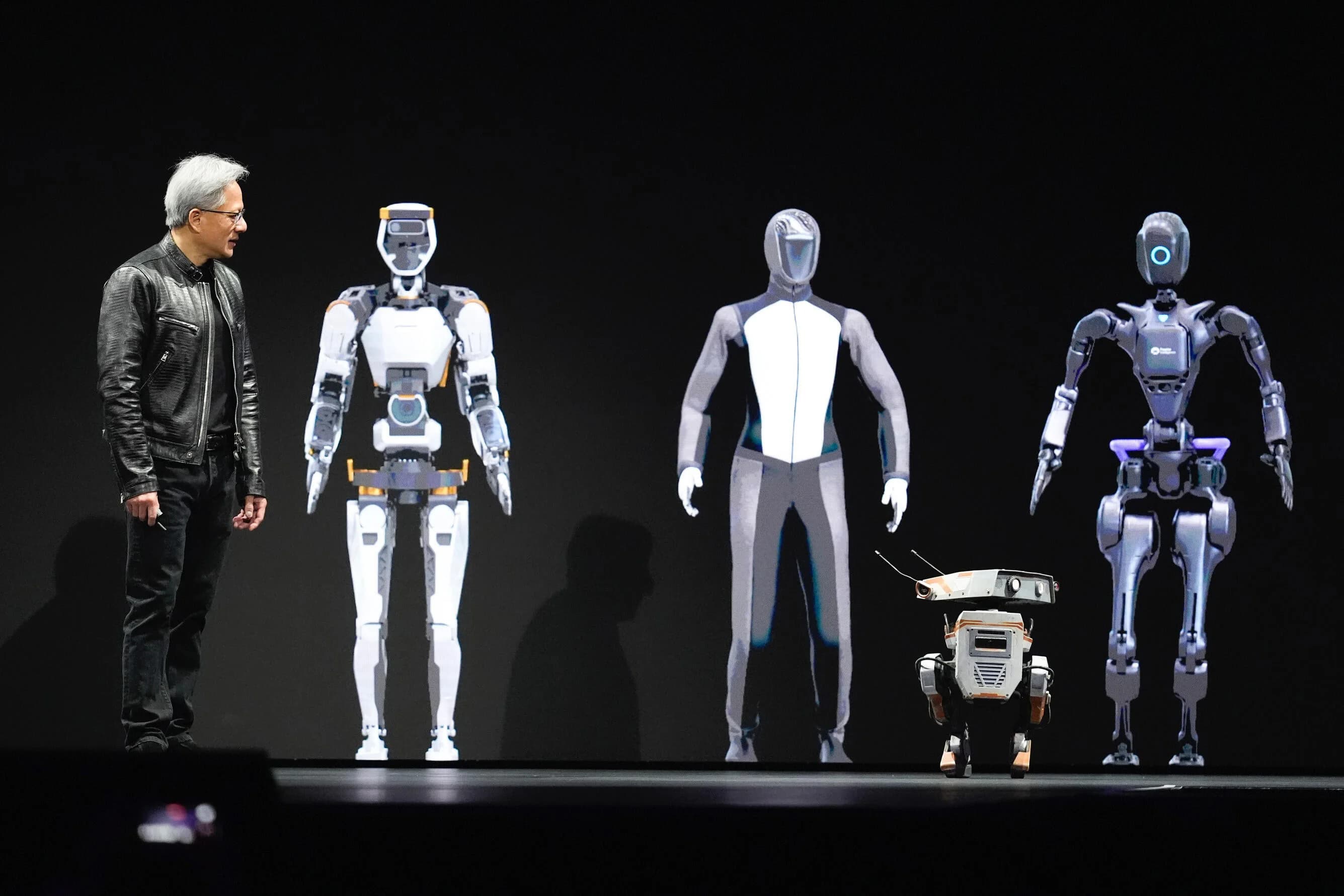
Humanoid robots attract the most attention, but near-term commercial deployments are in narrower form factors: mobile manipulation robots for warehouse picking, inspection robots for infrastructure, and surgical robots for precision procedures. These work because the task scope is constrained, the environment is semi-controlled, and the economic case is clear. Humanoid general-purpose robots are further out — but the foundation model approach to robot control is compressing that timeline faster than hardware-only approaches ever did.
Open Questions
- Does sim-to-real transfer produce data of sufficient quality for general-purpose manipulation, or does it introduce distributional gaps that compound at deployment?
- Will robot capabilities scale smoothly with compute and data the way language models have, or will physical manipulation require architectural breakthroughs?
- Which labor markets — by geography, sector, and wage level — reach the economic threshold for robot substitution first, shaping the future of work, and how fast does it spread from there?
- Who owns the training data advantage in robotics: hardware companies that control physical fleets, or AI labs that understand scaling?
- Does a general-purpose humanoid robot require human-level dexterity, or is a narrower physical profile sufficient for most economically valuable tasks?
Part of the knowledge graph at The Best Blog Ever — reference definitions for ideas that matter.
Related Concepts