The AI Review Site That Refuses to Rank Anything Yet
Most AI tool rankings are marketing claims with a score attached. BestSuperintelligent.com enforces open model data, evidence labels, and zero unverified rankings.

By Tal Slavin · Edited by Liyam Flexer
Open almost any modern roundup of artificial intelligence applications across our Artificial Intelligence Hub and you encounter a predictable formula: a ranked list, a subjective score out of ten, and an affiliate link declaring a definitive winner. BestSuperintelligent.com has inverted this model entirely by declining to award arbitrary scores, withholding category rankings, and applying strict evidence labels to every technical claim in generative AI.
AI Overview
BestSuperintelligent.com is an independent research and comparison platform designed for enterprise teams and developers navigating foundation models and autonomous agents. The platform’s governing rule states that no software product receives an evaluation score or ranking until backed by independent, repeatable empirical testing. In place of unverified top-ten listicles, the site provides a 14-model API token cost calculator, five-question model selection tools, and open datasets licensed under Creative Commons CC BY 4.0, advancing the discipline of model evaluation.
Key Facts
| Feature | BestSuperintelligent.com | Standard AI Aggregator |
|---|---|---|
| Current Product Status | 9 tools cataloged as Planned | Instant subjective 10/10 scores |
| Ranking Policy | Requires ≥2 tested tools per category | Unverified affiliate rankings |
| Evidence Tagging | 6 standardized provenance tiers | Marketing copy passed as facts |
| Model Pricing Data | Open CSV/JSON downloads (CC BY 4.0) | Paywalled or scraped estimates |
| Test Transparency | Published protocols before testing | Undisclosed benchmarking environments |
A Review Site Built on Stating What It Does Not Know
The central dilemma of generative AI journalism is that vendors frequently publish cherry-picked evals, and review sites lack the resources to verify them. When software companies market context windows, reasoning benchmarks, or enterprise compliance, affiliate blogs routinely republish those claims as confirmed test results.
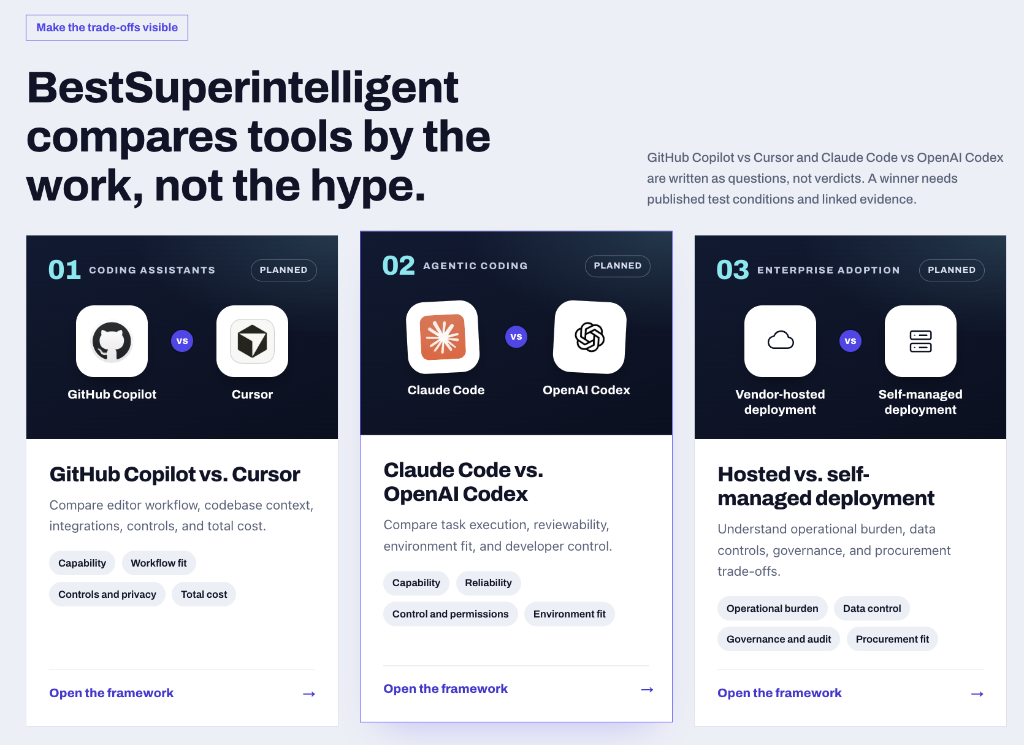
BestSuperintelligent.com tackles this directly on its homepage. Its operational rules dictate that an official ranking requires at least two fully evidenced, independently executed evaluations within a specific category. Because that empirical threshold has not yet been cleared, all product entries—including major coding assistants like GitHub Copilot, Cursor, and ElevenLabs—are clearly designated as Not scored and Planned.
The Evidence Provenance Model
The architectural engine of the publication is what can be defined as the Evidence Provenance Model. Under this protocol, every technical assertion on a product page is paired with an explicit classification:
- Vendor-Reported Claim: Statements quoted directly from company documentation or press releases.
- Independently Observed: Behaviors witnessed by analysts during live interaction without repeatable instrumentation.
- Independently Measured: Results generated from published, repeatable benchmark runs conducted outside vendor environments.
- Third-Party Research: Peer-reviewed academic findings or audited technical benchmarks cited with dated sources.
- Editorial Interpretation: Methodological analysis explaining the practical impact of an observed trade-off.
- Unverified: Assertions that could not be corroborated through documentation or primary observation.
The operational impact of this framework is demonstrated in the site’s ElevenLabs review. The page indexes subscription tiers, API quotas, and audio synthesis features, yet explicitly notes that SOC 2 and ISO 27001 compliance documentation was not verified on public vendor portals, cautioning readers rather than guessing.
Why It Matters
As enterprises shift from exploratory generative AI pilots to production agent deployments, procurement decisions carry severe financial and security liabilities. Token overages, training data retention policies, and hallucination rates in production cannot be evaluated with marketing copy.
BestSuperintelligent.com provides immediate operational utility through non-evaluative engineering tools:
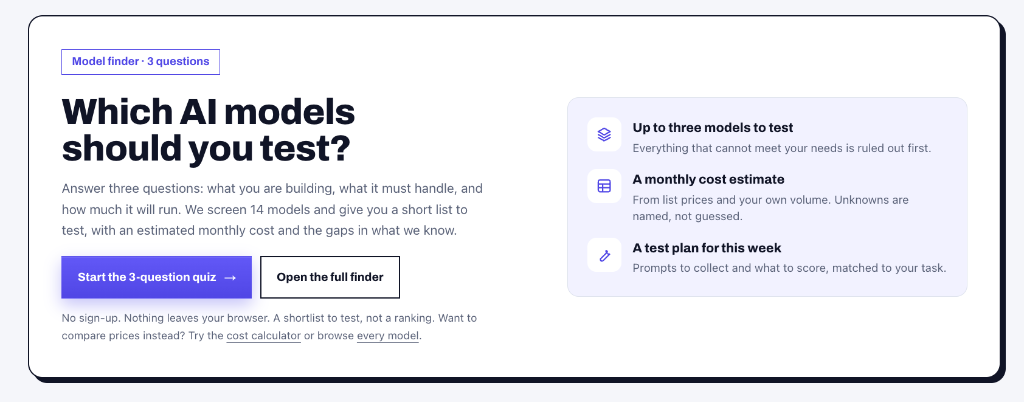
- Token Cost Calculator: The interactive cost calculator allows developers to model monthly request volumes and prompt/completion token ratios across 14 frontier models simultaneously.
- Model Finder: A targeted decision wizard matches engineering teams to candidate models based on technical requirements, latency budgets, and cost thresholds.
- Open Machine-Readable Data: All model context windows, rate limits, and pricing specifications are published as JSON and CSV feeds under CC BY 4.0, complete with an
llms.txtendpoint for automated agent discovery.
Limitations
BestSuperintelligent.com's deliberate restraint introduces obvious short-term trade-offs:
- Absence of Immediate Verdicts: Buyers seeking a fast, definitive "which coding agent should I buy today?" will not find a ranked winner.
- Vendor-Sourced Baseline Data: Current product profiles rely primarily on vendor statements while first-party empirical trials remain in development.
- Scope Restrictions: With nine cataloged tools across seven categories, niche open-source workflows and self-hosted models remain unindexed.
Related Articles
For further analysis on AI tooling infrastructure, benchmarking, and production engineering, read our companion research:
- AI Coding Tools Landscape — The macro landscape of developer assistants, code completion, and IDE agents.
- Agentic AI: The Pilot-to-Production Gap — Why enterprise agent pilots stall and how teams cross the production barrier.
- Model Evaluation Concept Guide — Formal metrics, automated evaluation pipelines, and hallucination bounds.
References
- BestSuperintelligent.com Official Portal — Research directory and AI tool comparison platform.
- AI Model Cost Calculator — Interactive multi-model token pricing engine.
- Model Discovery Engine — Requirements-based model recommendation tool.
- Evaluation & Scoring Methodology — Six-dimension evidence evaluation rubric.
- Open Model Data Downloads — Open CSV and JSON machine-readable specifications.
- ElevenLabs Technical Breakdown — Evidence-first product specification reference.
- Editorial Independence & Monetization Policy — Governance rules on scoring separation.
The Bottom Line
In an industry driven by demo hype and speculative benchmarks, BestSuperintelligent.com offers an antidote. By establishing that no ranking can exist without verifiable evidence, publishing open data, and holding vendor claims to rigorous evidentiary tiers, it sets an essential benchmark for the future of technical software journalism.
Explore Related Concepts
Frequently Asked Questions
What is BestSuperintelligent.com?
BestSuperintelligent.com is an independent research platform for intelligent software that marks every claim with an explicit evidence tier.
Why does BestSuperintelligent.com have no rankings yet?
Its methodology requires at least two fully evidenced, independently benchmarked evaluations in a category before ranking any product.
Is the AI cost calculator free to use?
Yes, the 14-model pricing calculator and context window datasets are completely free and downloadable under a Creative Commons CC BY 4.0 license.