How Enterprises Actually Govern AI Agents
Thirty-five percent of enterprises admit they cannot shut down a rogue AI agent. The ones that can share a specific property: the kill switch and the audit log sit outside the agent's own control surface, not inside it.
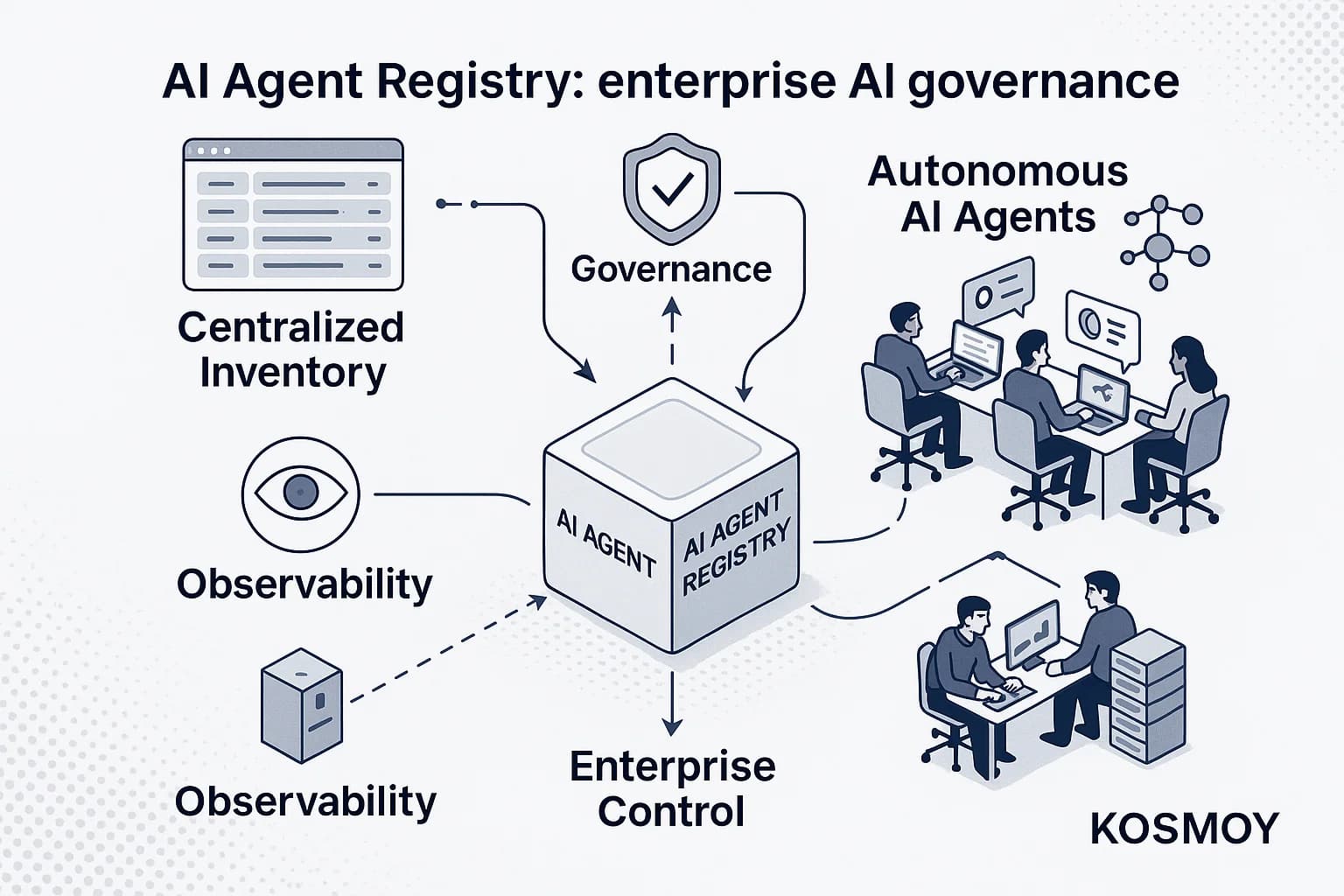
Thirty-five percent of enterprises admit they cannot shut down a rogue AI agent. That is not a hypothetical risk — it is a direct survey response from a 2026 Deloitte study of 3,235 enterprise leaders across 24 countries, the same study that found 74% of those organizations expect to deploy agentic AI within two years. Most agent governance in production today is not a functioning control system. It is a set of controls that look real in a slide deck and fail the moment they are actually tested.
AI Overview
Real AI agent governance requires that the mechanisms watching an agent — audit logs, human review checkpoints, and kill switches — sit outside the agent's own control surface, so the agent cannot influence the evidence used to evaluate it. In practice, most deployments fail this test: audit logs record only what the agent chooses to output rather than every intermediate step, human reviewers are expected to approve high volumes of actions without realistically reading them, and kill switches implement only session-level pausing rather than the full five-layer stack (session termination, permission revocation, circuit breakers, rollback, and full deactivation) needed to stop a failure in progress. A 2026 Deloitte survey of 3,235 leaders found only 21% of enterprises have mature agent governance despite 74% planning to deploy agents within two years, and 35% cannot shut down a rogue agent at all.
Key Facts
| Category | Artificial Intelligence — Governance & Controls |
| Organizations with mature agent governance | 21% (Deloitte, 3,235 leaders, 24 countries, 2026) |
| Organizations planning to deploy agents within 2 years | 74% |
| Cannot shut down a rogue agent | 35% |
| No formal agentic AI deployment plan | 36% |
| Gartner forecast | 40% of enterprises will demote/decommission autonomous agents by 2027 |
| Original framework | The Oversight Test — 3-question diagnostic |
| Updated | September 16, 2026 |
Why It Matters
For engineering and platform leads, the gap between "we have human-in-the-loop review" and "we have functioning oversight" is the difference between a control that catches a failure and one that only documents it after the damage is done. Building the audit log and the kill switch as agent-external systems — rather than trusting the agent's own outputs as the record — is materially more engineering work, but it is the work that determines whether a governance program does anything under load. For operators choosing a vendor or an internal build, the 35% figure on rogue-agent shutdown is a due-diligence question that a demo will never surface: ask specifically whether the kill switch can be triggered by someone other than the team that built the agent, and whether it has ever actually been tested against a live agent, not just documented. For the broader industry, Gartner's 40% decommission forecast is a signal that governance retrofitted after deployment is expensive and frequently fails — the organizations avoiding that outcome are building the oversight layer before scaling, not after an incident forces the question.
The Governance Maturity Gap
The scale of the gap between agent ambition and agent governance is the starting fact. Deloitte's 2026 State of AI in Enterprise, surveying 3,235 leaders across 24 countries, found only 21% of organizations have mature agent governance in place, while 74% expect to deploy agentic AI within two years. That is roughly three-and-a-half times more enterprises planning to deploy than have the governance maturity to do so safely.
The consequences show up in specific numbers. Thirty-five percent of organizations report they cannot shut down a rogue AI agent — not "would find it difficult," but cannot, as a stated fact about their current infrastructure. Thirty-six percent have no formal deployment plan for agentic AI at all, meaning the governance question has not been asked in a structured way before agents reach production. Gartner's separate May 2026 forecast projects that 40% of enterprises will demote or decommission autonomous agents by 2027, driven by governance gaps discovered after deployment rather than before.
These numbers describe an industry that solved "can we build an agent that works" well before it solved "can we prove the agent is still working, and can we stop it if it isn't." The rest of this article is about that second, harder problem.
What a Real Kill Switch Actually Requires
"Kill switch" is frequently used to describe a single button, but the mechanism that actually stops a failing agent is five layered controls, each catching a different failure speed:
| Layer | What it stops | Typical gap |
|---|---|---|
| Session/task termination | The agent's current run | Usually implemented; does not prevent the next trigger from restarting it |
| Permission revocation | Future actions via API keys, OAuth grants, or role-based access | Requires short-lived, scoped credentials — standing broad access defeats this layer |
| Circuit breakers | Runaway behavior via error-rate, spend, or volume thresholds | Requires thresholds defined and tested before deployment, not improvised during an incident |
| Rollback | Damage already done | Requires action logs detailed enough to reverse specific steps, not just explain them |
| Full deactivation | The agent entirely | Requires a unique agent identity separate from any shared service account |
Most production deployments implement the first layer and stop. Session termination pauses the current task, which handles the visible symptom — the agent is doing something wrong right now — without addressing whether the same trigger fires again in five minutes. The deeper layers require infrastructure decisions made before deployment: an agent needs its own identity distinct from a shared service account so its access can be revoked without breaking other systems, and its credentials need to be short-lived and narrowly scoped so revocation is fast and complete rather than partial.
A named human owner with actual shutdown authority is a recurring requirement across governance frameworks, and it is worth being precise about what that means: not a team that could theoretically escalate to someone with authority, but a specific person who can trigger deactivation directly, without needing sign-off from the team that built or benefits from the agent running.
The Oversight Test Framework
The five-layer kill switch answers what technical controls need to exist. It does not answer the more common failure mode, which is controls that exist on paper and do nothing under real conditions — audit logs that record what the agent chose to report, human review steps that rubber-stamp rather than catch. The Oversight Test is three questions that distinguish real governance from governance theater:
1. Can the agent choose what gets logged about its own actions? If the audit trail is generated by the same agent being audited — if it logs only its final output rather than every intermediate tool call and decision — the log cannot be trusted as independent evidence. A common failure mode is logging outputs while skipping the intermediate steps, which makes it impossible to tell whether the agent reached a correct answer through a sound process or a lucky one. A real audit trail requires complete action-level logs across the full multi-step workflow, generated by infrastructure the agent does not control.
2. Can the reviewer approve without reading? Human-in-the-loop checkpoints are supposed to pause high-risk actions pending human feedback. In practice, a reviewer facing dozens of approval requests per hour cannot meaningfully evaluate each one, and the checkpoint becomes a latency cost with no actual oversight value. Real human-in-the-loop design limits checkpoint volume to what a reviewer can genuinely evaluate, and reserves it for the actions where a wrong approval is costly enough to justify the friction.
3. Can the kill switch be triggered by someone other than the agent's own operator? If shutdown authority sits only with the team running the agent day to day, the control is subject to the same incentives and blind spots that let the failure happen in the first place — the team closest to a runaway agent is also the team least likely to want to admit it needs to be stopped. Independent shutdown authority, held by someone without a stake in the agent staying live, is what makes the kill switch a control rather than a courtesy.
A "yes" to either of the first two questions, or a "no" to the third, indicates the surrounding governance is theater: it exists as a documented process without functioning as an actual check on the agent's behavior.
Where This Is Heading
Governance is not implemented uniformly even within a single enterprise. Three models are in active use: centralized governance (common in regulated industries, slower to adapt but consistent), federated or domain-based governance (embedded in individual business units, faster but inconsistent across the organization), and hybrid models combining centralized policy with distributed execution — currently the most common approach, and arguably the correct default, since it keeps the audit-log and kill-switch requirements standardized while letting individual teams own their agent's specific configuration.
On the research side, recent academic work is starting to formalize what production teams have been building ad hoc. A May 2026 paper by Pan and Hou proposes a framework — "AgentRunner" — for dynamically adjusting an agent's autonomy level to match task complexity and risk, explicitly aiming to close the gap between full autonomy and human oversight for enterprise deployment. Whether frameworks like this get adopted broadly or enterprises continue building bespoke governance layers, the direction is the same one this article's data points toward: oversight infrastructure that exists independent of the agent it watches, not oversight bolted onto the agent's own reporting.
The Bottom Line
Every statistic in the Deloitte and Gartner data points at the same gap: enterprises are building agent capability faster than they are building the infrastructure to watch it. That gap closes with specific, checkable engineering decisions — a kill switch with five layers instead of one, an audit log the agent cannot edit, a reviewer with a workload that leaves time to actually read what they are approving — not with a governance policy document. The Oversight Test is deliberately three yes-or-no questions rather than a maturity score, because the organizations in the 35% who cannot shut down a rogue agent do not need a more nuanced assessment of their governance posture. They need to fix that first.
Limitations
The governance maturity and kill-switch statistics cited here (21% mature governance, 35% cannot shut down a rogue agent, 36% no deployment plan) come from a single Deloitte survey reported through SoluLab's July 2026 coverage, not a primary methodology document the author reviewed directly; "mature governance" is a self-reported classification by survey respondents and its definition may vary across the surveyed organizations. Gartner's 40% decommission forecast is a separate analyst projection, cited by title and date because Gartner's site blocks automated link verification. The arXiv paper on the AgentRunner framework is cited only for its confirmed title, authors, and stated contribution — the underlying PDF extraction used in research for this article was partially garbled, so this article does not cite specific technical claims or figures from that paper beyond what was independently verified against the paper's public abstract page. The Oversight Test is an original diagnostic framework synthesized from failure patterns named independently across two industry sources, not a validated instrument tested against a controlled dataset.
References
- SoluLab, "AI Agent Governance: Kill Switches and Enterprise Controls," by Tanmay Pandya — solulab.com, July 21, 2026
- Dataversity, "Agentic AI Governance," by Dennis O'Reilly — dataversity.net, September 1, 2026
- Pan, Kai and Hou, Rong, "Beyond Autonomy: A Dynamic Tiered AgentRunner Framework for Governable and Resilient Enterprise AI Execution," arXiv:2605.10223, May 11, 2026
Related
Part of our ongoing coverage in the AI hub. See Why Agentic AI Pilots Stall Before Production for the operational gaps that precede governance failures, Who Is Liable When an AI Agent Fails for how the absence of these controls translates into legal exposure, and Agentic AI Workflows: What Actually Ships in the Enterprise for how autonomy levels map to required controls. For the concept pages, see AI Agents and Agentic Reasoning.
Explore Related Concepts
Frequently Asked Questions
What is a kill switch for an AI agent, and why do most deployments not have one?
A real kill switch is five layered mechanisms working together: session or task termination, permission revocation (revoking API keys, OAuth grants, or role-based access), circuit breakers that trigger automatically on error-rate, spend, or volume thresholds, rollback capability built on detailed action logs, and full deactivation. Most deployments implement only session termination — pausing the current task — which does not prevent a misconfigured agent from immediately resuming on its next trigger. A 2026 Deloitte survey found 35% of organizations admit they cannot shut down a rogue agent at all.
Why is human-in-the-loop review sometimes called 'governance theater'?
Human-in-the-loop review becomes theater when the review step exists on paper but does not function as real oversight — for example, when a reviewer is expected to approve dozens of agent actions per hour without realistically reading each one, or when the audit log the reviewer relies on is generated and curated by the same agent being reviewed. Real oversight requires that both the review checkpoint and the log it depends on sit outside the agent's own control, so the agent cannot influence what evidence exists about its own behavior.
What percentage of enterprises have mature AI agent governance?
Only 21% of enterprises have mature agent governance, according to Deloitte's 2026 State of AI in Enterprise survey of 3,235 leaders across 24 countries — despite 74% of those same organizations expecting to deploy agentic AI within two years. Gartner separately projects that 40% of enterprises will demote or decommission autonomous agents by 2027 due to governance gaps discovered after deployment.
What does a real audit trail for an AI agent need to include?
A real audit trail logs complete action-level detail across every step of a multi-step workflow, not just the agent's final output. Logging only outputs is one of the most common governance failures cited in industry analysis, because it makes it impossible to tell whether an agent reached a correct answer through a sound process or a lucky one. The log also needs to be detailed enough to support rollback — reversing specific actions — not just detailed enough to explain what happened after the fact.
What is the Oversight Test for AI agent governance?
The Oversight Test is a three-question diagnostic: Can the agent choose what gets logged about its own actions? Can the human reviewer approve an action without realistically reading it first? Can the kill switch be triggered only by the agent's own operator, or by someone independent of that operator? A 'yes' to the first two, or a 'no' to the third, indicates governance theater rather than functioning oversight — the controls exist on paper but cannot actually catch or stop a failure.