Agentic AI Workflows: What Actually Ships in the Enterprise
Two open protocols, one Linux Foundation home, and a 40% cancellation forecast. Agentic workflows are past the demo stage — the question now is which rung of autonomy your process can actually survive.
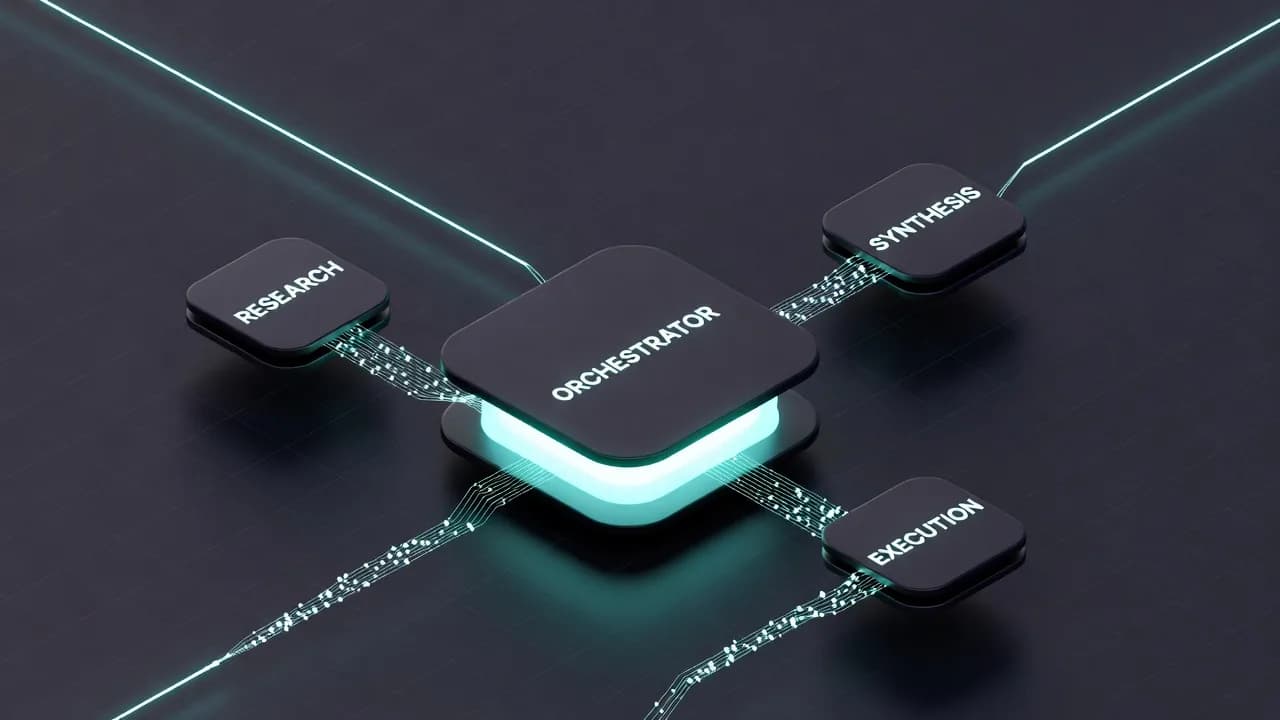
Agentic AI workflows are business processes in which a model plans the steps, calls the tools and decides what happens next — instead of a human scripting every branch in advance. That definition sounds simple. In practice it splits the enterprise into two camps: teams that have a working agent loop in production and teams that have a chatbot wearing an "agent" badge. The gap between those camps is now the most important variable in enterprise AI spending, and the numbers from 2025 and 2026 show it: adoption climbing, protocols consolidating, and a cancellation forecast that most vendors would rather you did not read.
AI Overview
An agentic AI workflow is a process where an AI model reasons about a goal, selects and calls external tools or APIs, evaluates the result and iterates until the task is complete, with humans setting objectives and approving high-consequence actions. In 2026 the underlying plumbing has standardized around two open protocols: MCP for connecting agents to tools and data, and A2A for agent-to-agent task handoffs, both hosted by the Linux Foundation's Agentic AI Foundation. Adoption is real — McKinsey reports 40% of large enterprises scaling agents — but so is failure: Gartner forecasts over 40% of agentic AI projects will be canceled by the end of 2027. The difference between the two outcomes is how much autonomy a process is granted relative to how well its errors can be detected and reversed.
Key Facts
| Category | Artificial Intelligence — Implementation Guide |
| Core mechanism | Plan → tool call → observe → re-plan loop, bounded by permissions and budgets |
| Agent-to-tool standard | Model Context Protocol (MCP), released November 2024; 10,000+ published servers by December 2025 |
| Agent-to-agent standard | Agent2Agent (A2A) 1.0, 150+ supporting organizations, SDKs in Python, JavaScript, Java, Go and .NET |
| Governance | Agentic AI Foundation (Linux Foundation), founded December 9, 2025; A2A joined August 2026 |
| Adoption | 40% of large enterprises (>$1B revenue) scaling agents vs 27% a year earlier (McKinsey, Aug 2026) |
| Failure forecast | >40% of agentic AI projects canceled by end-2027 (Gartner, June 2025) |
| Original framework | The Autonomy Ladder — five rungs, each with a gating control |
| Updated | September 9, 2026 |
Why It Matters
For founders and operators, agentic workflows change the unit of software from "a tool a person uses" to "a process that runs itself and asks for help." That shift moves cost from headcount to inference and evaluation, moves risk from human error to model error at machine speed, and moves vendor lock-in from the application layer to the protocol layer. Whoever controls the tool registry and the handoff format controls the margin — which is why AWS, Google, Microsoft, OpenAI and Anthropic all signed onto one foundation in the space of eight months. For investors, the 40% cancellation forecast is not a bear signal on the category; it is a filter. The survivors are the projects that matched autonomy to reversibility, and that is a measurable property, not a vibe.
What Changed Between the Demo and the Deployment?
The agent demos of 2024 shared a shape: a model, a handful of hand-written function definitions, and a loop that ran until it produced an answer or ran out of tokens. Every team wrote its own connector for every tool, every orchestrator spoke its own dialect, and nothing built by one vendor could hand work to anything built by another.
Two protocols removed most of that friction.
MCP — the Model Context Protocol, open-sourced by Anthropic in November 2024 — defines a standard way for a model to discover and call tools, read resources and use prompts from any server that implements it. By the time Anthropic contributed MCP to the Linux Foundation in December 2025, the Agentic AI Foundation announcement counted more than 10,000 published MCP servers. We covered the mechanics in MCP: the protocol quietly becoming the TCP/IP of AI agents; the short version is that MCP made tool access a commodity.
A2A — the Agent2Agent protocol, announced by Google in April 2025 — solves the other half. Where MCP connects one agent to many tools, A2A lets independent agents advertise capabilities through an "agent card," negotiate a task, stream progress and return artifacts, without either side exposing its internal state or prompts. The Linux Foundation's April 2026 update reported version 1.0 as the first stable specification, more than 150 supporting organizations (up from 50 a year earlier), SDKs in five languages, and native support in Azure AI Foundry, Copilot Studio and Amazon Bedrock AgentCore, with production deployments in supply chain, financial services, insurance and IT operations.
In August 2026 A2A moved under the same Agentic AI Foundation roof as MCP. That matters less for the code than for the politics: the two layers of the agent stack are now governed together, by a membership that includes AWS, Anthropic, Block, Bloomberg, Cloudflare, Google, Microsoft and OpenAI. The connector wars are over. The competition moved up a level, to orchestration and evaluation — the layer we have argued is the real moat.
How Does a Multi-Agent System Actually Run?
Strip away vendor vocabulary and a production agentic workflow has five moving parts.
A planner. A model receives a goal and current state, and produces the next action — not a full plan, because full plans go stale the moment the first tool call returns something unexpected. Good planners re-plan every step; the cost of that is covered in agentic loop economics at scale.
A tool layer. Every capability the agent can exercise — query a database, file a ticket, send an email, run code — exposed through MCP with explicit permissions. The tool layer is where autonomy is actually bounded: an agent cannot take an action it has no tool for.
Memory. Working state within a task, plus whatever persists between tasks. The design choices here determine whether an agent can recover from a failed step or just repeats it; see how agents remember across steps.
Handoffs. When a task exceeds one agent's tools or context, it delegates. Inside one vendor's stack that is an internal call; across vendors or business units it is an A2A task, with the delegating agent responsible for validating what comes back.
An evaluator. A fixed set of tasks with known-good outcomes, run before every prompt, model or tool change. Without it, nobody can say whether a change made the system better, and the project drifts toward the cancellation column. Our framework for evaluating AI agents covers the build.
Notice what is not on the list: "autonomy." Autonomy is not a component. It is a dial, set per process, and the rest of this article is about where to set it.
The Autonomy Ladder
Most agentic projects fail because they were built at rung four and deployed at rung one — or sold at rung four and built at rung zero. The Autonomy Ladder separates the two questions every operator should ask: how much does the model decide, and what control gates promotion to the next rung?
| Rung | What the model decides | Typical failure mode | Gating control before promotion |
|---|---|---|---|
| L0 — Prompted | Nothing beyond the answer text | Hallucinated facts in a document a human still reads | Human reads every output |
| L1 — Tool-calling | Which tool to call, with which arguments, once | Wrong argument to a real system (wrong customer, wrong amount) | Tool allow-list; read-only tools first |
| L2 — Single-agent loop | The sequence of calls until a goal is met | Runaway loops; silent partial completion | Step and spend budgets; evaluation suite passing on fixed tasks |
| L3 — Orchestrated multi-agent | Which specialist agent handles which sub-task | Error laundering — a bad result passed between agents until it looks authoritative | Every handoff validated against a schema; end-to-end traces logged |
| L4 — Cross-organization | Whether to delegate to an external agent via A2A | Trust boundary failures; unpriced liability | Agent cards with signed capabilities; contractual SLAs; human approval on irreversible actions |
Three observations fall out of the table.
First, the failure modes get quieter as you climb. An L0 hallucination is visible to the person reading it. An L3 error is buried in a trace nobody opens unless something breaks downstream. The controls therefore have to get louder as the model gets more autonomous — which is the opposite of how most projects are staffed, where observability is the last line item.
Second, the gating control at each rung is a measurement, not a policy document. "Passes the evaluation suite" is a fact; "has appropriate guardrails" is an opinion. McKinsey's March 2026 trust survey found nearly two-thirds of organizations citing security and risk as the top barrier to scaling agents, while only about a third reported maturity of three or higher on agentic AI governance. That gap is the ladder with the gates missing.
Third, rung is process-specific, not company-specific. The same enterprise can run IT ticket triage at L3 and payment approval at L1, and should. Companies that announce an "agentic transformation" at a single autonomy level are describing a slide, not a system.
How Do You Implement Agentic Workflows Without Joining the 40%?
Gartner's June 2025 forecast — over 40% of agentic AI projects canceled by end of 2027, with only about 130 of thousands of self-described agentic vendors judged real — reads as pessimism. Read against the ladder, it is a checklist of what the canceled projects skipped. The implementation sequence below is what survivors have in common.
1. Pick a process by error cost, not by ambition. The right first workflow has digital inputs and outputs, an existing API surface, a success criterion a script can check, and errors that are cheap or reversible. Invoice reconciliation qualifies. Customer refunds do not — yet.
2. Build the evaluation suite before the agent. Twenty to fifty real task instances with known-good outcomes. If the team cannot assemble them, the process is not understood well enough to automate, agentically or otherwise.
3. Wire tools through MCP with read-only first. Start at L1 with tools that cannot change state. Promote individual tools to write access one at a time, each behind its own budget.
4. Run L2 in shadow mode. The agent runs the full loop, logs every step and proposes an action; a human executes. Compare proposals to human decisions for a fixed period. This is where most "it worked in the demo" projects discover their real success rate.
5. Instrument before you orchestrate. Do not add a second agent until traces from the first are readable by someone who did not build it. L3 without end-to-end tracing is where error laundering starts.
6. Price the loop. An agent that re-plans every step spends tokens every step. Set a per-task spend ceiling and measure cost per successful completion, not cost per call — the framing in the enterprise AI ROI reckoning.
7. Promote by evidence. A process moves up a rung when its gating measurement passes in production, not when a roadmap says so.
Teams that follow this sequence are slower to a press release and faster to a P&L line. McKinsey's August 2026 survey found nearly three-quarters of AI high performers fundamentally redesigning workflows, against one-quarter of everyone else — and only 37% of all respondents attributing any EBIT impact to AI at all. Workflow redesign is the ladder climbed properly; EBIT is what happens when you reach a rung the process can hold.
What Does the Protocol Consolidation Mean for Vendors and Buyers?
For buyers, MCP plus A2A under one foundation means the integration tax on switching agent vendors is falling toward zero. Any agent that speaks A2A can be swapped for another that does; any tool behind an MCP server is available to whichever planner is cheapest or best this quarter. That shifts negotiating power to the buyer at exactly the moment vendors are trying to lock in multi-year agent contracts.
For vendors, the defensible positions are the ones the protocols do not commoditize: proprietary evaluation data for a vertical, orchestration logic that encodes domain process knowledge, and the trust infrastructure — signed agent cards, audit trails, liability terms — that L4 requires. A related shift is already visible in pricing, where seat-based licensing does not survive a world where the "user" is another agent.
For the broader web, the same protocols underpin the agentic web — agents transacting with agents, with the Agent Payments Protocol (60+ supporting organizations as of April 2026) extending A2A into money movement. That is L4 at internet scale, and every gating control in the ladder applies to it.
Limitations
The adoption figures cited here are self-reported survey data (McKinsey, 1,719 respondents across 97 countries for the 2026 State of AI; roughly 500 organizations for the trust survey) and analyst forecasts (Gartner), not audited deployment counts; "scaling agents" is a respondent's own classification and likely includes systems this article would place at L1. Gartner's and McKinsey's pages block automated link verification, so those sources are cited by title and date rather than hyperlinked, per this site's link policy. Protocol adoption numbers (organizations, servers, stars) come from the Linux Foundation and its member companies, who have an interest in the totals. The Autonomy Ladder is an analytical framework derived from the author's operator experience with agent systems; the failure modes are observed patterns, not a statistically sampled taxonomy, and the rung boundaries are judgment calls that will blur as tooling improves.
The Bottom Line
Agentic AI workflows are no longer a bet on whether the plumbing will standardize — it has, under one foundation, with MCP handling tools and A2A handling handoffs. The remaining bet is organizational: whether a team can match the autonomy it grants a process to its ability to detect and reverse that process's mistakes. The 40% of projects Gartner expects to be canceled will mostly be the ones that granted L3 autonomy with L0 controls. The ones that ship will look boring from the outside — one process, one rung at a time, promoted by measurement. Boring is what a working agent looks like.
References
- Linux Foundation Announces the Formation of the Agentic AI Foundation (AAIF) — Linux Foundation, December 9, 2025
- A2A Protocol Surpasses 150 Organizations, Lands in Major Cloud Platforms — Linux Foundation, April 9, 2026
- Announcing the Agent2Agent Protocol (A2A) — Google Developers Blog, April 2025
- A2A Protocol specification · Model Context Protocol · Agentic AI Foundation
- Gartner, "Gartner Predicts Over 40% of Agentic AI Projects Will Be Canceled by End of 2027," press release, June 25, 2025
- McKinsey & Company, "The State of AI: Global Survey 2026," August 25, 2026; "State of AI trust in 2026: Shifting to the agentic era," March 25, 2026
Related
Part of our ongoing coverage in the AI hub. Start with What Is AI? for the foundations, then MCP: the protocol quietly becoming the TCP/IP of AI agents for the tool layer, agentic loop economics at scale for what the loop costs, and tree search and hierarchical agents in production for planner design. For the concept pages, see AI Agents and Agentic Reasoning.
Explore Related Concepts
Frequently Asked Questions
What are agentic AI workflows?
Agentic AI workflows are business processes in which an AI model does not just answer a prompt but plans a sequence of steps, calls external tools and APIs, checks its own results and decides what to do next — with humans setting goals and approving high-consequence actions rather than scripting every step.
How are agentic workflows different from traditional automation or RPA?
Traditional automation and RPA follow a fixed, pre-written sequence and break when inputs deviate. An agentic workflow chooses its path at run time: it reads the current state, selects a tool, evaluates the outcome and re-plans. The trade-off is that its behavior is probabilistic, so it needs evaluation, logging and permission boundaries that rule-based automation never required.
What is the difference between MCP and A2A?
MCP (Model Context Protocol) standardizes how a single agent connects to tools, data sources and applications — the agent-to-tool layer. A2A (Agent2Agent) standardizes how independent agents discover each other, exchange tasks and return results — the agent-to-agent layer. Both are open-source projects hosted under the Linux Foundation's Agentic AI Foundation as of 2026, and most production multi-agent systems use both.
How do you implement agentic workflows in a business?
Start with one process that has a measurable outcome, clear tool boundaries and a tolerable cost of error. Wire tools through MCP, run the agent in a logged loop with a spending and step budget, evaluate against a fixed task set before every change, and only add a second agent or an A2A handoff once the single-agent version passes evaluation in production. Promote autonomy one rung at a time.
Why do so many agentic AI projects get canceled?
Gartner's June 2025 forecast that over 40% of agentic AI projects will be canceled by end of 2027 cites escalating costs, unclear business value and inadequate risk controls, plus 'agent washing' — vendors rebranding chatbots and RPA as agents. Gartner estimated only about 130 of thousands of self-described agentic vendors were real at the time.
Which enterprise processes are good first candidates for agentic AI?
Processes with a clear success definition, digital-only inputs and outputs, cheap or reversible errors, and existing APIs: IT operations ticket triage, invoice and supplier-data reconciliation, first-draft compliance reviews, and code migration or test generation. Customer-facing money movement and irreversible actions belong on a higher rung, behind human approval.