The Real Cost of Agentic Loops at Scale
Falling token prices and multiplying agent steps are pulling in opposite directions — and at production scale, the multiplication usually wins.
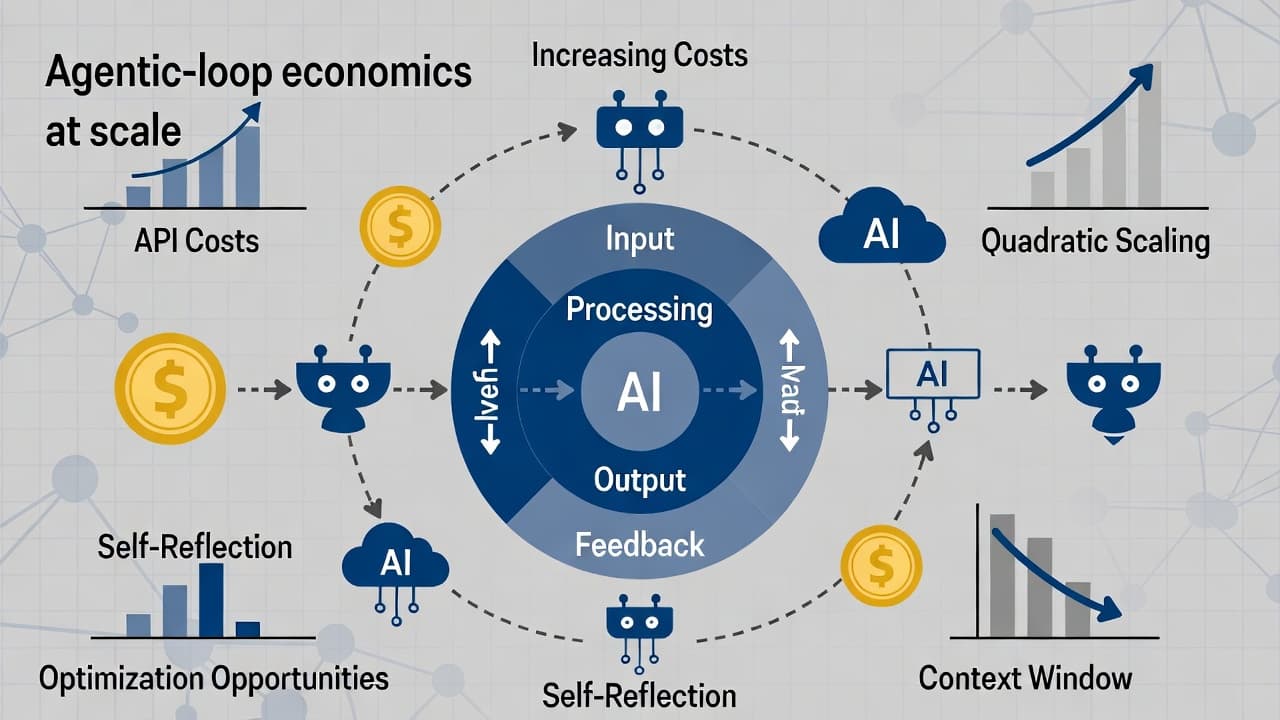
Two cost trends are moving through AI infrastructure at the same time, in opposite directions, and most conversations about agent economics only track one of them. Per-token prices are falling fast. Agentic workloads are pulling more tokens per task, faster still. Which one dominates your bill depends entirely on how many steps your loops actually run — and that is a number worth modeling before scaling a product, not after.
In short:
- Token deflation: Per-token inference prices fall roughly 10x per year for equivalent model capability.
- Step multiplication: Autonomous loops consume 10x to 100x more tokens per completed task than a standard chat turn.
- Context accumulation: Re-sending conversation histories and tool execution outputs compounds input token billing with every cycle.
- Routing as control: Model routing and hard step ceilings prevent non-agentic lookup queries from triggering expensive recursive loops.
AI Overview
Agentic loop economics are defined by a fundamental tension between falling unit prices and multiplying workload volumes. While the price of generating an individual token drops roughly 10x per year, autonomous agent systems consume 10x to 100x more tokens than a single chat turn. Because multi-turn reasoning loops re-transmit accumulated message transcripts and tool outputs at every decision step, the compounding token count routinely outpaces raw infrastructure deflation. Controlling inference spend at scale requires treating step count as an engineering constraint: implementing hard iteration limits, utilizing prompt caching, and routing straightforward queries away from multi-step autonomous loops entirely.
Key Facts
| Metric | Industry Standard |
|---|---|
| Category | Artificial Intelligence — Autonomous Workloads |
| Annual Inference Price Decline | ~10x per year for equivalent capability (a16z data) |
| Token Multiplier (Agent vs Chat) | 10x to 100x+ per user objective |
| Typical Single Chat Turn | 500 – 1,000 tokens |
| Typical 1-Hour Agent Session | 50,000 input / 15,000 output tokens |
| Prompt Caching Savings | 25% – 50% on repetitive loop transcripts |
| Primary Cost Control Lever | Model routing & hard step ceilings |
Why It Matters
Software teams building on top of foundation models frequently make a budgeting error: they treat falling model prices as inevitable margin expansion.
When token prices drop 80% to 90%, leadership assumes gross margins will improve. In practice, cheaper tokens do not shrink bills; they expand ambition. Instead of asking an LLM to generate a single paragraph, developers build autonomous agents that read directory trees, generate hypotheses, execute shell commands, parse error traces, and retry until tests pass.
In this new regime, a single user click no longer triggers one API request; it triggers a recursive cascade of twenty or thirty interconnected model calls. If the unit cost of intelligence falls by a factor of ten, but your production workflow executes thirty times more steps, your inference bill triples. Understanding the structural mechanics of agentic loops is essential to preventing gross margin collapse before scaling user acquisition.
The Price Is Actually Falling
Start with the trend that gets less attention: model inference has gotten dramatically cheaper for the same capability. a16z's tracked analysis, which it calls "LLMflation," finds that for a model of equivalent performance, the cost is decreasing by roughly 10x every year — around a 1,000x decline over three years for GPT-3-equivalent capability (the demand-side twin of that story — why total spend still rises — is the Inference Cost Paradox). That is a real, structural deflation in the cost of intelligence, and it is the reason naive year-over-year cost comparisons for "the same task" are often misleading: the task got cheaper to run at a fixed capability level even as the frontier moved.
Anthropic's own current pricing illustrates where the market sits today: Claude Opus 4.8 runs $5 per million input tokens and $25 per million output tokens; Claude Sonnet 4.6 runs $3 and $15; Claude Haiku 4.5 runs $1 and $5. Anthropic publishes a worked example directly relevant to agent loops: a one-hour agent session consuming 50,000 input tokens and 15,000 output tokens on Opus-class pricing comes to about $0.71 — or roughly $0.53 with prompt caching enabled, since caching avoids re-paying for context that repeats across steps.
The Multiplication Is Winning
Set against that falling price is a rising quantity: agentic loops use far more tokens per task than a single exchange. A single chat turn typically runs on the order of 500 to 1,000 tokens. Agentic workloads — where an agent reasons, calls a tool, reads the result, and reasons again — commonly run 10 to 100 times that, and complex tasks involving many tool calls can push higher still, since each step re-sends the accumulated transcript alongside whatever new content it produces.
This is the same dynamic covered in the cost mechanics of agentic reasoning: a three-step loop costs roughly three times a one-shot answer, a five-step loop costs roughly five times, and the multiplier compounds with every additional step a problem turns out to need. The most extreme documented version of this multiplier comes from Anthropic's own account of building a multi-agent research system: their production multi-agent architecture used roughly 15 times the tokens of a normal chat interaction to gain a real, measured performance improvement on hard tasks — a concrete illustration that the step-count multiplier is not a theoretical worst case, it's what a well-built production system actually spends when the problem calls for it.
Falling per-token prices offset part of that multiplication — a 10x price drop absorbs a lot of a 10x token increase — but they don't automatically cancel it out, especially for loops that run well past five or ten steps, or that scale to thousands of queries a day.
| Force | Direction | Typical magnitude |
|---|---|---|
| Per-token price (equivalent capability) | Falling | ~10x per year (a16z) |
| Tokens per agentic task vs. single turn | Rising | ~10-100x, task-dependent |
| Net effect on total cost per task | Depends on step count and volume | Must be modeled per workload |
The Step Multiplication Law
We define The Step Multiplication Law to formalize how recursive context accumulation breaks linear cost assumptions:
Total task cost scales quadratically with step depth whenever an agent loop preserves full conversational context across iterations without summarization.
In a single-turn query, the cost function is simple:
Cost = (Input Tokens × Input Price) + (Output Tokens × Output Price)
In an agentic loop of N steps, however, every step must ingest the entire preceding history plus the environment's latest tool response:
Total Tokens = Step 1 + (Step 1 + Step 2) + ... + (Full Cumulative History)
As N increases from 3 to 15, the prompt overhead does not merely grow by 5×; the area under the context curve balloons. If a tool returns an unexpectedly large JSON payload (such as an un-paginated database response or HTML scrape), every subsequent step pays for that payload over and over again.
What This Looks Like at Real Volume
The stakes of getting this wrong scale directly with how many queries a product runs. A handful of anecdotal industry accounts illustrate the shape of the risk: rapid AI infrastructure budget run-ups in enterprise engineering organizations, and healthcare companies watching inference bills spike six-fold in six weeks after a retrieval fault.
The defensible, vendor-neutral pattern behind those anecdotes is straightforward: an agentic loop that runs longer than intended — because of a bug, a missing iteration cap, or a task that turns out to be more open-ended than expected — doesn't fail loudly. It just keeps consuming tokens at whatever multiplier its step count implies, and the bill reflects that multiplier before anyone notices the loop should have stopped. This is the same failure mode covered in the agentic-reasoning concept as the infinite-loop problem, and the fix is the same one: a hard iteration cap, because cost containment for agents is fundamentally a step-count problem before it's a pricing problem.
The Actual Lever: Route, Don't Just Optimize
Given that per-token price is largely outside a builder's control and step count is largely dictated by the problem, the lever that's actually available is deciding which queries get routed into an agentic loop at all. A meaningful share of production traffic for most applications is simple lookups, classifications, or single-fact questions that never needed multiple steps in the first place — sending that traffic through an agent loop by default multiplies cost for zero benefit, since a single inference would have answered it just as well.
This routing principle is core to practical LLM cost optimization: a query that doesn't need multiple steps shouldn't be charged the multi-step price. The 10x annual price decline from a16z's data is a tailwind every builder gets for free; the 10-100x step multiplication is the part actually under a team's control, and routing is the mechanism for controlling it.
Limitations
Modeling agent costs against theoretical step counts has clear boundary limits:
- Stochastic Path Variance: Unlike deterministic code, an agent given identical inputs on different days may solve a task in 4 steps or wander for 18 steps depending on sampling temperature and minor tool output changes.
- Provider Pricing Divergence: Frontier reasoning models (such as o1/o3 or Claude 3.7 with extended thinking) charge premium rates for hidden reasoning tokens, altering the simple ratio between input and output billing.
- Tool Payload Unpredictability: Even with strict prompt engineering, external APIs can return massive payloads that instantly blow out cached context windows unless aggressively filtered before injection into the prompt history.
Related
- How Agents Remember Across Steps
- Tree-Search and Hierarchical Agents in Production
- The Inference Cost Paradox
- Building AI Systems That Actually Work
- AI Agents Concept Guide
Sources
- a16z LLMflation Research — Tracking historical multi-year declines in cost per token across model capability tiers.
- Anthropic Claude Platform Pricing Documentation — Official token pricing, prompt caching rates, and worked agentic loop cost examples.
- Anthropic Engineering: Multi-Agent Research Architecture — Empirical token consumption ratios in production multi-agent systems.
The Bottom Line
Per-token prices will likely keep falling — that trend has held for years and shows no clear sign of reversing. But agentic workloads are pulling costs the other direction fast enough that the net effect on any given product's bill is not obvious without doing the arithmetic for that product's actual step counts and volume.
The teams that get burned are the ones that assumed falling prices would cover rising step counts by default. The teams that succeed treat routing — sending only the queries that need a loop into a loop — as the primary cost control, backed by hard step limits and prompt caching.
Explore Related Concepts
Frequently Asked Questions
Are AI agents getting cheaper or more expensive to run?
Both forces are real and pull in opposite directions. Per-token prices for equivalent model capability have fallen roughly 10x per year according to tracked industry data. But agentic workloads use far more tokens per task than a single chat turn — commonly 10-100x more — so total cost per task can rise even as the underlying price per token falls.
How many tokens does a typical agent loop use compared to a single query?
Estimates vary by task complexity, but a single chat turn is commonly on the order of 500-1,000 tokens, while agentic workloads with multiple tool calls are reported to run anywhere from 10x to 100x or more of that, depending on how many steps and how much context each step carries forward.
Does prompt caching meaningfully reduce agent costs?
Yes, for loops that repeat similar context across steps. Anthropic's own documented example shows a roughly 25% cost reduction on a one-hour agent session when caching is used versus not, and the savings scale further with longer, more repetitive sessions.
What is the simplest way to control agentic AI costs at scale?
Route by necessity: send simple, single-step queries to a cheap model or no agent loop at all, and reserve expensive multi-step agentic loops for problems that actually require them. The savings come from not running a loop where one is not needed, more than from making any individual loop cheaper.
What happens when an agent loop hits an infinite retry state?
A stuck agent loop consumes tokens linearly or quadratically per turn until reaching hard provider timeout limits or account spending caps. Because autonomous agents do not fail loudly, production systems require strict iteration step ceilings and circuit-breaker telemetry.