Building AI Systems That Actually Work: The Architecture Nobody Talks About
The model is not the system. Most builders focus on the wrong layer and pay for it in production.

Most AI products fail not because the model is bad, but because the system around the model is architecturally broken.
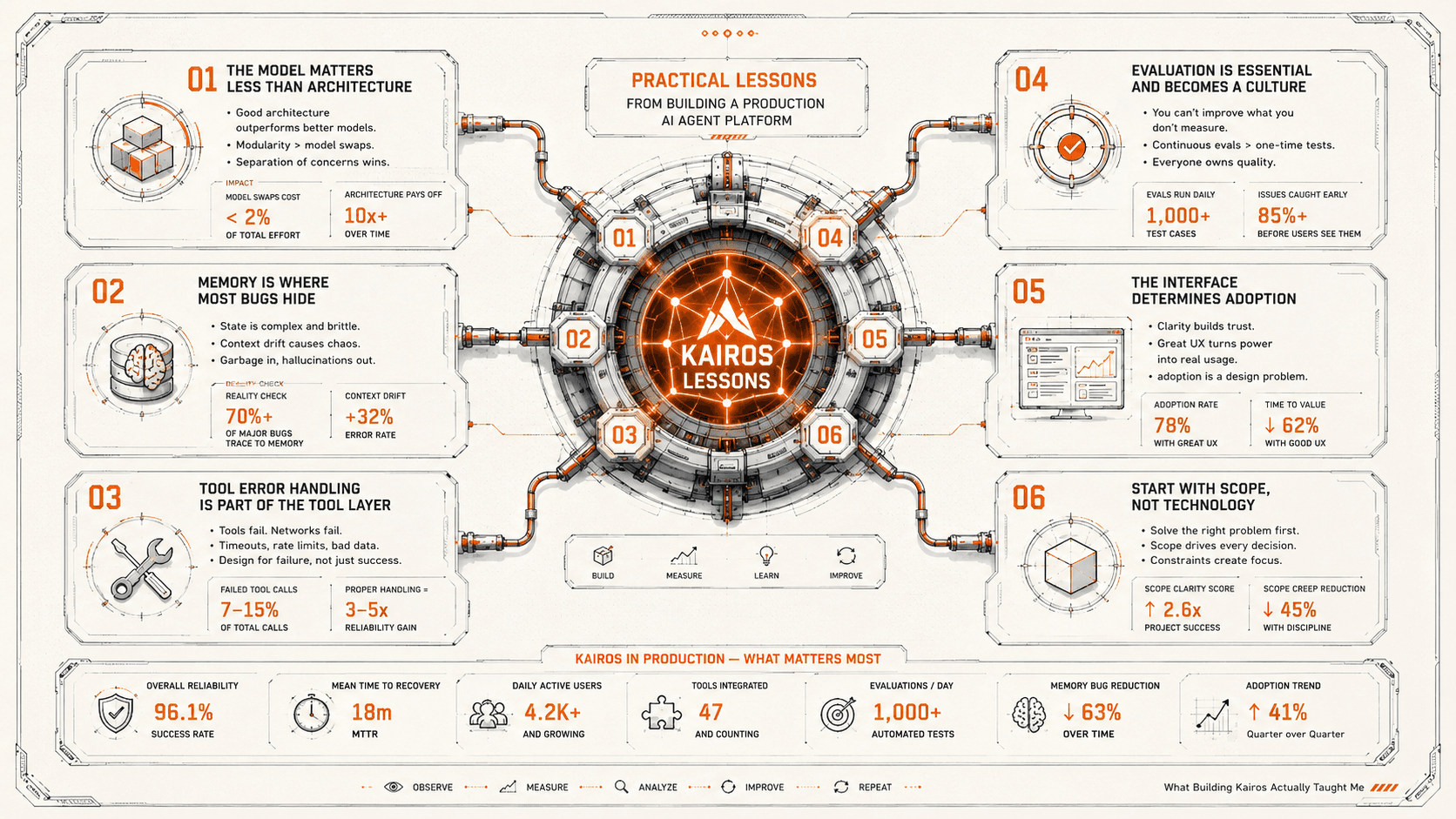
The difference between a scaled AI product and a dead startup is rarely capability. It's which layers you designed first and which ones you bolted on as afterthoughts. The builders who understand this win. Everyone else burns capital until the numbers force a rewrite.
The Six Layers of an AI System
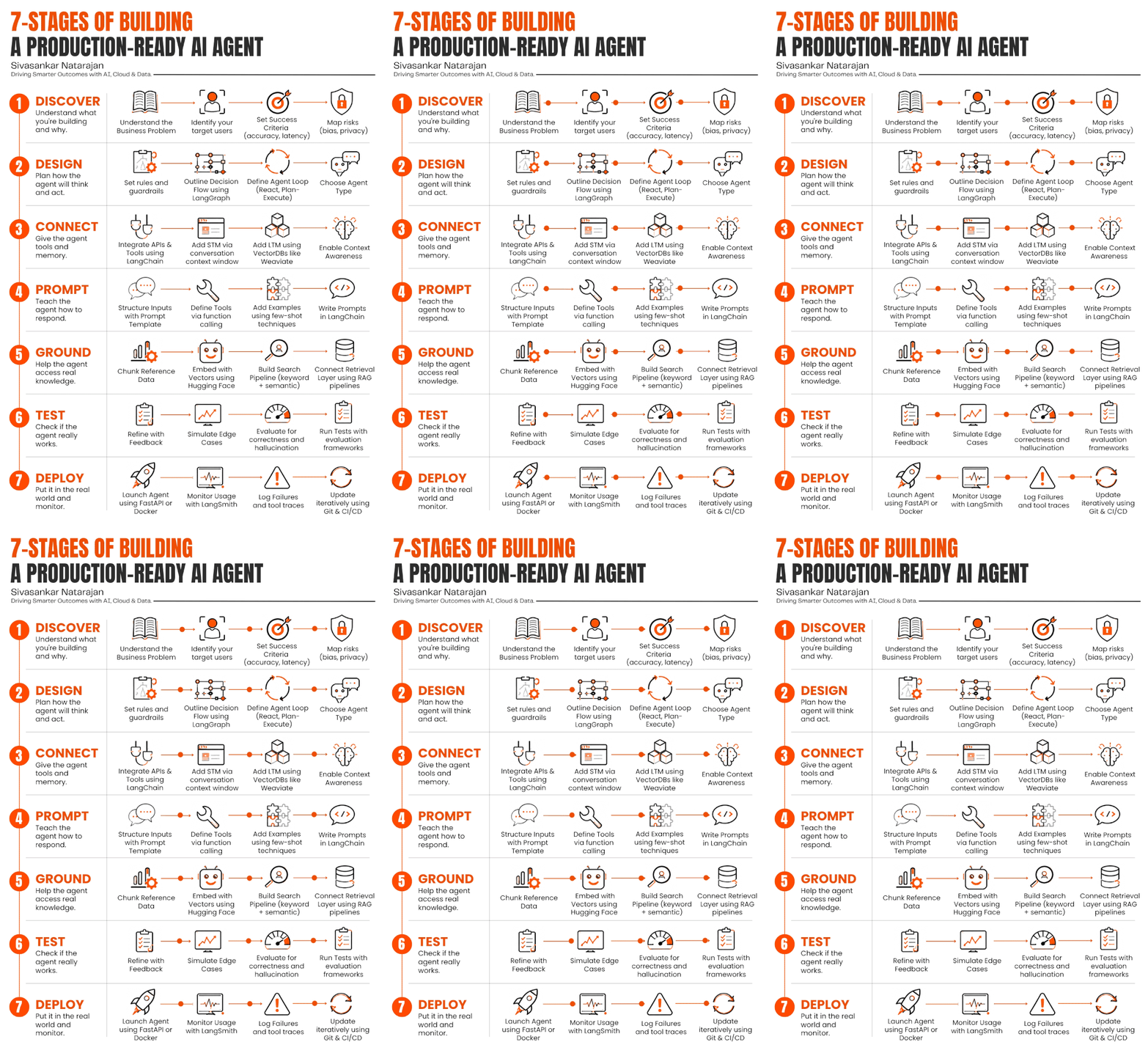
An AI product is not a model in a chat interface. It's six distinct layers, each with different constraints and failure modes. Most builders focus exclusively on layer 1 (the model) and cross their fingers on the other five.
Layer 1: Prompt Architecture The query comes in; you structure it for the model. This includes system prompts, few-shot examples, context framing, and instruction clarity. Most builders treat this as "write a good prompt and ship." Reality: prompt architecture is load-bearing. A bad prompt breaks layer 1 for entire use cases, and no amount of fine-tuning fixes it.
Layer 2: Retrieval (Context) Where does the context come from? For chatbots, this is conversation history. For domain-specific tools, it's a knowledge base or document corpus. For real-time systems, it's live data. The retrieval layer decides what information is available to the model. If retrieval breaks, the model can't work around it. Most RAG failures are layer 2 failures disguised as layer 1 failures, which is why the retrieval architecture you build matters more than the model you point it at.
Layer 3: Routing Not every query needs the same model. Easy queries (e.g., "what's your return policy?") can run on a cheap 13B model. Hard queries need a 70B or frontier model. Routing decides which query goes to which model. This layer alone determines whether your system is profitable or not. Most builders skip it and pay $10 for queries that should cost $0.10.
Layer 4: Inference Optimization You know the bottleneck now. What's the cheapest way to get the answer? This is quantization, distillation, speculative decoding, parallelization — the tradeoffs covered in inference optimization. Layer 4 is where you optimize once you understand what you're optimizing for. Doing it first (before you know the constraints) wastes engineering.
Layer 5: Verification The model output is back. Is it correct? For customer support, is the answer relevant to the question? For code generation, does the code compile? For analysis, are the numbers sensible? Verification is the layer that prevents you from shipping wrong answers to customers at scale. Most products have zero verification and discover this the hard way.
Layer 6: Feedback & Retraining The query is answered; the user got the result. Did they get what they asked for? If not, why? Feedback loops feed data back into layer 2 (improving retrieval), layer 1 (improving prompts), or layer 4 (discovering optimizations). Products without feedback loops plateau immediately. Products with strong feedback loops improve continuously.
Every layer has to work. One broken layer breaks the entire system.
The Failure Points (And Why They're Not Where You Think)
Most builders obsess about layer 1: "Is the model good enough?" Wrong question.
Here are the actual failure points:
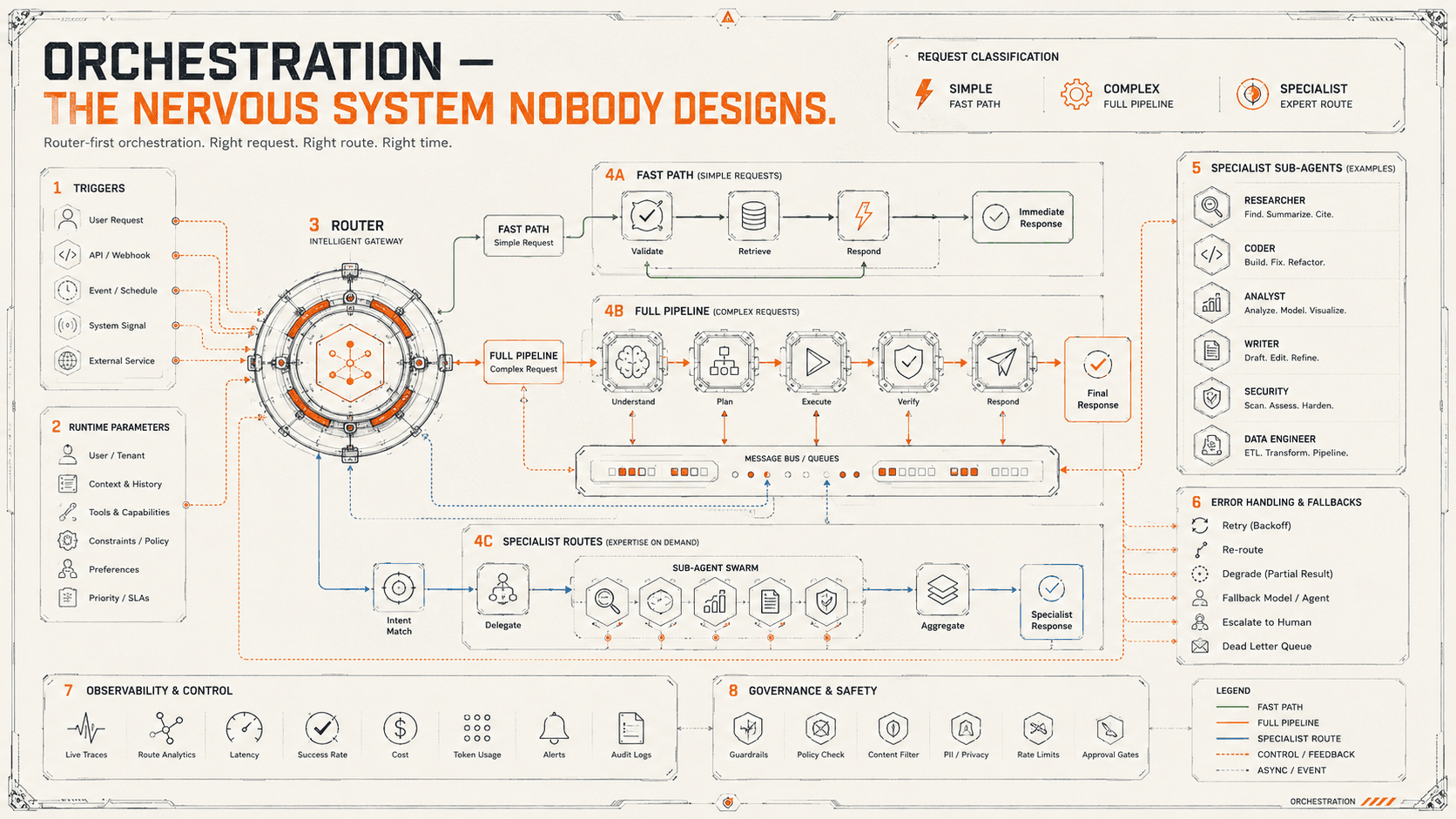
Failure 1: No Retrieval (Layer 2 Collapse) You ship a product that relies entirely on the model's training data. It works fine on public questions; it fails on proprietary or recent information. By month two, users are asking things the model doesn't know, and your product appears to have gotten worse. You didn't add new data; you just discovered that retrieval was always the constraint. All the money you spent on a frontier model was wasted because the model has nothing new to work with.
Failure 2: Inefficient Routing (Layer 3 Cost Explosion) Every query runs on the biggest model in your inventory. Costs are 2-3x what they should be. You didn't notice until usage scaled and the AWS bill made you hyperventilate. By then you're underwater and rebuilding the routing layer is a 6-week project.
Failure 3: Unverified Outputs (Layer 5 Trust Collapse) The model hallucinates, misspeaks, or gives partially wrong answers. For 6 weeks, you shipped these outputs to customers without checking. You only found out when a user called out an error. Now you have a verification problem, a trust problem, and a data problem (how many outputs were wrong?). Rebuilding layer 5 costs time and reputation.
Failure 4: No Fallback Chain (Layer 6 Cascade) Your RAG breaks at 2x usage. The system crashes, and you have no plan for degradation. You could have kept serving users with cheaper fallbacks, but you didn't design for it. Now you're down, customers are mad, and your post-mortem is "we didn't think about fallbacks." Fallbacks should have been designed on day one.
Failure 5: No Feedback Loop (Growth Ceiling) You ship the product. It works at day 1. At month 6, the same query returns the same hallucination it did at day 1. You have no mechanism for learning from failures, improving retrieval, or fixing the most common errors. Products without feedback loops are buildings built on sand. You can't improve them at scale; they just get larger.
These are not hypothetical. They're patterns from actual deployments that the industry keeps repeating because most builders don't think systemically about AI architecture.
A System That Works: The Decision Tree
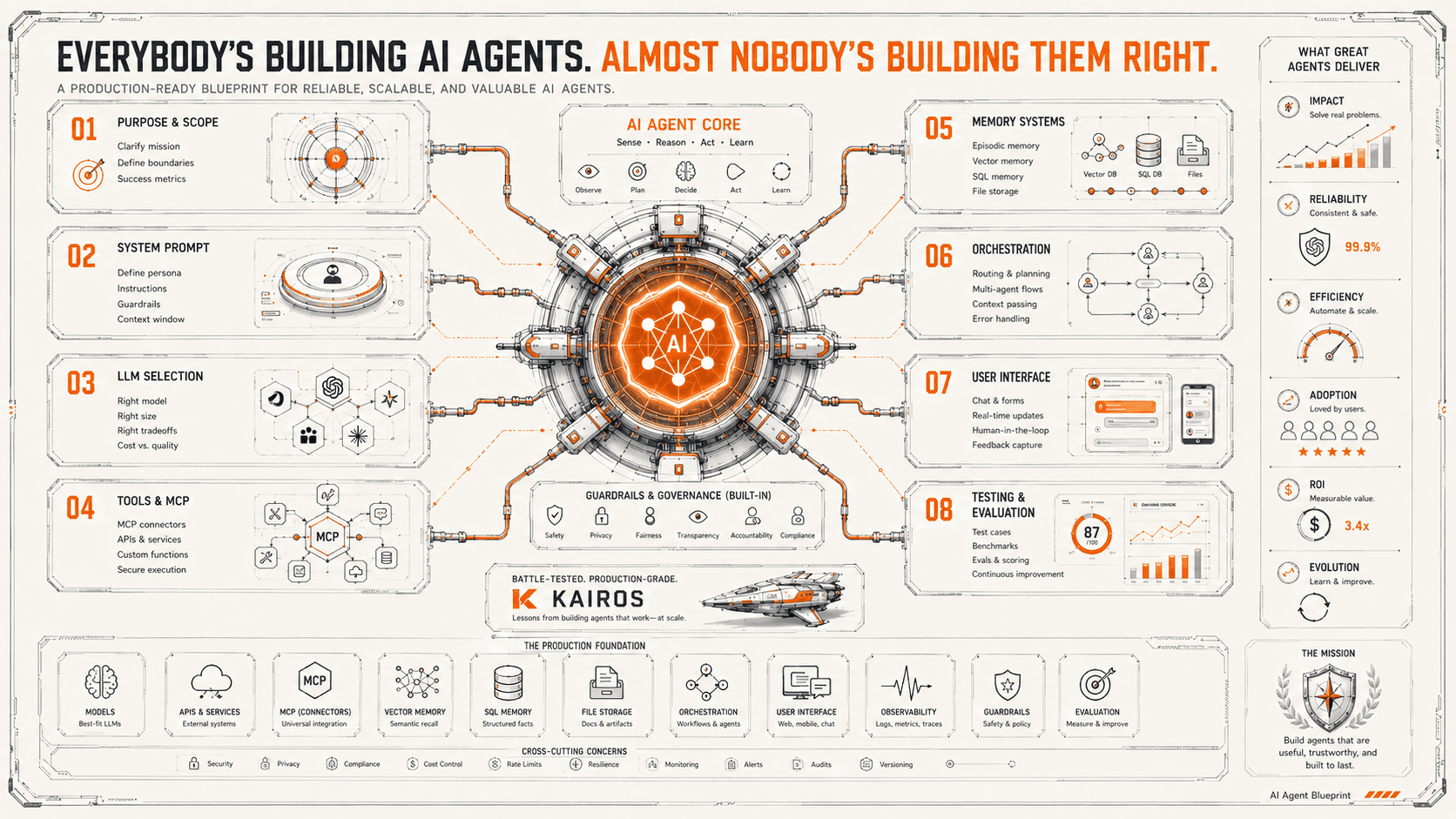
Here's what a sound AI system looks like:
Stage 1: Validate That AI Is Even Needed Can you solve this with a rule-based system, a search index, or a trained classifier? If yes, do that first. AI is expensive. Use it only when you've ruled out cheaper alternatives. For most use cases (classification, routing, simple extraction), you don't need the model at all.
Stage 2: Build Layer 2 First (Retrieval) Assume the model will have enough capability. Your constraint is context. Build a knowledge base, populate it, test retrieval quality in isolation. This is not glamorous. It's non-negotiable. If retrieval is bad, the model can't help. Spend two weeks on retrieval before you touch layer 1.
Stage 3: Add Layer 3 (Routing) as a Design Constraint Not after launch. During design. Know your query distribution. Build the routing decision tree. "This category of queries runs on model X, this category runs on model Y." Bake cost modeling into the architecture from day one.
Stage 4: Build Layer 1 (Prompt Architecture) With layer 2 working, layer 3 designed, now optimize the prompt. System prompt, few-shot examples, instruction clarity. Test against your actual query distribution, not against hypotheticals. Measure layer 1 quality against the specific retrieval layer you built. A perfect prompt paired with bad retrieval still fails.
Stage 5: Add Layer 5 (Verification) Before you launch. Not after. Build the checks: does the output match the retrieval? Does it answer the question asked? Is it consistent with previous answers? For every product category (summarization, extraction, generation), the verification rules are different. Write them down. Implement them. Test them.
Stage 6: Design Layer 6 (Feedback) Infrastructure How will you learn from mistakes? If the user disagrees with the output, what happens? If verification catches an error, where does that signal go? Build the feedback loop before you have enough users to need it. On day 1 it won't matter; on day 100 it's the difference between stagnation and improvement.
Stage 7: Optimize Layer 4 (Inference) Once Everything Else Works Now that you know the actual query distribution, the actual cost bottlenecks, the actual capability constraints, optimize. Not before. Quantizing a model that's running on the wrong routing logic saves nothing.
This is the reverse of how most builders work. Most go: "Pick the best model (layer 1) → bolt on retrieval (layer 2) → ignore routing (layer 3) → hope inference is fast enough (layer 4) → discover you need verification (layer 5) → never build feedback (layer 6)."
The Cost Model That Matters
Here's the math that actually determines whether your product survives. It sits on top of the compute economics that set the price of every token you burn:
Unit Cost = (Retrieval Cost + Inference Cost + Verification Cost) / Successful Outcomes
Not: "How much does a single inference cost?" But: "How much does it cost to give a customer a correct, useful answer?"
Most builders optimize the denominator of the first equation (inference cost per token) and ignore the numerator (tokens per successful outcome) and the ratio (cost per successful outcome).
Example:
- Product A: $0.01 inference cost, 40% success rate → $0.025 per successful outcome
- Product B: $0.10 inference cost, 95% success rate → $0.105 per successful outcome
- Product C: $0.005 inference cost, 15% success rate → $0.033 per successful outcome
Product B wins if you're selling to a price-insensitive customer. Product A wins if you're selling to price-sensitive users and can live with 40% failures. Product C is dead — cheapest inference, highest failure rate.
The architecture determines this ratio. Better retrieval (layer 2) lowers the denominator (more successful outcomes). Smart routing (layer 3) lowers the numerator (cheaper inference on easier queries). Good verification (layer 5) increases reliability without increasing cost.
Most builders only optimize the numerator and wonder why they're unprofitable.
Real Architectures: What Works
Pattern 1: Retrieval-First with Smart Fallbacks
For domain-specific Q&A (support, knowledge bases, internal tools):
- Layer 2 is the bottleneck; invest here. Vector database, keyword search, hybrid retrieval.
- Layer 3: Easy question → small model + retrieval. Hard question → large model + retrieval.
- Layer 5: Verify the answer is grounded in the retrieval. If not, return the retrieval chunk instead.
- Layer 6: User feedback on answer quality → reweight retrieval rankings.
This pattern is: cheap to run, reliable, improves over time.
Pattern 2: Reasoning with Verification Gates
For analysis, code generation, problem-solving:
- Layer 4 is critical; you need the model to think, not just retrieve. This is where agentic reasoning earns its cost — multi-step tool use pays off only when the task genuinely needs it.
- Layer 3: Routing based on problem complexity (simple tasks → smaller model, complex tasks → larger).
- Layer 5: Verify outputs are sensible. For code: can it be parsed? Does it import real libraries? For analysis: are numbers reasonable?
- Layer 6: Feedback on whether the output was actually useful (did the code work? did the analysis matter?).
This pattern is: flexible, gets better with usage data, but more expensive per query.
Pattern 3: Hybrid Parallel (The Expensive but Safe Option)
For high-stakes decisions (medical, financial, legal):
- Run retrieval + small model in parallel with retrieval + large model.
- Layer 5: Compare answers. If they agree, use the cheap answer. If they disagree, escalate to human review.
- Layer 3: Cost optimization based on agreement rate. As the small model learns, use it more often.
This pattern is: expensive initially, but cost-optimizes over time as you learn when the cheap model is trustworthy.
The Checklist
Before you ship, answer these:
Layer 1 (Prompt Architecture)
- System prompt is specific to your use case, not a generic ChatGPT prompt
- Few-shot examples are from your actual query distribution, not hypotheticals
- The prompt explicitly tells the model what to do when it doesn't know the answer (say "I don't know," not hallucinate)
Layer 2 (Retrieval)
- You've tested retrieval quality in isolation; you know the failure rate
- You have a fallback plan if retrieval returns no results
- You've measured latency; retrieval isn't blocking inference
Layer 3 (Routing)
- You know your query distribution (easy vs. hard, by category)
- You've built the routing decision tree (which queries go to which model)
- You've modeled cost per query type; you know profitability per category
Layer 4 (Inference Optimization)
- You know your actual bottleneck (not assumed; measured)
- You've benchmarked quantization, distillation, or speculative decoding (or decided they're not necessary)
- Inference latency is acceptable for your use case (< 100ms for real-time, < 5s for batch)
Layer 5 (Verification)
- You have written verification rules for your specific use case
- Verification runs on every output before it reaches the user
- You've tested that verification catches actual errors (not just hypothetical ones)
- Your system has a graceful failure mode if verification rejects the output
Layer 6 (Feedback & Retraining)
- You log the query, the retrieval context, the output, and user feedback
- You have a process to analyze failures and update layer 1 (prompts), layer 2 (retrieval), or layer 4 (optimization)
- You've scheduled a monthly review to identify systematic failure patterns
Cost & Sustainability
- You've modeled your unit cost per successful outcome (not per inference)
- You know the profitability threshold (cost per query / price per query = margin)
- You've identified which queries are underwater and have a plan to fix it
The Mistake That Kills Products
The most common: Shipping layer 1 before layers 2, 3, and 5 are done.
The reasoning: "Let's get the model working first, then optimize."
The reality: Once you have 1,000 users, rewriting the system architecture is a 3-month project. You can't afford it. You're stuck with whatever you built on day one.
This is why the best products are built in the order: 2 → 3 → 1 → 5 → 4 → 6. Not 1 → everything else.
The second-most common: Assuming retrieval and verification are implementation details.
They're not. They determine whether the product works. Teams that treat them as core architecture win. Teams that treat them as "nice to have optimizations" die.
The Supporting Layer: Concepts and Deep Dives
Each of the six layers has its own failure modes, and each deserves more than a paragraph. These are the reference pages that go deep where this guide stays wide:
- Retrieval-augmented generation — what RAG is, where it breaks, and how to design for failure. Pair it with retrieval architecture that works for the implementation patterns.
- Routing queries to models — the cost decision tree that keeps layer 3 profitable.
- Verification is not optional — how to check outputs are correct, by use case, before they reach a customer.
- Feedback loops and retraining — turning production failures into a system that improves instead of plateaus.
- Prompt engineering — the system design of prompts, beyond "write a better prompt."
- Inference optimization — quantization vs. distillation vs. other patterns, and the cost/quality tradeoffs.
- The Inference Cost Paradox — why falling per-token prices still produce rising total spend (layer 4 economics).
- How LLM API pricing works — token asymmetry and which half of the bill to attack first.
- Model evaluation — how to measure whether capability is actually your bottleneck before you spend on it.
- AI compute — the economics underneath every unit-cost number in this guide.
- Agentic reasoning — when agents help, and when they make things worse.
- How agents remember across steps — state that outlives a single context window.
- The Social State Encoder — when the “system” is a robot: conditioning motor policies on relational trust at multiple control rates.
The Bottom Line
Building an AI product that survives at scale requires thinking systematically about six layers, not obsessing about the first one. The layers interact. Decisions in layer 2 force changes in layer 3. Decisions in layer 3 unlock optimization in layer 4.
The builders who understand this win because they ship cheaper, more reliable products with feedback loops. The builders who don't optimize the wrong thing and wonder why they're unprofitable.
Start with layer 2. It's where the actual constraint lives.
Explore Related Concepts
Frequently Asked Questions
Why do so many AI products fail, even when the model is state-of-the-art?
The model is the easiest part. It's the system around it — retrieval, routing, cost optimization, failure handling, verification — that determines success. Builders optimize for capability and ignore the other five layers.
Should I fine-tune a model or use a larger off-the-shelf model?
Fine-tuning is a layer 4 decision, not a layer 1 decision. First: verify your system architecture is sound (retrieval, routing, verification). Then: measure whether capability is actually your bottleneck. Most of the time it isn't.
How do I know if my AI system is designed correctly before I ship?
Run the architecture checklist at the end of this guide. Test your fallback chains manually. Measure inference cost per successful outcome. If any layer is weak, you're one traffic spike away from losing money.
Can I use RAG without it degrading in production?
Yes, if you build the fallback chain correctly. Most RAG implementations break because they have no layer 5 (verification). Add verification, add fallbacks, and RAG stays stable. Without them, RAG fails at exactly 10x usage.