Offline Accuracy Is a Trap: Build Evals That Predict Production
Your model scores 91% offline and users still churn. The gap is not the model — it is how you measure.
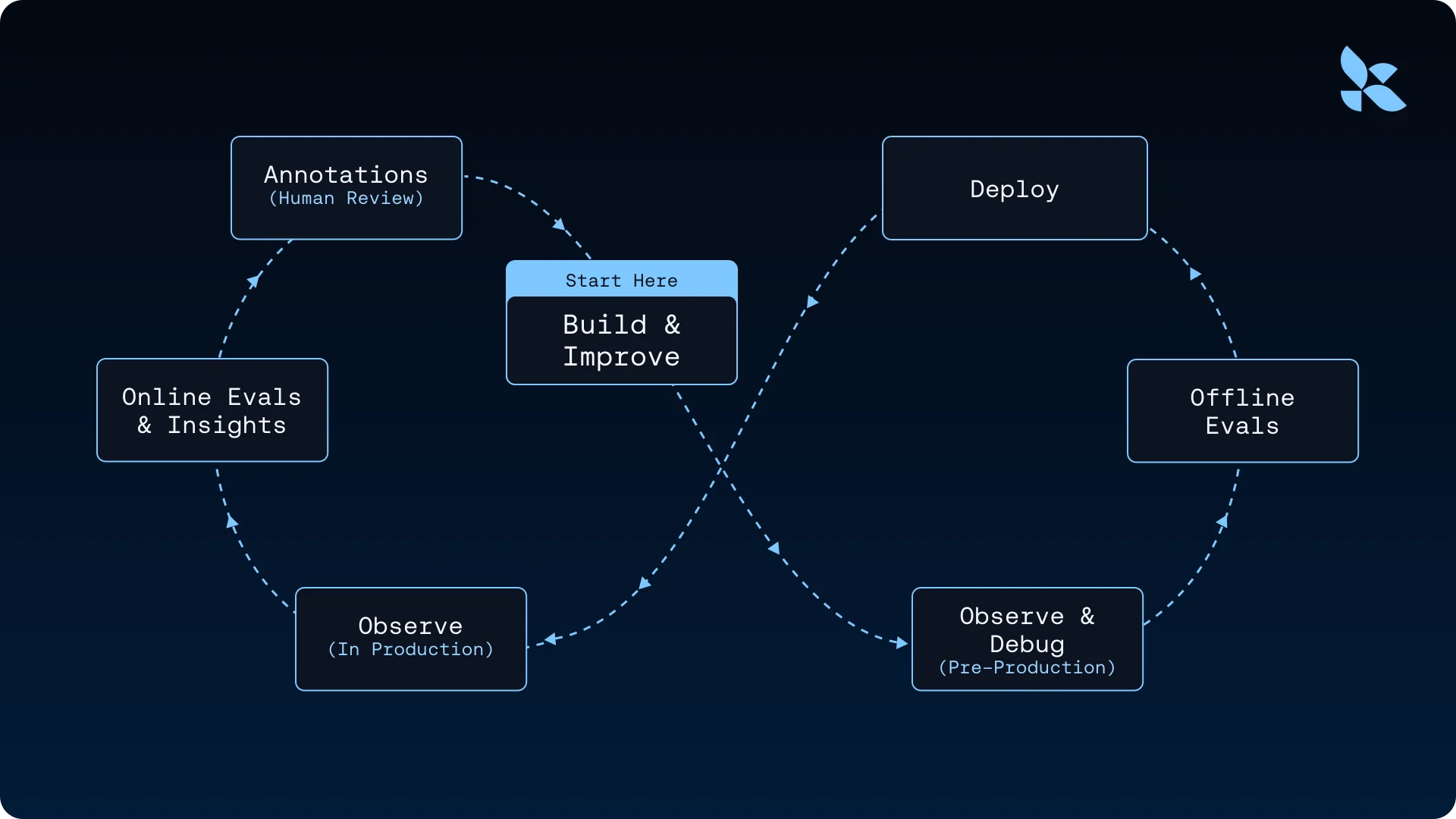
Your offline score is not a product decision. It is a snapshot of a frozen distribution, scored against labels that were true last month, aggregated into a single number that hides the slices where users actually leave — a recurring failure mode across artificial intelligence products that look green in staging and red in support.
Teams that treat golden-set accuracy as a launch gate ship confidently and learn the hard way. Teams that build a production evaluation stack promote models because live outcomes improved — on the slices that matter, at a cost they can afford.
Evaluation sits next to verification and feedback loops inside the six-layer system. Verification asks: is this output safe to show right now? Evaluation asks: is this system getting better over time, and should we ship the next change? Confusing the two is how you get a green dashboard and a red support queue.
The Offline Trap
Public benchmarks are marketing. Stanford's HELM made that explicit: single-score leaderboards hide trade-offs across scenarios, metrics, and risks. LMSYS Arena improved human preference ranking, but preference on open chat is still not your return-policy bot, your claims assistant, or your code agent.
Your internal golden set has the same failure modes, just closer to home:
- Distribution freeze. You labeled Q1 traffic. It is now Q3. Users ask about features that did not exist when you labeled.
- Label rot. The "correct" answer changed when policy, pricing, or docs changed. The set still scores the old truth.
- Aggregate lies. 91% overall with 40% on the "billing dispute" slice is not a 91% product. It is a product that fails the queries that generate tickets.
- Train-test contamination of process. Engineers tune prompts against the same set they report. The score rises; generalization does not.
None of this means offline evals are useless. It means they are Layer 1 of measurement, not the decision.
| What offline golden sets catch | What they miss |
|---|---|
| Gross capability regressions | Live distribution shift |
| Prompt breakage on known intents | Novel intents and adversarial users |
| Retrieval grounding on fixed docs | Doc drift and empty retrieval paths |
| Format / schema failures | Latency under load, cost at scale |
| Obvious hallucinations on labeled cases | Confident-wrong answers on unlabeled slices |
If your promotion rule is "offline accuracy up, ship," you are optimizing a scoreboard.
The Four-Layer Production Evaluation Stack
A stack that predicts real quality has four layers. Ship without any one of them and you recreate the offline trap under a different name.
Layer 1: Offline golden set (the gate, not the goal)
Build a set that looks like production, not like a contest.
- Size: 100–200 labeled examples to start; grow with every high-cost failure.
- Source: Real queries (anonymized), not invented "edge cases" from a brainstorm.
- Labels: Ground truth from docs, human experts, or verified outcomes — not the previous model's answer.
- Slices: Tag every example by intent, risk, language, and difficulty. Report per-slice, never only overall.
- Holdout: A portion the team does not tune against. If you only report the set you optimized, you are measuring yourself.
Scoring must match the product. For retrieval-augmented generation, faithfulness and answer relevance matter more than fluency — frameworks like RAGAS formalize that split. For code, execute. For agents, check tool calls and final state, not prose quality.
Offline is a regression gate: no change ships if critical slices regress beyond a written budget. It is not proof users will be happier.
Layer 2: Shadow traffic (the dress rehearsal)
Before a model or prompt change becomes the default, run it in parallel on live traffic without showing the user the new answer.
You compare:
- Agreement rate between champion and challenger
- Where they diverge (those examples become gold labels)
- Latency and cost of the challenger under real load
- Verification fail rates if verification already runs on both paths
Shadow traffic answers the question offline cannot: does this change behave on today's distribution?
Practical rules:
- Shadow at least one full business cycle (weekday + weekend for consumer; full trading day for finance).
- Cap shadow cost; sample if needed, but sample stratified by slice, not pure random.
- Log divergences into a review queue. Human-labeled divergences are the highest-value labels you will ever buy.
Layer 3: Online outcome metrics (the only truth users care about)
Online metrics measure what happened after the answer, not how pretty the answer looked.
Define success in product language:
| Product type | Online success signal | Failure signal |
|---|---|---|
| Support / Q&A | Ticket resolved without escalation | Repeat contact, thumbs-down, correction |
| RAG knowledge | Citation clicked / claim verified | "Wrong doc," empty retrieval, escalation |
| Code assistant | Code accepted + tests pass | Immediate revert, edit distance spike |
| Agent workflow | Goal completed without human takeover | Loop timeout, wrong tool, abort |
| Analysis / ops | Decision accepted downstream | Manual override, later correction |
Pair every quality metric with cost per successful outcome — the same unit economics logic as routing and inference cost. A model that is 2 points "better" offline and 3× more expensive online is often a net loss.
Write the promotion rule before the experiment:
- Must improve: primary success rate on target slices by ≥X
- Must not regress: critical slices by more than Y
- Must hold: p95 latency, verification pass rate, cost per success
If you invent the rule after seeing the numbers, you will ship the story you wanted.
Layer 4: Slice failure analysis (where products actually improve)
Aggregates hide the work. Improvement comes from named failure modes:
- Empty retrieval on policy questions
- Multi-hop questions answered from the first doc only
- Tool agents that call the wrong API with high confidence
- Long-context queries that ignore the middle of the prompt
- Languages or regions with 2× the error rate
For each top failure mode, you want:
- A count and a cost (tickets, refunds, churn risk)
- A owner (retrieval, prompt, routing, model, verification)
- New golden-set examples drawn from the failures
- A retest path through Layers 1–3
This is how evaluation feeds feedback loops instead of sitting in a weekly dashboard nobody opens.
LLM-as-Judge: Useful, Biased, and Easy to Overfit
Automated judges scaled evaluation. They also introduced a new way to fool yourself.
The G-Eval line of work and follow-ups on LLM-as-a-judge show that large models can rank outputs with decent human correlation — and that they exhibit position bias, verbosity bias, and self-preference. If your judge prefers long answers, your product will get wordier, not better. If your judge is the same family as your generator, you may reward style clones.
Use judges as scalers, not oracles:
- Calibrate. Score 50–100 examples with humans and the judge. Measure agreement per slice.
- Constrain. Score atomic claims (grounded? complete? safe?) more than "overall quality."
- Blind. Randomize order; hide model identity.
- Refresh. Judges drift when you change the judge model. Re-calibrate.
- Never sole-promote. A judge-only win with flat or worse online outcomes is not a win.
Self-consistency and multi-sample checks help for reasoning tasks, but they raise cost — again, measure success per dollar, not elegance per paper.
How Evaluation Connects to the Rest of the System
Evaluation is not a separate "MLOps tab." It is how you know each layer is doing its job.
| System layer | What evaluation proves |
|---|---|
| Prompt architecture | Same retrieval, different prompt → quality delta |
| Retrieval | Faithfulness / recall on live empty-result rates |
| Routing | Cheap path success rate vs. escalate rate (FrugalGPT-style cascades only work if you measure them) |
| Inference | Quality held under quantization or smaller models |
| Verification | Catch rate vs. false reject rate on labeled failures |
| Feedback | Time-to-fix for top slices; whether the same bugs recur |
Model evaluation as a concept is the discipline. This stack is the operating system. Agentic systems need extra checks (trajectory success, tool validity) because a fluent final message can hide a broken path.
A Worked Promotion Decision
Suppose you have two candidates for a support RAG bot. Here is the right way to decide.
Offline (Layer 1)
| Slice | Champion | Challenger |
|---|---|---|
| Shipping status | 94% | 95% |
| Returns policy | 88% | 91% |
| Billing disputes | 72% | 70% |
| Overall | 89% | 90% |
Naive rule: ship challenger. Correct rule: billing disputes are launch-blocking (high refund risk). Challenger regresses. Do not ship on overall +1.
Shadow (Layer 2)
On 10k live queries, challenger diverges on 12% of billing turns; human review finds 40% of those divergences are worse. Cost is 1.4× higher.
Online plan (Layer 3)
If you still want to test, run a 5% experiment with a kill switch: refund-related escalations must not rise; cost per resolved ticket must not rise more than 10%.
Slice work (Layer 4)
Take the billing failures, add 30 labeled examples, fix retrieval filters, re-run Layers 1–2. The next challenger should win on the slice that matters, not the average that flatters.
That is evaluation as capital allocation: you spend labeling and experiment budget where failure is expensive.
The Checklist Before You Promote Anything
Offline
- Golden set drawn from production, tagged by slice
- Holdout set the team does not tune against
- Critical slices named with regression budgets
- Scoring matches product success (not generic "helpfulness")
Shadow
- Parallel run on live distribution for a full cycle
- Divergences logged and sampled for human review
- Latency and cost measured under real concurrency
Online
- Success metric defined in product language
- Cost per successful outcome tracked
- Kill criteria written before the experiment starts
- Sample size large enough to see slice-level moves
Judge / automation
- Human calibration sample with known agreement
- Bias checks (length, position, self-preference)
- Judge never the sole promotion signal
Org
- One owner for the evaluation stack (not "the intern with the spreadsheet")
- Failures become labels within a week
- Dashboard shows slices, not a single green number
The Mistake That Keeps Shipping Bad Models
Three mistakes that ship broken models every week:
- Optimizing the score you can measure instead of the outcome you need. Offline accuracy is easy. Online trust is hard. Teams report the easy number, celebrate the release, and staff up support.
- One global metric hides local failure. Products fail locally. A single average is how billing, medical, or legal slices die quietly under a healthy mean.
- Evaluation without verification. You discover the model is wrong in the weekly review instead of in the request path. Measurement after the user suffers is reporting, not product engineering.
The Bottom Line
Offline accuracy is a trap when it is your only number. Use it as a gate. Build the rest of the stack: shadow traffic for distribution truth, online outcomes for user truth, and slice analysis for the work that actually improves the system.
Promotion is a written contract — what must rise, what must not fall, what you will pay per success. Everything else is theater with better charts.
Start with your three most expensive failure slices. Label them. Measure them online. Refuse to ship any change that does not move those numbers. That single habit outperforms another quarter of benchmark chasing.
Explore related deep dives: building AI systems that actually work, verification, retrieval architecture, routing for cost, and feedback loops.
Explore Related Concepts
Frequently Asked Questions
Why does my model score high offline and still fail in production?
Offline sets are frozen, clean, and labeled for yesterday's distribution. Production is messy, adversarial, and shifting. Aggregate accuracy also hides slice failures — one broken intent can destroy trust while the overall score still looks fine.
How large should a golden set be before I trust it?
Start with 100–200 labeled examples covering your real query mix, not edge-case trivia. Expand the set with every production failure you care about. A small set that matches traffic beats a large set that matches a benchmark.
Is LLM-as-judge good enough to replace human labels?
No. Use it to scale scoring after you calibrate against humans on a held-out sample. Measure agreement; if the judge disagrees with humans on your critical slices, do not promote on judge scores alone.
What is the minimum online metric I need before shipping a model change?
Define success for your product (task completed, citation grounded, code runs, ticket resolved) and track it by slice. Pair it with cost per successful outcome and a hard regression budget on your worst-performing slices.
How does evaluation relate to verification and feedback loops?
Verification checks each output before the user sees it. Evaluation decides whether the system as a whole is improving. Feedback loops close the data path from production failures back into labels, retrieval, and prompts. You need all three.