The Immortals of Technology: Who Will Be Remembered in 2,000 Years?
Most innovators change products. A handful change civilizations. An even smaller number become permanent — recognizable names 2,000 years from now.
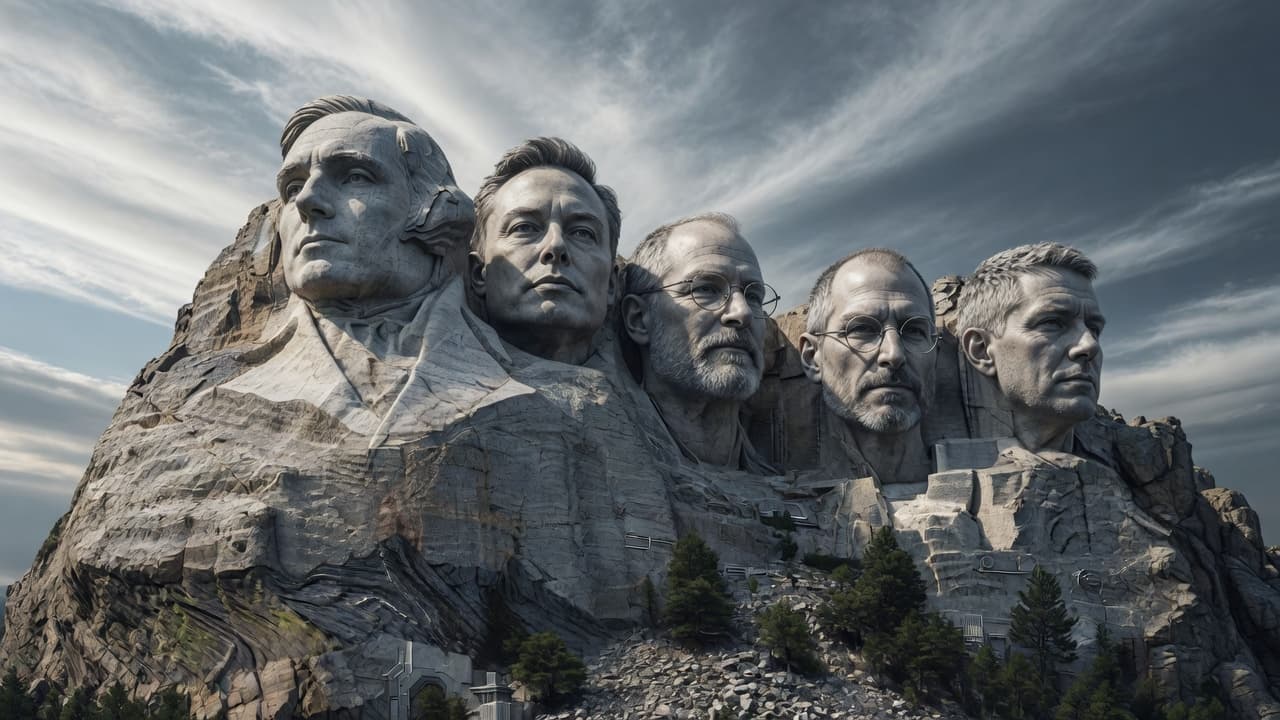
In the year 4026, someone will be assigned a history project. The question on the page: who were the most important figures of the early digital age?
That future student won't care about market capitalizations. They won't search stock returns or follower counts. They'll ask the question historians have always asked: whose absence would have made the world fundamentally different? This is the immortality test — simple, brutal, and almost nobody passes it.
Two thousand years after their deaths, we still recite Aristotle's logic, navigate by Euclid's geometry, and build on Newton's physics. These names survived not because their contemporaries celebrated them most loudly, but because every subsequent generation found their work inescapable. The question for our era: which names from the technology revolution will join that list?
Two thousand years ago, history made its selections. It is making them again right now.
What Separates the Eternal from the Forgotten
Before naming candidates, it helps to understand the mechanism. Historical permanence is not a reward for success. It is a function of leverage — the degree to which one person's ideas become the permanent operating infrastructure of human civilization.
Alexander conquered a vast empire. Two centuries later, much of it was reconfigured — but the Greek language and intellectual frameworks he spread outlasted every political boundary he drew. His military victories faded; his cultural transmission endured. Newton didn't just discover gravity; he gave humanity a mathematical language for reality itself, one space agencies still use as bedrock three centuries later. Gutenberg didn't write important books; he built the machine that made mass literacy possible, permanently rewiring European civilization.
The pattern is consistent: the most enduring figures are not those who accumulated the most — they are those whose absence would have delayed civilization itself. That is the filter. It eliminates almost everyone.
The question is not who is influential today. The question is who will still matter in the year 4026.
Alan Turing: The Strongest Candidate
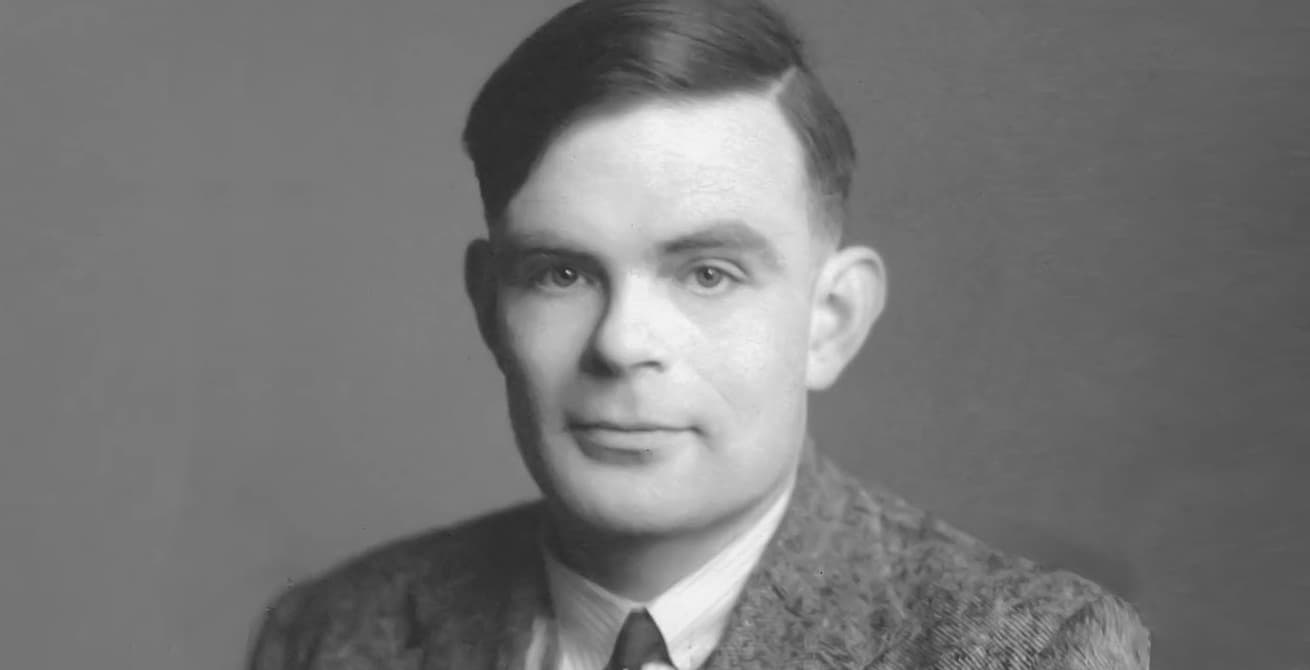
Turing's 1936 paper described a theoretical machine. Every computer ever built is, in effect, a physical implementation of it.
If forced to name one person from the 20th century most likely to still be a household name in 4026, Alan Turing is the safest answer.
In 1936, at the age of 24, Turing published On Computable Numbers, a paper describing a theoretical device capable of performing any computation. It was abstract and largely ignored outside academic circles. It was also the conceptual blueprint for every computer, smartphone, server, and AI system ever built. The entire digital age is, in a very real sense, a physical implementation of Turing's 1936 thought experiment.
That alone would warrant a place in history. But his reach goes further. During World War II, his work breaking German Enigma encryption at Bletchley Park is estimated by some historians to have shortened the war by two to four years and saved millions of lives. The geopolitical map of the 20th century was shaped in part by what Turing accomplished in a converted English manor house.
Then, in 1950, he posed a question that launched an entirely new field: can machines think? That question is still unanswered. The whole discipline of artificial intelligence — the technology now reshaping every industry on Earth — is, intellectually, the ongoing attempt to resolve it, a line that runs in a fairly direct arc through deep learning's breakthroughs from AlphaGo to GPT-3.
Turing's influence is not contained in a product, a company, or an industry. It is embedded in the architecture of the modern world. If his name sounds like Euclid or Archimedes to students in 4026, it will be because, like them, he invented the language everyone else uses without knowing it.
Elon Musk: The Multiplanetary Gambit
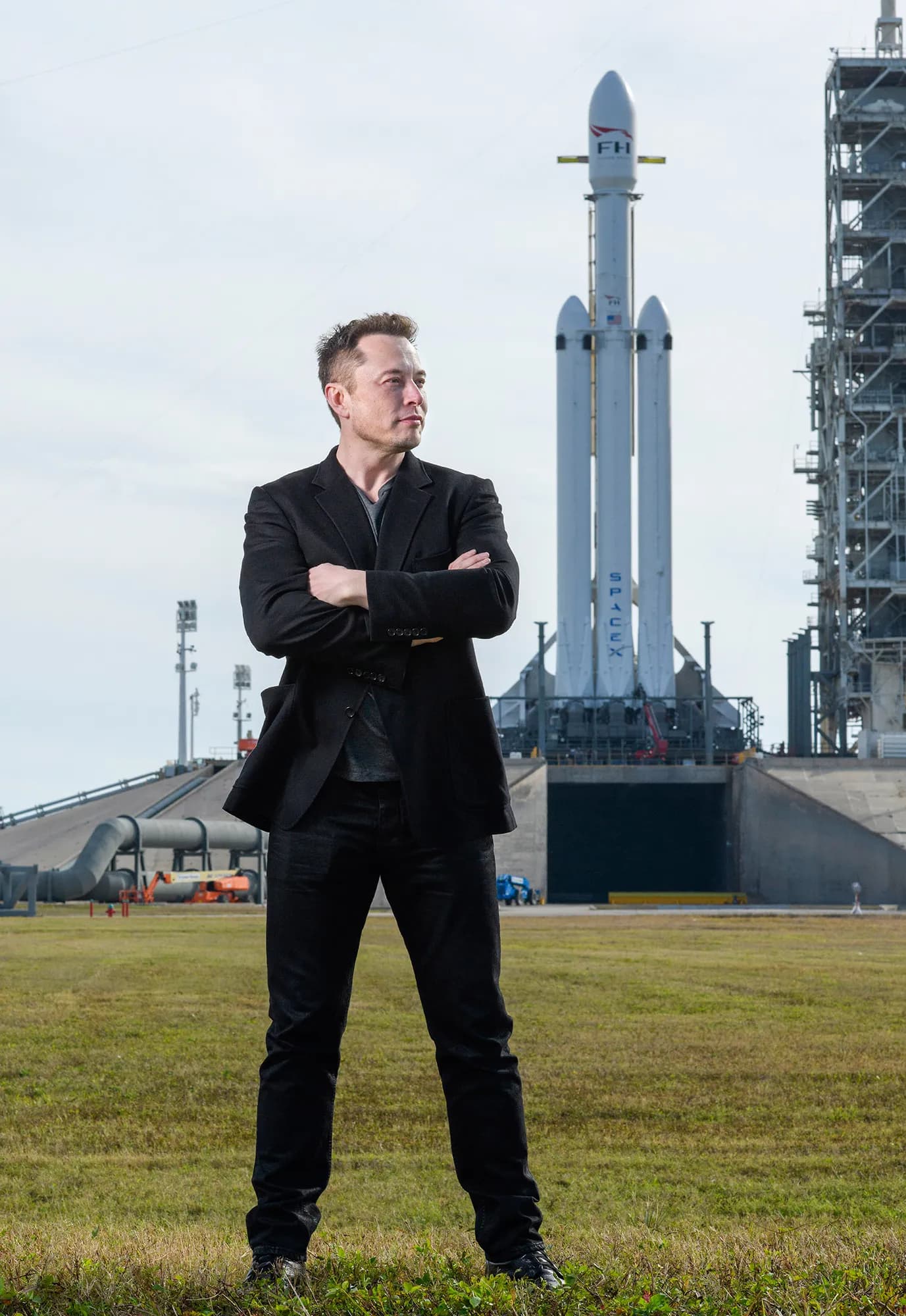
If Mars colonization succeeds, historians may one day categorize this era as one of humanity's most consequential departures.
No living technologist carries a larger historical upside — or a larger historical risk — than Elon Musk.
The common analysis focuses on Tesla's disruption of automotive manufacturing, SpaceX's reinvention of rocket economics, or X's contested role in public discourse. History is unlikely to focus on any of these. What history will evaluate is a single, specific outcome: did humanity become a multiplanetary species? That is Musk's stated mission, the explicit purpose of SpaceX, and the venture against which his legacy will ultimately be measured. Everything else is detail.
If a permanent, self-sustaining human civilization is established on Mars, future historians will categorize Musk alongside Columbus and Magellan — except at a scale those explorers never reached. The crossing of an ocean changed trade routes. The crossing of interplanetary space changes the existential risk profile of the entire human species. Schoolchildren on multiple planets may one day learn his name the way we learn the explorers who first crossed the Atlantic.
If the mission fails, the assessment changes entirely. Without Mars colonization, Musk may still be remembered as a formidable entrepreneur of the early 21st century — in the category of Henry Ford or Andrew Carnegie: important figures who transformed industries and appear in economic history, but not the names that define an era of civilization. The gap between those two outcomes is enormous. Very few people alive today hold stakes that large.
The most durable names are not the richest. They are the people who changed the operating system of civilization — not the applications running on top of it.
Tim Berners-Lee: The Invisible Giant
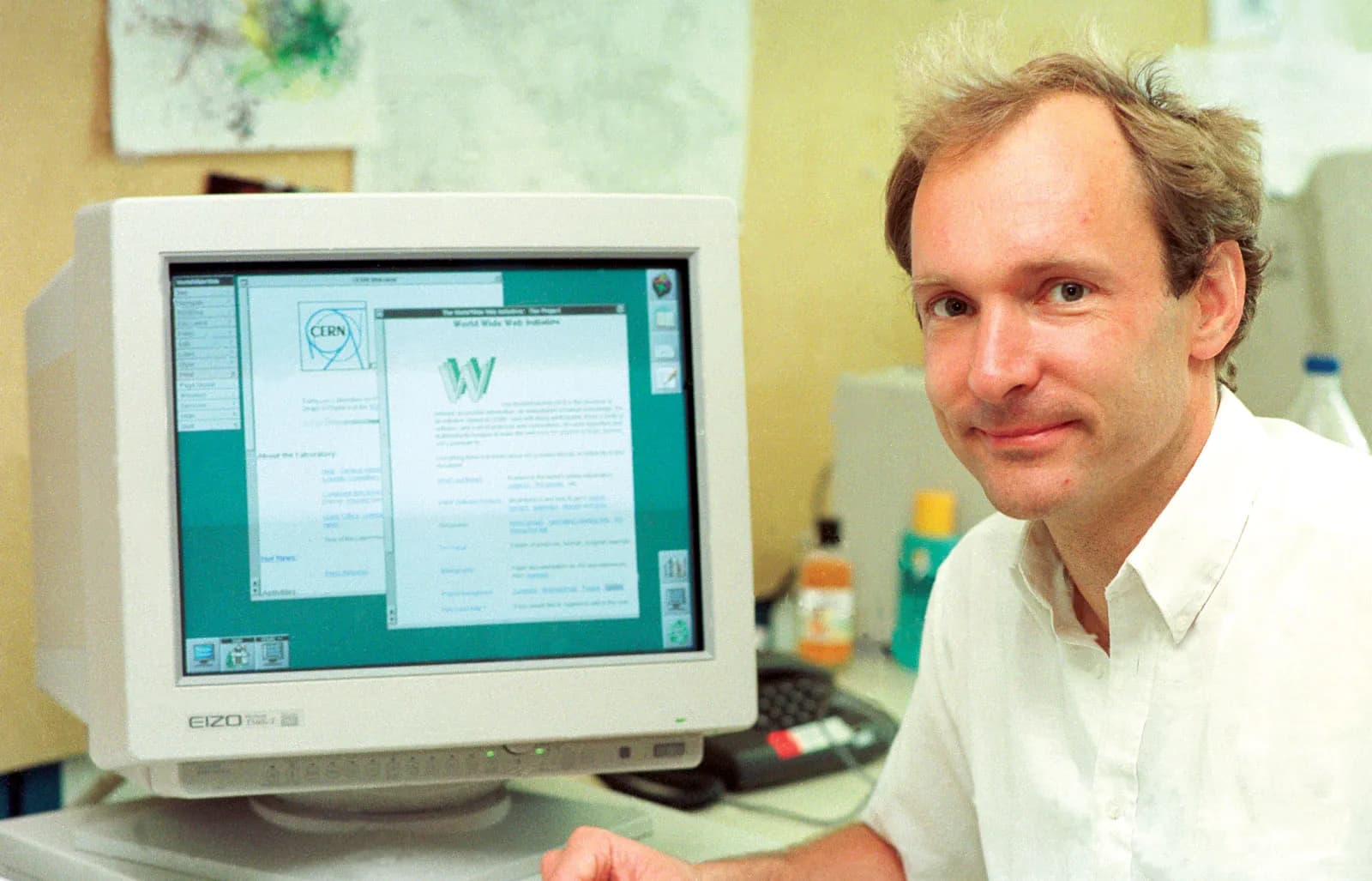
In 1989, a physicist at CERN proposed a "management information system." His supervisor called it "vague but exciting." What emerged was the architecture of human knowledge.
Most people know the internet. Far fewer know Tim Berners-Lee. That asymmetry — between the scale of someone's impact and the breadth of their recognition — is one of history's most consistent patterns, and it may eventually correct.
In 1989, while working as a physicist at CERN, Berners-Lee proposed a system for sharing research documents. What followed was the invention of the World Wide Web — the layer of protocols, hyperlinks, and markup that transformed the internet from a specialist network into humanity's primary infrastructure for communication, commerce, knowledge, and culture. Every website, digital publication, social platform, marketplace, streaming service, and AI interface traces its architecture in part to what he designed.
Critically, he made a decision that permanently shaped the digital economy: he released the core technologies of the Web freely and openly, without patents or licensing fees. That single act of deliberate non-commercialization may have done more to accelerate global digital adoption than any business decision of the era. The modern knowledge economy is partly the product of that choice.
Berners-Lee lacks the cultural celebrity of Jobs or the dramatic narrative of Musk. He is a quiet engineer who built the pipes, not a showman who built the products that ran through them. But history tends, eventually, to rediscover its plumbers. The people who built the infrastructure — not those who merely used it brilliantly — are the ones whose names prove most durable.
Steve Jobs: The Cultural Architect
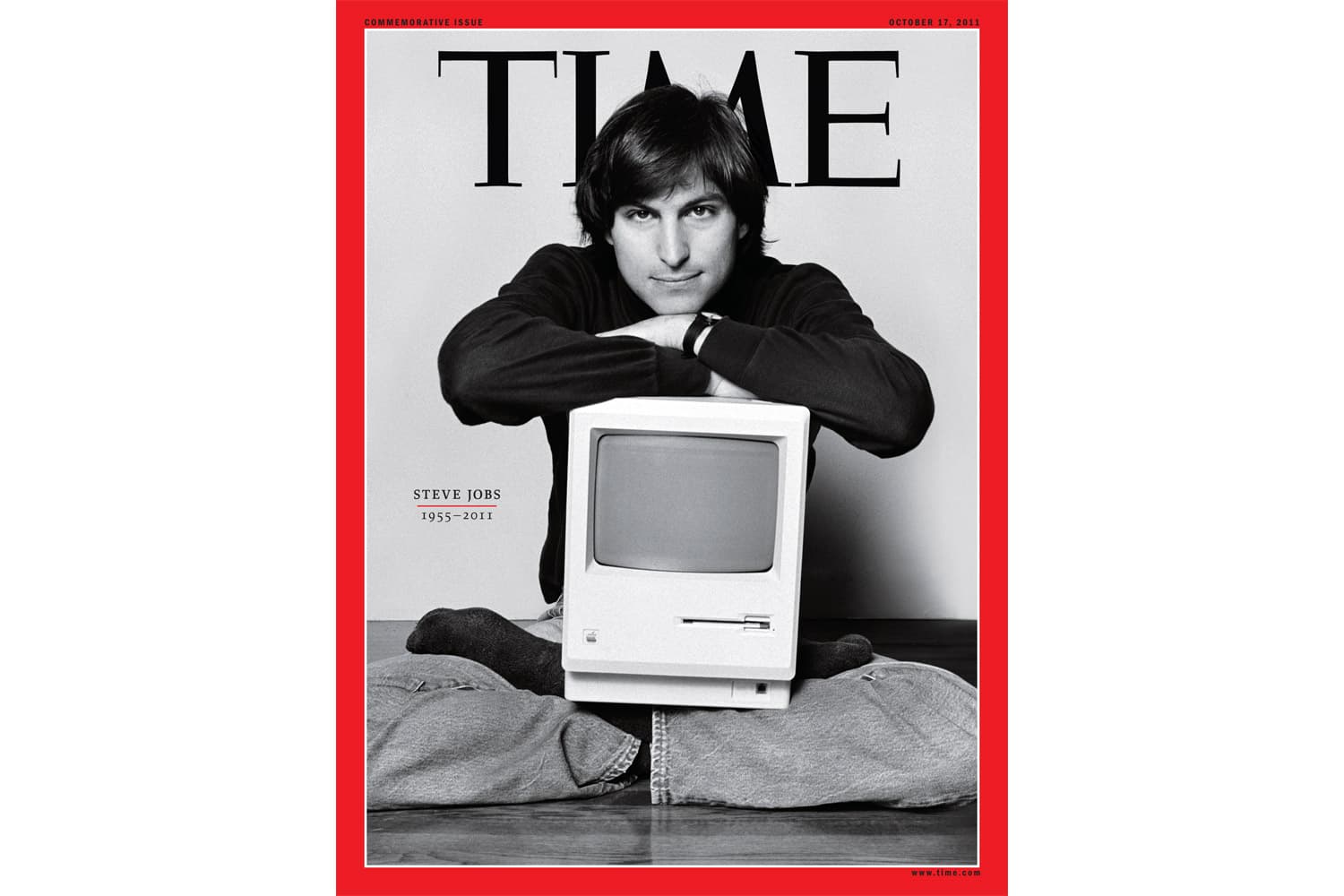
Jobs didn't invent the smartphone. He made it a cultural object that billions of people needed to own.
Technology history rewards inventors. Civilizational history also rewards translators.
Steve Jobs did not invent the personal computer, the smartphone, the graphical user interface, the touchscreen, or digital music distribution. He is frequently criticized — fairly, in technical terms — for taking credit for innovations developed by others. That critique, while accurate, misses the more important point. What Jobs uniquely accomplished was the translation of advanced technology into cultural desire.
He understood, before nearly anyone else, that the limiting factor of the digital revolution was not engineering capability but human willingness to engage with it. He solved that problem not through engineering, but through design, storytelling, and an almost irrational insistence on aesthetic experience. The iPhone, released in 2007, was not merely the world's best phone — it was a cultural object that redefined what a phone was for, making it the primary interface between billions of people and the digital world.
Jobs may ultimately be remembered less as a technologist and more as the person who negotiated the terms of the human-computer relationship — making it intimate, personal, and emotionally resonant in a way that pure engineering could not. That role, the translator between technological possibility and human adoption, is genuinely rare. And it tends to be remembered.
Claude Shannon: The Forgotten Genius
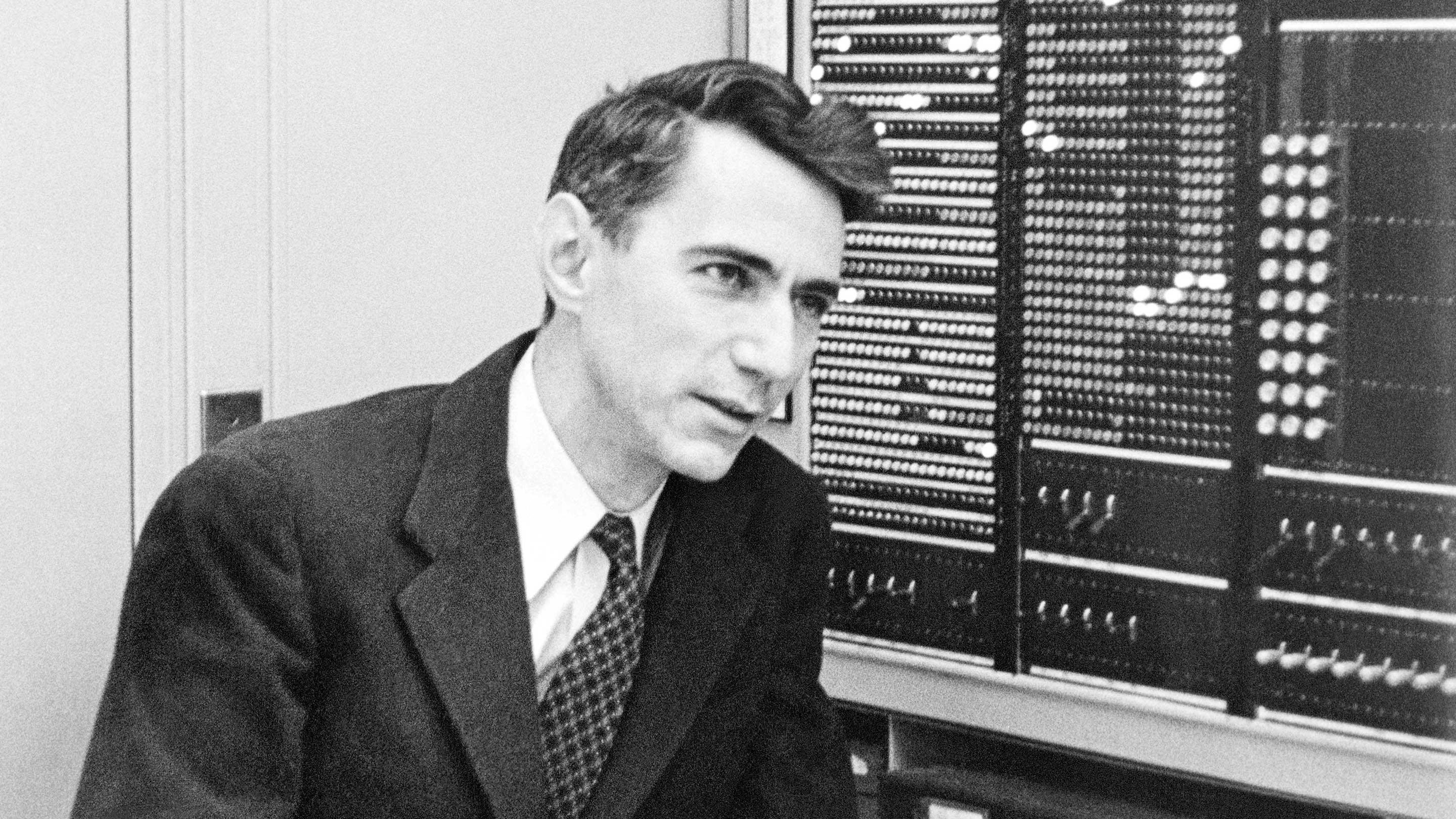
In 1948, Shannon mathematically defined what "information" actually is. Every digital system in existence operates on his framework.
If this article were evaluated purely on intellectual depth and civilizational impact per person, Claude Shannon might rank at the top. He is also one of the least famous people on this list, which makes him a striking case study in how historical recognition actually works — and how it sometimes fails.
In 1948, Shannon published A Mathematical Theory of Communication, a paper that did something extraordinary: it mathematically defined what information is. Before Shannon, "information" was a vague, intuitive concept. After him, it had a precise structure — one that could be measured, compressed, and transmitted with maximum efficiency. That framework, information theory, is the hidden foundation beneath every email ever sent, every video ever streamed, every mobile network ever built, and every AI model ever trained. To say modern digital civilization is built on Shannon's mathematics is, if anything, an understatement.
And yet most people have never heard of him. His relative obscurity is partly circumstantial — he was famously private and indifferent to fame — partly disciplinary, and partly a reflection of how recognition flows to product-makers rather than framework-builders. But history has a long memory and occasionally makes corrections. Archimedes' work was nearly lost multiple times before being copied and preserved. Two thousand years from now, if digital civilization endures in any recognizable form, Shannon's name may be viewed as one of the deepest thinkers the human species produced in its first computational century.
The Civilization Builders
One of the clearest patterns in historical survival is that the most durable names span eras and disciplines — they are remembered not as businesspeople, but as civilization-shapers. This comparison places current candidates alongside historical figures who passed the same test.
| Figure | Era | Primary Contribution | Civilizational Impact |
|---|---|---|---|
| Johannes Gutenberg | 1400s | Printing press | Enabled mass literacy; reshaped European power structures |
| James Watt | 1700s | Steam engine efficiency | Accelerated the Industrial Revolution |
| Nikola Tesla | 1800s | AC electrical systems | Made long-range electrical power possible |
| Alan Turing | 1900s | Theoretical computing | Conceptual blueprint for all digital systems |
| Claude Shannon | 1900s | Information theory | Mathematical foundation of all digital communication |
| Tim Berners-Lee | 1900s | World Wide Web | Created the architecture of the digital knowledge economy |
| Steve Jobs | 2000s | Human-computer interface | Translated technology into mass cultural adoption |
| Elon Musk | 2000s | Multiplanetary expansion | Potential architect of humanity's interplanetary future |
Notice the consistent pattern: the most durable names are not necessarily the richest, nor the most famous in their own time. They are almost invariably the people who changed the operating system of civilization, not the applications running on top of it.
The Dark Horse Candidates
History is notoriously bad at identifying its own future legends in real time. Gregor Mendel established the foundational principles of genetics and died with his work largely unread; his papers were discovered decades later. Ignaz Semmelweis identified the cause of hospital-spread infection, was ridiculed by the medical establishment, and was institutionalized. Both are now considered foundational. Our era almost certainly contains its own versions — people whose work is technically significant but socially invisible.
Several categories deserve attention:
- AI alignment researchers. The scientists working to ensure advanced AI systems remain aligned with human values may be working on the most consequential problem in human history. If they succeed, they will be largely invisible. If they fail, their names may become permanently significant for a very different reason.
- Longevity scientists. Researchers like Aubrey de Grey and David Sinclair, and the broader field working on biological aging, could produce changes to the human lifespan that rank among the most consequential biological events in our species' history. Whoever first reverses biological aging may be remembered the way Edward Jenner is remembered for vaccination.
- Quantum computing pioneers. If quantum computing achieves practical supremacy at scale, the architects of that transition may occupy a position analogous to Turing's. See our coverage of quantum computing.
- Climate engineers. If the climate crisis is resolved through technological intervention, the team that designs that solution may be remembered on a civilizational scale.
The challenge is that we cannot identify these figures in advance with certainty. A future ranking will be indifferent to current social-media presence, market capitalization, or quarterly earnings. It will care exclusively about permanent, structural change.
The AI Wildcard
Artificial intelligence introduces a possibility that didn't exist in previous technological eras. The creators of genuinely transformative AI systems — systems capable of accelerating scientific discovery, restructuring education, or solving previously unsolvable coordination problems — may become historical figures on the scale of Gutenberg.
If advanced AI ultimately reshapes the trajectory of human civilization as profoundly as the printing press or the steam engine, the people centrally responsible for large language models and the systems built on them will face intense historical scrutiny — the fuller arc of that trajectory, from symbolic AI's early promises to today's frontier models, is traced in AI evolution: from inception to innovation. This creates an unusual situation: some of the most historically significant figures of the early 21st century may currently be working in relative obscurity — researchers in AI safety, mechanistic interpretability, or theoretical foundations — whose contribution only becomes legible once the long-term consequences are clear.
The identification problem cuts both ways. We may be celebrating names today who will be footnotes in a century, while the figures who matter most for the next two millennia are not yet household names.
What History Actually Remembers
Most people assume history rewards success. It doesn't. History rewards leverage. Success means accumulating resources, influence, or recognition within your lifetime. Leverage means your work becomes so embedded in subsequent human activity that every generation after you builds on it whether they know it or not.
Euclidean geometry is still taught in every mathematics classroom on Earth, more than 2,300 years after Euclid wrote it down — not because it is the most sophisticated mathematics available, but because it is the foundation on which everything more sophisticated is built. Newton's laws are still used by NASA for orbital calculations, more than 300 years on — not because they're perfectly accurate, but because they remain the cleanest description of physical reality at human-relevant scales. Gutenberg's press didn't just make books cheaper; it collapsed the information asymmetry between institutions and individuals, making the Reformation, the Scientific Revolution, and the Enlightenment structurally possible.
The common thread is not fame, wealth, or even recognition in their own time. It is this: every generation that comes after them finds their work inescapable. That is the real measure of historical permanence.
The Bottom Line
If humanity still exists in 4026 — if the civilization we are building now survives its own adolescence — these are the current best candidates for genuine historical immortality.
Alan Turing is the safest bet. His ideas underpin every digital system that exists or will ever exist; he is to computing what Euclid is to geometry. As AI becomes the dominant technology of civilization, the man who first asked whether machines can think will only become more foundational. Claude Shannon may be the most intellectually undervalued — the mathematics he wrote in 1948 is not a component of the digital age, it is the digital age, stated formally. Tim Berners-Lee built the architecture through which the majority of human knowledge now flows, and chose to give it away. Steve Jobs understood that adoption is as important as invention, making computing intimate. Elon Musk is the most unpredictable, his legacy spanning the widest possible range — from "important entrepreneur" to "founder of multiplanetary civilization" — on the outcome of a single bet that hasn't resolved yet.
Two thousand years from now, most of today's corporate giants will be forgotten. The platforms that dominate headlines will be footnotes. The billionaires who dominate business news will be as obscure as the wealthy merchants of 14th-century Florence. The people history remembers will be the ones who changed the infrastructure of civilization so permanently that future generations had no choice but to inherit their work.
Those people may already be among us. We are simply not paying attention to the right things.
Explore Related Concepts
Frequently Asked Questions
Who is most likely to be remembered 2,000 years from now?
Alan Turing is the strongest candidate by most measures. His 1936 theoretical framework for computing is the conceptual foundation of every digital system ever built. As AI becomes increasingly central to civilization, Turing's question — can machines think? — only becomes more foundational.
Will Elon Musk be remembered in 2,000 years?
It depends almost entirely on one outcome: whether humanity establishes a permanent, self-sustaining civilization beyond Earth. If Mars colonization succeeds at scale, Musk may rank among history's most consequential figures. If it does not, he will likely be remembered as a significant entrepreneur — important, but not civilizational.
Why are Bill Gates and Jeff Bezos not on this list?
Neither fails the historical-relevance test entirely, but both are more likely to be remembered as enormously successful businesspeople than as civilization-shapers. Microsoft and Amazon are significant institutions; they are not intellectual frameworks or civilizational infrastructure the way computing theory, the Web, or information theory are.
Who is Claude Shannon and why does almost nobody know him?
Claude Shannon founded information theory in 1948, mathematically defining what information is and establishing the principles of efficient digital communication. Every digital system ever built runs on his framework. He is relatively unknown because he was private, avoided the spotlight, and worked at a level of abstraction harder to explain than a famous product.
Could an AI system itself become historically immortal?
Possibly. If an advanced AI system makes a discovery or achieves something that fundamentally alters civilization — curing a major disease, solving a critical coordination problem, producing a scientific breakthrough — both the system and its creators could be remembered. This is genuinely uncharted territory.
Why are there no non-Western figures on the list?
The digital technology revolution has been disproportionately centered in the United States and Europe, which this list reflects. But future civilizational contributions — particularly in AI, quantum computing, and biotech — are increasingly global. The next historically immortal figure may come from anywhere.