TimesFM-3: The Forecaster That Sees the Whole System
Google's new time-series foundation model reads every signal at once — related products, foot traffic, next week's promotions — and forecasts the entire horizon in a single forward pass. Zero-shot. No fine-tuning. Top of every leaderboard it touched.

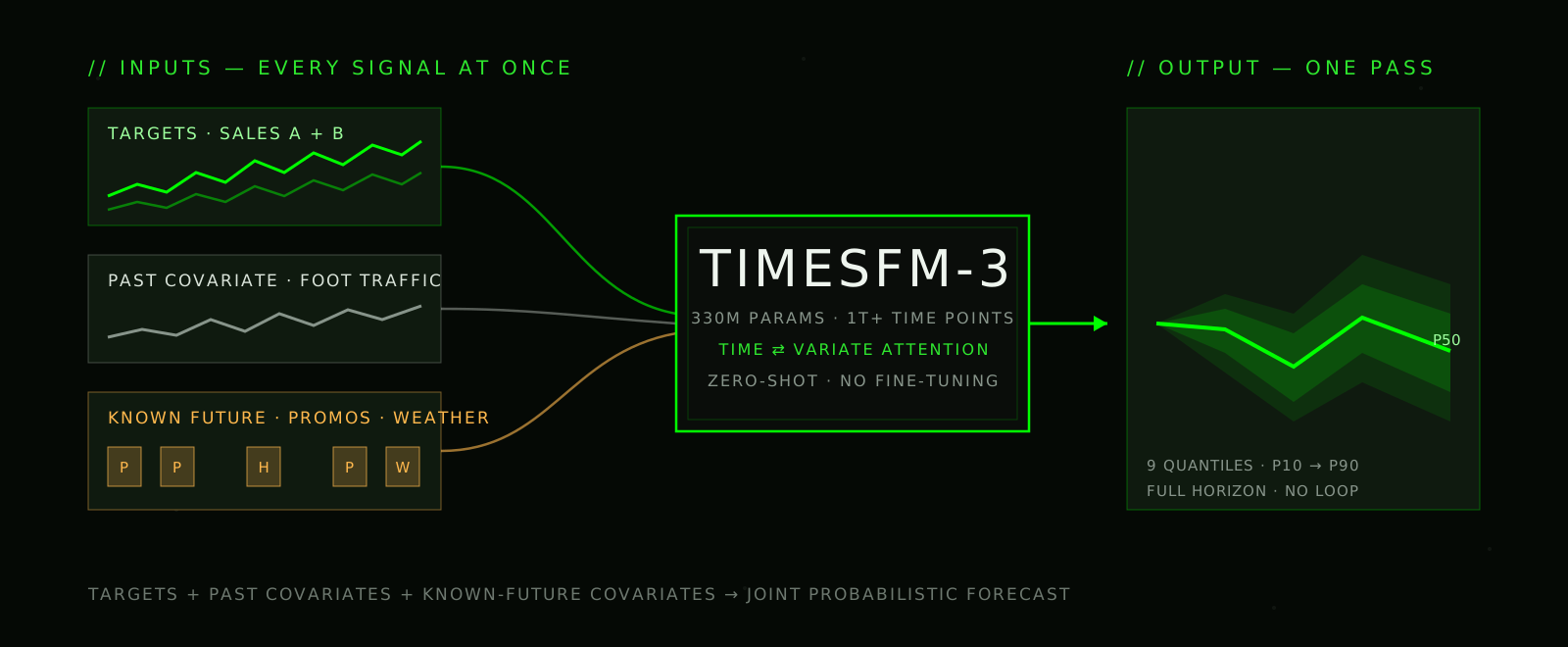
TimesFM-3 is Google's third-generation time-series foundation model: 330 million parameters, pre-trained on more than 1 trillion time points, and the first TimesFM natively built for multivariate forecasting — multiple targets, past covariates and known-future signals, predicted jointly in a single forward pass, zero-shot. On GIFT-Eval, fev-bench and TIME, Google reports it as the top-ranked pre-trained foundation model for both point and probabilistic forecasting. If TimesFM (2024) proved that forecasting has its GPT moment, TimesFM-3 is the moment the model stopped squinting at one series and started reading the whole system.
AI Overview
TimesFM-3 is a 330-million-parameter time-series foundation model, released by Google, that forecasts multiple related time series at once — plus covariates whose future values are already known — in a single zero-shot forward pass. Unlike its predecessor TimesFM-2.5, which only ever forecast one series from its own history, TimesFM-3 is natively multivariate: it jointly predicts co-evolving series, learns cross-series correlations through an alternating attention mechanism, and decodes the entire forecast horizon at once instead of looping step by step. Google reports it as the top-ranked pre-trained foundation model on the GIFT-Eval, fev-bench and TIME benchmarks.
Key Facts
| Category | Artificial Intelligence — Research Breakdown |
| Developer | |
| Parameters | 330 million |
| Pre-training data | 1+ trillion time points (real + synthetic) |
| Forecast mode | Zero-shot, multivariate, single forward pass |
| Benchmarks | #1 on GIFT-Eval, fev-bench, TIME (pre-trained foundation models) |
| Availability | Open PyTorch checkpoint on Hugging Face |
| Updated | September 1, 2026 |
Why It Matters
Most real-world forecasting problems are multivariate by nature — sales depend on related products, foot traffic, weather, and a promotion calendar someone already finalized. Before TimesFM-3, using that context meant building and maintaining a custom model per problem. TimesFM-3 folds that context into a single zero-shot call, which lowers the cost of a good forecast from "hire a forecasting team" to "pass in the covariates you already have." That shift matters most for teams — retail, logistics, infrastructure, finance — who have covariate data sitting unused because building a bespoke multivariate pipeline was never worth the engineering cost.
Why Does Multivariate Forecasting Matter?
Since the debut of TimesFM in 2024, time-series foundation models have gone from research curiosity to production infrastructure — deployed across retail, finance, observability, manufacturing, healthcare and the natural sciences. The pitch was irresistible: one pre-trained model, any series, respectable forecasts out of the box, no data-science team required.
But there was a ceiling. Up through TimesFM-2.5 (September 2025), the models were strictly univariate: they forecast a series using only that series' own history. Real forecasting problems almost never live in that vacuum. Consider ice cream sales for a retail chain. Past sales alone rarely tell the full story — a good forecast should also draw on sales of related products (cones, syrups), historical foot traffic, and events you already know are coming: weather forecasts, planned promotions, holidays.
That's the gap TimesFM-3 closes. It can jointly predict multiple co-evolving series, capturing the dependencies between them, and it can condition on external signals — all in one shot, with no per-task training. The model natively supports three kinds of input:
- Targets — multiple related series forecast simultaneously (e.g., jointly forecasting different brands of ice cream), with point and quantile forecasts for every target.
- Past covariates — features known only historically, like past foot traffic or past sensor readings. They inform the forecast but have no future values.
- Past-future covariates — dynamic signals whose future is known in advance: promotional calendars, weather forecasts, holidays. The model sees them across the entire horizon and lets them steer the prediction.
The Core Shift. Univariate models answer "what does this series usually do?" Multivariate models answer "what will this series do, given everything else I know?" The second question is the one every business actually asks.
The Alternating Attention System
TimesFM-3 keeps the proven decoder-only transformer architecture of its predecessors. As before, contiguous data points are grouped into patches of 32 time steps — the time-series equivalent of tokens — and each series is normalized independently (as in TimesFM-2.5) so that a series measured in millions and a series measured in single digits can share one model.
Multivariate token construction
For targets and past covariates, a token maps directly to a single patch. Past-future covariates get a smarter treatment: a "lookahead" construction where each token concatenates the current patch with future patches. The model is literally allowed to peek at signals it's entitled to know — next week's promotion schedule, tomorrow's weather forecast — without ever leaking information it shouldn't have.
Alternating attention: the 2D grid
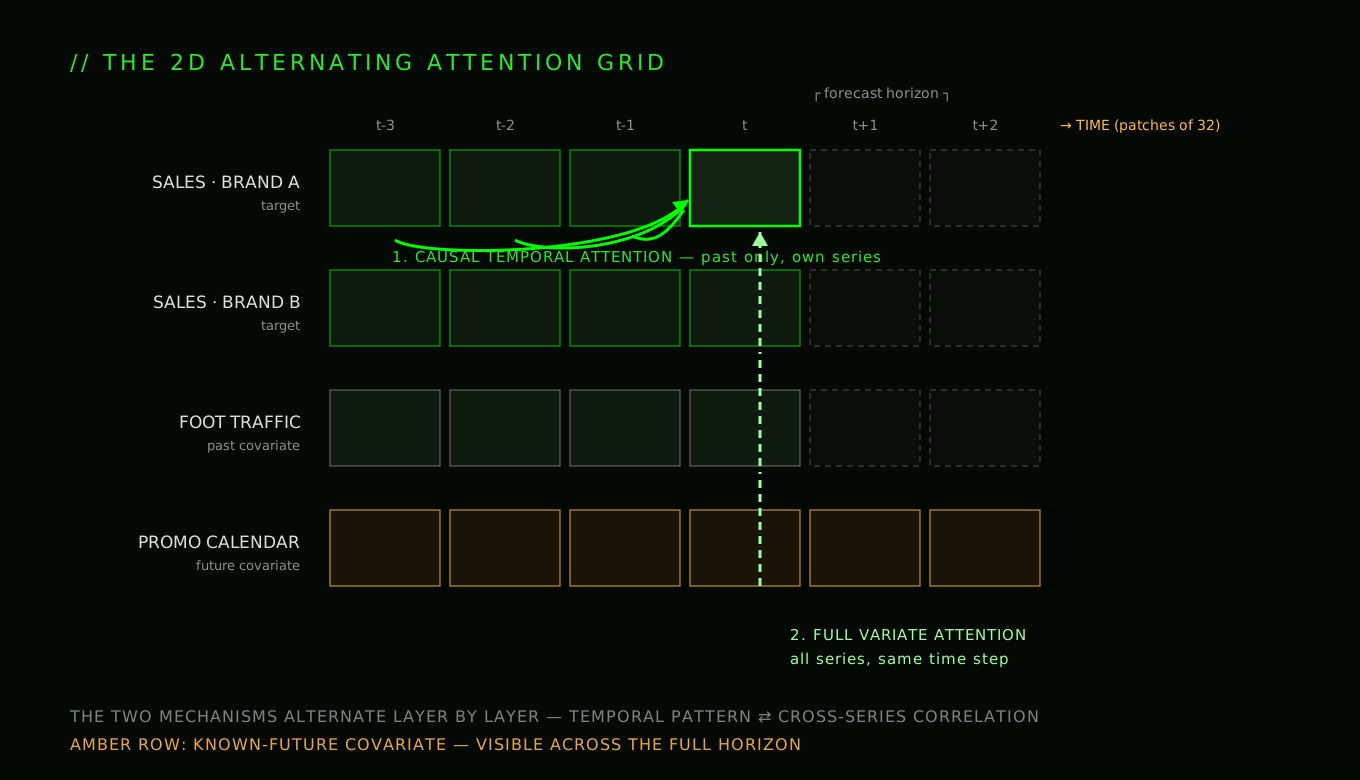
After tokenization and an input residual block, tokens enter the main transformer stack — which operates as a two-dimensional grid rather than a single sequence:
- Causal temporal attention (horizontal): tokens attend across time within their own series. Strictly causal — a token can only see the past of its own series, so there is zero data leakage from the future.
- Full variate attention (vertical): at any given time step, a token attends to every other series in the dataset. This is where cross-series structure gets learned — how a promotion in one series lifts sales in another, how foot traffic leads revenue.
These two mechanisms alternate through the layer stack, weaving temporal patterns and cross-series correlations into a single representation.
How Does It Forecast the Whole Horizon in One Pass?
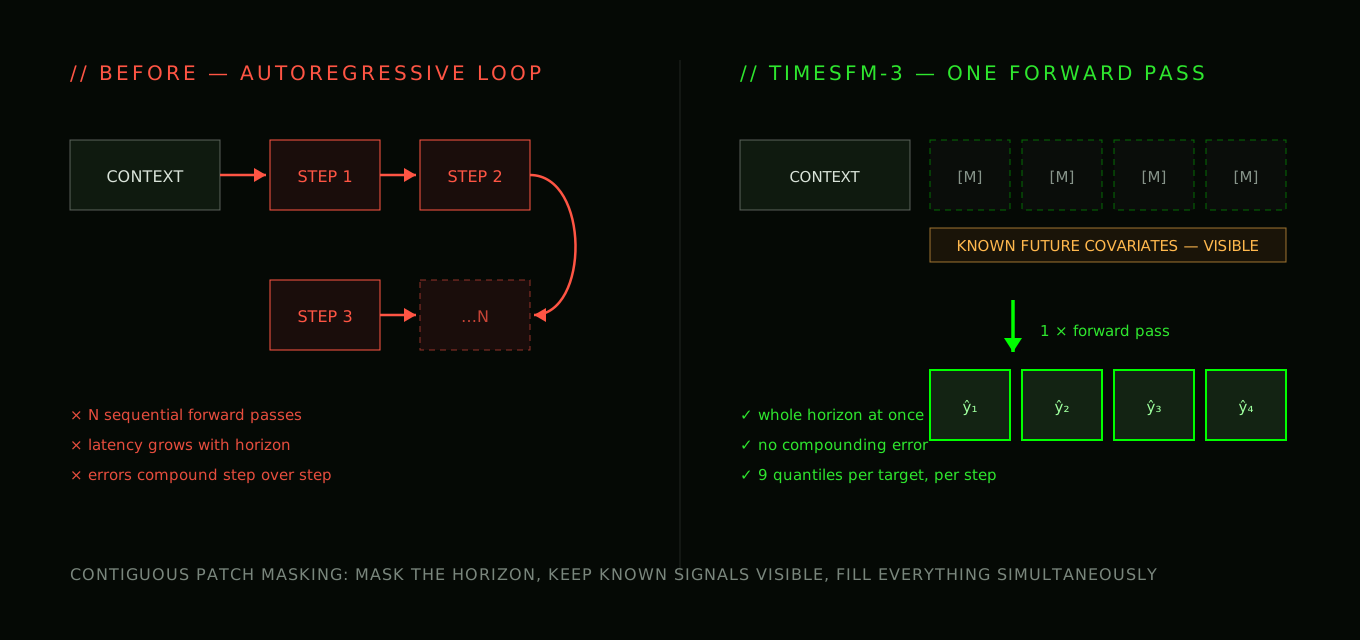
Every previous TimesFM decoded autoregressively: predict a patch, append it, predict the next. That loop costs latency, compute, and — worst of all — compounding error: each step inherits the mistakes of the one before it.
TimesFM-3 drops the loop entirely using Contiguous Patch Masking. The model appends masked placeholder tokens for the whole future horizon alongside the observed context. Targets and past covariates are masked in the horizon (their futures are unknown); past-future covariates stay visible, injecting the known signals — holidays, scheduled promotions — right where the prediction happens. The alternating attention layers then fill in all masked horizon patches simultaneously. One forward pass, entire horizon, done.
And it isn't just a point estimate. At every horizon step, for every target, the model predicts 9 quantiles from the 10th to the 90th percentile — a full probabilistic view of forecast uncertainty, natively.
What Does This Look Like in Practice?
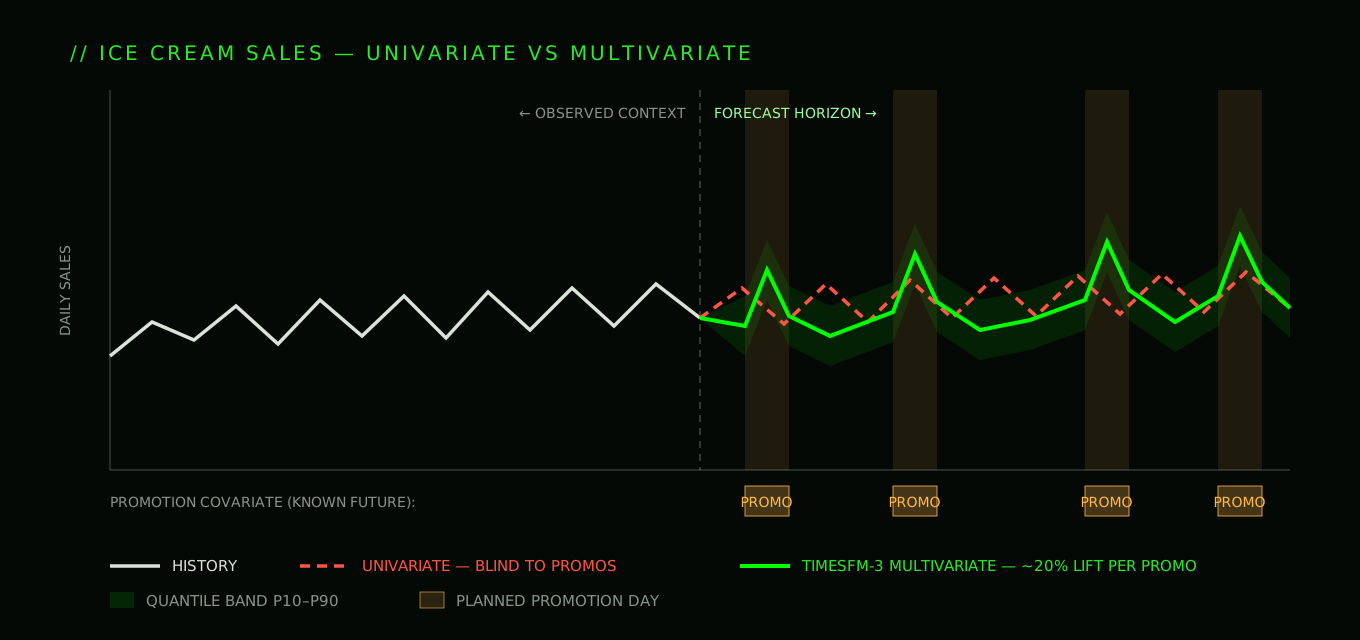
Back to the ice cream chain. You're planning next month's promotion schedule and need a sales forecast. A standard univariate model looks at historical sales, finds the weekly rhythm, and projects it forward — blind to the promotions you've already booked. TimesFM-3's multivariate mode takes the promotion calendar as a past-future covariate, learns the promotion→sales-lift relationship from the historical context, and applies it to exactly the future days where promotions are planned. The result: the forecast anticipates roughly a 20% sales bump on each promotion day — and over a full month, that compounds into a meaningfully more accurate revenue projection.
TimesFM-3 vs TimesFM-2.5: What Actually Changed?
| TimesFM-2.5 (Sep 2025) | TimesFM-3 (2026) | |
|---|---|---|
| Scope | Univariate only | Natively multivariate |
| Parameters | 200M | 330M |
| Covariates | None | Past + known-future (dynamic) |
| Multiple targets | One series at a time | Joint, with cross-series attention |
| Decoding | Autoregressive, patch by patch | Single pass — Contiguous Patch Masking |
| Pre-training corpus | Real-world time series | Real + synthetic · 1T+ time points |
| Uncertainty | Quantile head | 9 quantiles (P10–P90), every target, every step |
How Does It Perform on Benchmarks?
Google evaluated TimesFM-3 on the three big public forecasting benchmarks: GIFT-Eval, fev-bench and TIME. The reported result: top-ranked among all pre-trained foundation models on all three, in both point-forecast accuracy and probabilistic forecast quality (average rank across tasks, lower is better) — against a field that includes multivariate-capable rivals like Chronos-2 and the Toto 2.0 family, plus its own predecessor, TimesFM-2.5.
The detail worth pausing on: Google reports two entries per benchmark. In univariate mode — no covariates, no cross-series information, every target treated independently like a traditional forecaster — TimesFM-3 already matches or outperforms the competing models. Switch on full multivariate mode and it takes another leap, claiming the best average rank across the board. The multivariate machinery isn't compensating for a weak base model; it's compounding on top of a state-of-the-art one.
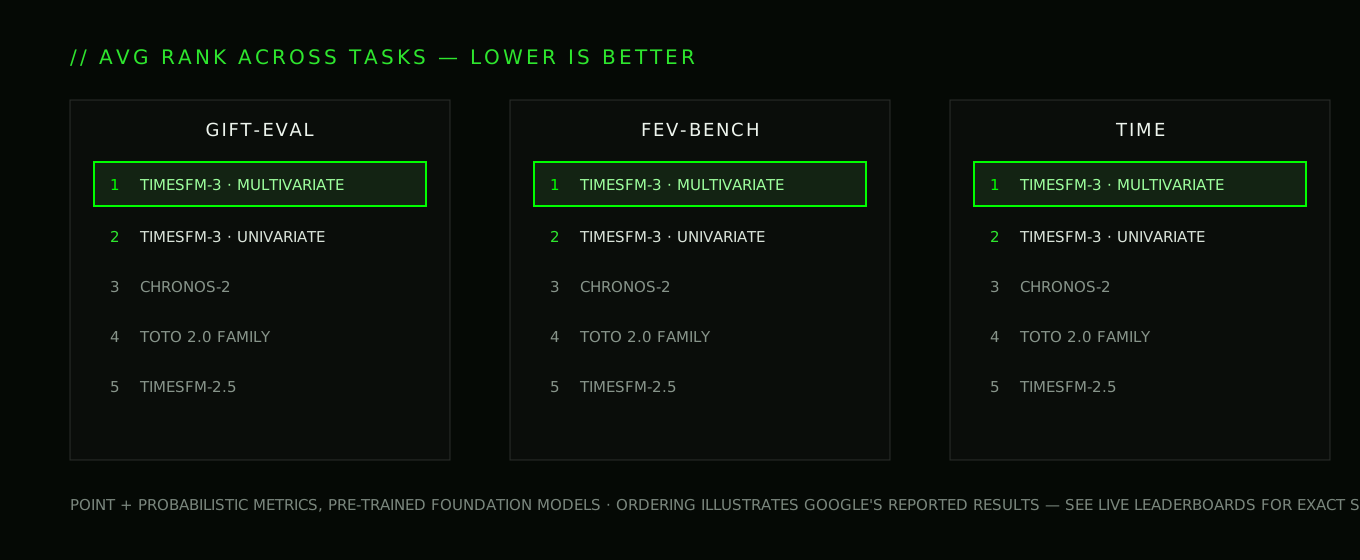
Why the Two-Entry Result Matters. A model that only wins with covariates is a feature, not a foundation. TimesFM-3 winning in plain univariate mode first — then extending the lead with multivariate context — is what makes it a genuine generational upgrade.
How Do You Get Started?
TimesFM-3 ships as an open 330M-parameter PyTorch checkpoint, with code and utilities in the TimesFM repository. If you're already running TimesFM-2.5 in production, the upgrade path is the point: same zero-shot workflow, plus everything your problem was actually multivariate about all along.
# Checkpoint (Hugging Face)
https://huggingface.co/google/timesfm-3.0-pytorch

# Code, examples & docs (GitHub)
https://github.com/google-research/timesfm

# Install
pip install timesfm

# Already in the cloud: TimesFM powers AI.FORECAST in BigQuery —
# univariate today, with TimesFM-3 integration signaled as next.
For teams that would rather not touch a checkpoint at all, TimesFM already backs the AI.FORECAST function in BigQuery — SQL-native forecasting with no ML expertise required — which is exactly the delivery channel to watch as TimesFM-3 rolls through Google's stack.
The forecast you need was never "what will this series do?" It was "what will this series do, given everything else I already know?" TimesFM-3 is the first foundation model to answer the real question — in one pass.
Limitations
Google's benchmark claims are self-reported, and the model is brand new — independent, adversarial evaluation (out-of-distribution series, noisy or missing covariates, longer horizons than the published benchmarks test) hasn't had time to accumulate. Zero-shot performance also still depends on how well a given deployment's series resemble the pre-training distribution; a genuinely novel domain can underperform a purpose-built model even with covariates in hand. And multivariate mode has a real requirement the univariate version didn't: usable, correctly-timestamped covariate data. A promotion calendar that's inaccurate or arrives late feeds the model bad information exactly where it's supposed to help most.
The Bottom Line
TimesFM-3 collapses three long-standing trade-offs at once. Multivariate context without task-specific training — the covariates that used to require a custom gradient-boosting pipeline now ride along zero-shot. Whole-horizon decoding without autoregressive error accumulation — one forward pass, nine quantiles per step. And benchmark supremacy without caveats — top-ranked on GIFT-Eval, fev-bench and TIME even before the multivariate machinery kicks in, per Google's reported results. For anyone forecasting demand, load, traffic or revenue, the question is no longer whether a foundation model can handle your real problem. It's how fast you can hand it your covariates.
References
- TimesFM: A decoder-only foundation model for time-series forecasting — Google Research
- TimesFM-2.5 checkpoint — Hugging Face
- TimesFM-3 checkpoint — Hugging Face
- google-research/timesfm — GitHub
- GIFT-Eval leaderboard · fev-bench · TIME leaderboard
Related
Part of our ongoing coverage in the AI hub. For the underlying mechanics, see How LLM API Pricing Works and MCP: The Protocol Quietly Becoming the TCP/IP of AI Agents — or start with What Is AI? for the foundational definitions this piece builds on. For the transformer mechanics underneath TimesFM-3's attention grid, see Machine Learning.
Explore Related Concepts
Frequently Asked Questions
What is TimesFM-3?
TimesFM-3 is Google's third-generation time-series foundation model. It has 330 million parameters, is pre-trained on more than 1 trillion time points, and forecasts multiple interdependent time series — with covariates — in a single forward pass, zero-shot, with no task-specific fine-tuning.
What is multivariate time-series forecasting?
Multivariate forecasting predicts a time series using not just its own history but also related series and external features — for example, forecasting ice cream sales using related product sales, past foot traffic, and known future events like promotions, weather and holidays.
What is the difference between TimesFM-3 and TimesFM-2.5?
TimesFM-2.5 (September 2025) was strictly univariate — it forecast one series from its own history. TimesFM-3 is natively pre-trained for multivariate forecasting: multiple targets, past covariates, and known-future covariates, and it decodes the entire horizon in one non-autoregressive pass instead of patch by patch.
Can TimesFM-3 use known future events like promotions or weather forecasts?
Yes. TimesFM-3 supports past-future (dynamic) covariates — signals whose future values are known in advance, such as planned promotions, holidays or weather forecasts. These stay visible in the forecast horizon and directly guide the model's predictions.
How does TimesFM-3 perform on forecasting benchmarks?
On GIFT-Eval, fev-bench and TIME, Google reports TimesFM-3 as the top-ranked pre-trained foundation model for both point and probabilistic forecasting — ahead of Chronos-2, the Toto 2.0 family and TimesFM-2.5. Even in univariate mode it matches or beats competing models; full multivariate mode extends the lead.
Is TimesFM-3 open and where can I get it?
TimesFM-3 is available as a 330M-parameter PyTorch checkpoint on Hugging Face (google/timesfm-3.0-pytorch) with code in the google-research/timesfm GitHub repository. Google has signaled BigQuery integration, where TimesFM already powers the AI.FORECAST function.