The Orchestration Layer: Why the Moat Sits Above the Model
Model quality is no longer a durable edge — every frontier vendor clears the bar within a quarter of each other. The real switching cost lives one layer up, in the orchestration built around the model.
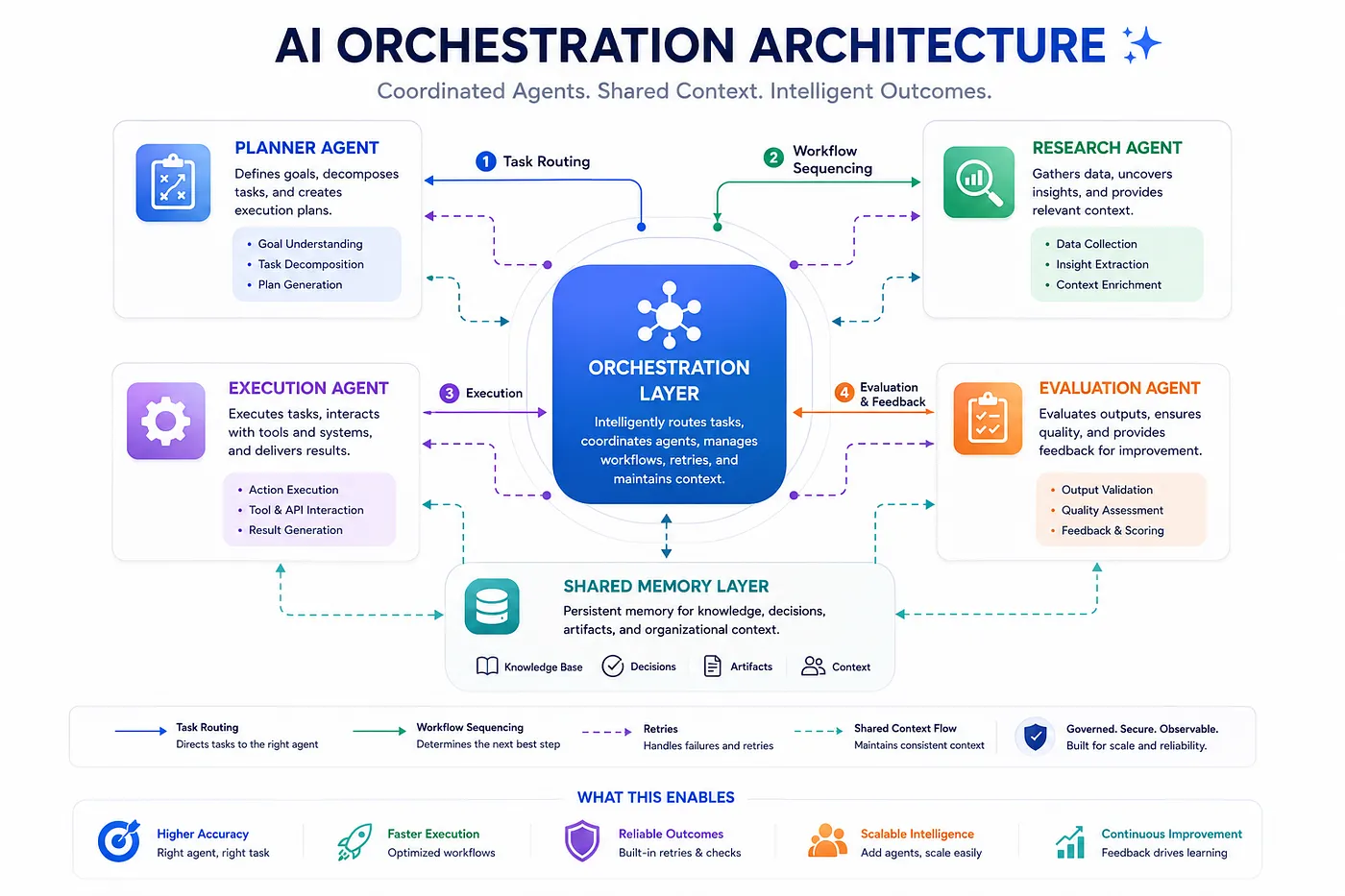
Frontier AI models are converging on price and performance faster than most companies budgeted for, which means "our model is better" is no longer a durable competitive position — this quarter's benchmark lead rarely survives to the next. Defensibility in enterprise AI has moved one layer up, into what this analysis names the Integration Graph: the accumulated web of permissions, escalation rules, audit logging, model-routing decisions, and workflow state that a business builds around its agents. This is the same lesson enterprise SaaS taught a decade ago — the moat was never the feature set, it was the configuration trapped inside the workflow — now replaying at the agent layer. For buyers, the decisive vendor question is portability: how much of the graph survives a provider switch. For builders, the durable investment is the unglamorous plumbing that makes an agent trustworthy enough to run unsupervised — because that is what becomes load-bearing, and load-bearing is what compounds.
Introduction
For the last two years, the pitch from nearly every AI vendor has been some version of "our model is smarter." That was a reasonable place to compete when capability gaps were wide and visible. It's a much weaker place to compete now that several providers clear the bar for the tasks most businesses actually run through them — drafting, summarizing, classifying, routing, retrieving. The leaderboard still moves, but it moves in inches, and this quarter's inch advantage rarely survives to next quarter (the Stanford AI Index tracks the convergence in the capability data year over year).
That should worry any operator who chose a vendor because of a benchmark screenshot. It should also change how you think about where defensibility actually lives in an AI-driven business — whether you're the one selling the tooling or the one buying it.
Why It Matters
Capital allocation follows the moat, and right now much of it is chasing the wrong layer. Vendors racing on model quality are investing in a lead with a shelf life measured in months; buyers shopping on capability charts are optimizing for the one component that will be easiest to swap and ignoring the one that will hold them in place. Reading the stack correctly — commodity below, moat above — changes vendor selection, build-vs-buy decisions, and where an AI product team should spend its next engineering quarter.
Core Concepts
Orchestration layer. Everything that sits between raw model capability and a business process: which model handles which step, what it's allowed to touch, what gets logged, what triggers a human handoff, and how all of it maps onto a specific company's org chart and risk tolerance.
Integration Graph. This analysis's term for the accumulated, organization-specific web of decisions embedded in that layer — permissions, escalation logic, audit trails, routing rules, workflow state. Defined precisely in the framework section below.
Switching cost. The real price of leaving a vendor: not the contract, but the rebuild — everything in the graph that doesn't come with you.
The Moat Was Never the Model
Enterprise software already ran this experiment. Nobody stayed on a CRM or an ERP for a decade because the underlying feature set was unmatched — features get copied within a release cycle or two. What made switching expensive was everything wrapped around the feature set: the custom fields, the approval chains, the reports finance depends on, the integrations nobody wants to rebuild. The software itself was replaceable. The accumulated configuration was not.
Agentic AI is recreating that pattern one layer up, and most vendor evaluations haven't caught up to it. When a business connects an agent to its ticketing system, its data warehouse, and its approval workflow, the model doing the reasoning becomes the easiest part to swap. The hard part — the part actually holding the relationship in place — is the orchestration around it.
That orchestration layer is where the durable position sits — the same kind of economic moat enterprise software built out of accumulated configuration, not features. It's harder to copy because it isn't a product feature; it's an accumulation of decisions specific to one organization's operations. And it's harder to leave because unwinding it means rebuilding permission structures and escalation logic from scratch, not just pointing a new API key at a different endpoint.
The Integration Graph
Name the thing and it becomes auditable. The Integration Graph is the full set of organization-specific structure accumulated around an AI deployment — and its five components are also the checklist for locating where your switching costs actually live:
| Component | What accumulates | Why it doesn't transfer |
|---|---|---|
| Permissions | What each agent may read, write, and touch, per system | Encoded in one vendor's policy model |
| Escalation logic | When a human takes over, and which human | Mapped to your org chart inside their workflow engine |
| Audit trail | What was logged, in what format, for whom | Compliance depends on continuity — a format break is a gap |
| Routing rules | Which model or tool handles which step | Expressed in vendor-specific orchestration config |
| Workflow state | In-flight processes, history, learned context | Often has no export path at all |
The diagnostic that falls out of the table is one question, asked component by component: if this vendor disappeared tomorrow, how much of this comes with me, and how much gets rebuilt from zero? The answer is a number between "all of it" and "none of it," and that number — not the benchmark chart — is your actual exposure.
Interactive companion: The Orchestration Stack — an interactive infographic. Watch models hot-swap beneath a fixed orchestration layer, click each layer of the stack for detail, and run the Portability Audit — six toggles that score your own vendor exposure.
Why This Matters for the Buy-Side
If you're purchasing AI tooling rather than building it, the practical implication cuts against the current instinct to shop on capability. A model comparison chart tells you almost nothing about what happens to your operational context if you switch providers in a year. The better diagnostic is the portability question above, asked before the contract, not after.
Vendors who can answer it with an honest, specific account of what's portable are telling you something real about how they think about the relationship. Vendors who redirect to model benchmarks are — whether they intend to or not — signaling that they're competing on the layer that's about to become a commodity.
Why This Matters for the Sell-Side Too
For teams building AI products, the temptation is to keep racing on model quality because it's legible and easy to market — the same trap platform economics warns against when a vendor competes on the commodity layer instead of the layer that actually compounds. The more durable investment is in the boring plumbing — the permissioning, the audit logging, the workflow state that makes an agent trustworthy enough to run unsupervised inside somebody else's business. That plumbing is unglamorous, it doesn't fit in a benchmark table, and it's exactly the thing that's expensive for a customer to rip out once it's load-bearing.
The uncomfortable version of this argument: "our model is better" is a marketing claim with a shelf life measured in months, while "our orchestration is embedded in how your teams actually work" is a structural position that compounds. One of those is a moat. The other is a temporary lead that the next model release erases.
Limitations
- This is editorial analysis, not measured data. The convergence trend is documented; the strategic reading of it is an argument, and arguments about moats get tested by markets, not by their internal logic.
- A frontier break would reshuffle the layers. A genuine step-change in capability — not an inch, a discontinuity — would temporarily restore the model layer as a differentiator. The claim here is about the trend, not a law.
- Deep integration cuts both ways. The same Integration Graph that locks customers in can lock a vendor into bespoke complexity that doesn't scale across customers. Orchestration moats are built customer by customer, which is slower than shipping a better benchmark.
- Portability is partly a standards question. If open interchange formats for agent permissions and workflow state emerge and win, the graph becomes more portable and this moat thins. Watch the standards bodies, not just the vendors.
Related Analysis
- The Data Moat in the AI Era
- The Shadow Infrastructure: Agentic AI, Real-Time Compliance, Private Credit
- Business hub
References
- Stanford HAI, AI Index — annual capability and convergence data — hai.stanford.edu/ai-index
Final Thoughts
The businesses that will look, a year from now, like they made the right AI bet are unlikely to be the ones that chose correctly on capability. They'll be the ones that understood capability was never the layer worth defending in the first place — and either built their Integration Graph deliberately, with portability priced in, or sold the plumbing everyone else treated as an afterthought.
Explore Related Concepts
Frequently Asked Questions
Do AI models have a moat?
Increasingly, no — capability converges across vendors faster than differentiation can be defended. The durable positions are forming a layer up, in the organization-specific orchestration built around the models.
What is an orchestration layer in AI?
The structure between raw model capability and a business process: model routing, permissions, escalation to humans, audit logging, and workflow state. It's where an agent stops being a demo and starts being trusted infrastructure.
What creates switching costs in enterprise AI?
Not the API integration — that's an afternoon. The Integration Graph: accumulated permissions, escalation rules mapped to your org chart, compliance-grade audit continuity, and workflow state that often has no export path.
How should I evaluate AI vendors?
Ask the portability question component by component: if this vendor disappeared tomorrow, what comes with you and what gets rebuilt from zero? Specific, honest answers signal a durable partner; redirection to benchmarks signals competition on the commodity layer.
Is this different from normal SaaS lock-in?
It's the same economics one layer up — with the addition of workflow state and agent permissions, which are stickier than SaaS configuration because they encode operational trust, not just settings.