ECONOMIC MOATS
What economic moats are, the five types that actually persist, and how to identify them in technology and AI businesses.
Part of: EconomicsAn economic moat is a structural competitive advantage that allows a business to defend above-average returns against well-resourced rivals over a long time horizon.
The Five Moat Types
Warren Buffett popularized the term, borrowed from medieval fortifications. Empirical research on durable competitive advantage has converged on five types that actually persist:
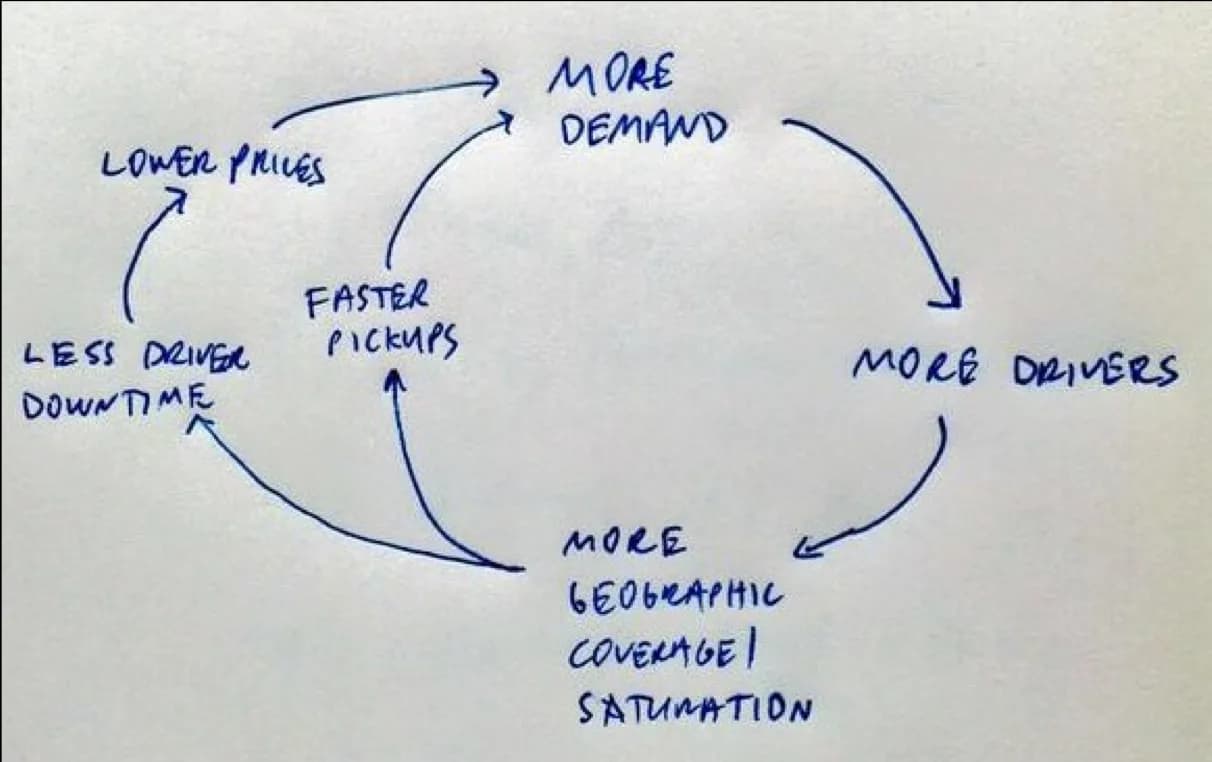
- Network effects: The product becomes more valuable as more people use it, creating a self-reinforcing flywheel that raises the cost of switching to any rival that starts with fewer users.
- Switching costs: Customers are locked in by accumulated data, deep integrations, or embedded workflows, making the price of leaving higher than the price of staying.
- Cost advantages: Structural lower costs through economies of scale, proprietary processes, or unique access to inputs — advantages a competitor cannot replicate simply by spending more.
- Intangible assets: Brands, patents, trade secrets, and regulatory licenses that grant pricing power or legal exclusion unavailable to the market at large.
- Efficient scale: A market whose size supports only one or two profitable competitors, so new entrants cannot achieve the volume necessary to survive.
In AI Businesses
The moat question is the central strategic question of the current AI investment cycle. Most AI application businesses have weak moats — they are built on commodity APIs and can be replicated quickly by a competitor willing to pay similar infrastructure costs. The businesses with durable moats are those with proprietary data that improves model performance, deep workflow integration that raises switching costs, or network effects driven by data flywheels that compound with scale. Identifying which AI companies have real moats versus temporary market position is the core analytical challenge for investors and strategists right now, and it sits at the heart of how venture capital underwrites the sector.
How Moats Erode
Even strong moats have natural decay rates. Technology shifts are the primary threat: the switching cost moat of enterprise software vendors gets disrupted when a new architectural paradigm — cloud, mobile, AI — makes existing integrations a liability rather than an asset. Brand moats erode when a product category becomes commoditized. Network effects can reverse when a better-designed platform succeeds in migrating users. The useful analytical question is not just whether a moat exists today but what its trajectory is, and whether the business is reinvesting to deepen it or harvesting it for short-term returns.
The Moat Audit
Identifying a real moat requires looking at observable metrics, not narratives. Gross retention shows whether customers actually stay. Pricing power tests show whether the company can raise prices without losing volume. Competitive win rates reveal whether the business wins deals against well-funded rivals. Many businesses claim moats in investor presentations that disappear under quantitative scrutiny. The discipline of distinguishing genuine structural advantage from temporary market position is what separates useful competitive analysis from storytelling.
The Reinvestment Test
The best moat analysis goes beyond identification to trajectory. A moat that is not actively deepened erodes. Companies that sustain moats for decades share one trait: they systematically reinvest excess returns into widening the advantage — through R&D, brand building, network expansion, or supply chain lock-in. Businesses that harvest their moats by returning cash without reinvesting in structural advantages are performing well in the short term while weakening the position that made the performance possible.
Open Questions
- Can AI-generated proprietary data constitute a durable moat, or will model commoditization erode that advantage as quickly as it is built?
- At what scale do switching costs in SaaS become strong enough to sustain pricing power against a well-funded new entrant offering a migration path?
- How should analysts weight moat trajectory versus moat strength when the two diverge — a strong moat that is clearly eroding versus a weak moat that is being actively deepened?
Part of the knowledge graph at The Best Blog Ever — reference definitions for ideas that matter.