NETWORK EFFECTS
What network effects are, the different types, and why they're the most powerful economic moat in technology.
Part of: BusinessA network effect exists when a product becomes more valuable to each user as more users join it.
Types of Network Effects
Direct network effects: The value flows directly between users of the same type — a messaging app is worth more when everyone you know is already on it.
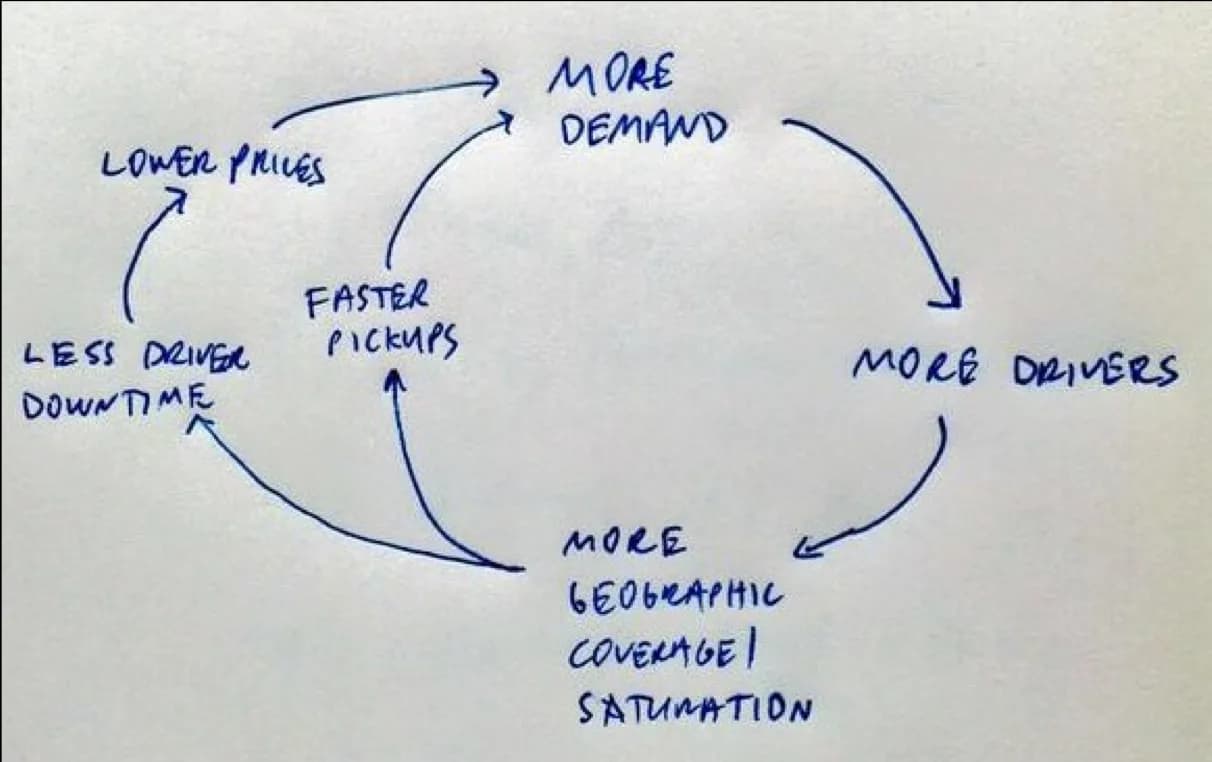
Indirect (cross-side) network effects: Value flows across two distinct user groups — more buyers attract more sellers, which attracts more buyers, the core dynamic behind every platform economics marketplace.
Data network effects: More users generate more data, which improves the product, which attracts more users — the mechanism most often claimed by artificial intelligence companies.
Not all network effects are equal
Local network effects, where you only care about your immediate social graph, are weaker than global ones. Indirect network effects can flip negative above a certain scale — too many sellers, too much noise, too much spam. Understanding the type and strength of a network effect is essential for evaluating whether a business's position is truly defensible — a durable economic moat — or just temporarily ahead of competition.
AI and network effects
AI businesses frequently claim data network effects. In practice, this flywheel is weaker than it appears for most applications. True data network effects require that user-generated data is proprietary, scarce, and directly improves machine learning model quality in a way that compounds. Most AI app data doesn't meet all three criteria. The companies that do have genuine data network effects — search, navigation, fraud detection — built them over years before the current AI wave and benefit from data collection at a scale new entrants cannot replicate quickly.
Measuring network effect strength
The analytical test for a real network effect is churn behavior segmented by network density. If users with denser networks — more connections, more counterparties, more transaction history — churn at meaningfully lower rates than isolated users, the network effect is real and compounding. If churn rates are similar regardless of network embeddedness, the product has engagement but not a genuine moat. This distinction matters enormously for valuation: businesses with strong measured network effects deserve a structural premium; businesses with claimed but unmeasured network effects often don't survive contact with competition once growth slows.
Why network effects compound slowly then suddenly
The value of a network scales roughly with the square of connected users (Metcalfe's Law). This means networks are nearly worthless below a critical mass threshold and extraordinarily valuable above it. A challenger doesn't need to be marginally better — it needs to be good enough to motivate simultaneous switching across a critical portion of the network. That coordination problem is the real moat, not the technology. It also explains why incumbents often appear vulnerable for years before the market tips irreversibly in their favor.
Open Questions
- Can data network effects be meaningfully durable when foundation model improvements benefit all players simultaneously?
- At what point do cross-side network effects in two-sided marketplaces become negative for one side, and how do you measure that threshold?
- How do you value a network effect that is real but confined to a geography or niche — is local density worth more or less than diffuse global scale?
Part of the knowledge graph at The Best Blog Ever — reference definitions for ideas that matter.