ModRetro builds the future in reverse
It builds machines that play thirty-year-old cartridges, and machines that play brand-new ones, all milled from magnesium and engineered to outlive you. Meet the company turning nostalgia into one of the most quietly radical hardware bets in tech.
The first thing people notice about a ModRetro Chromatic is the cold. Pull one out of the box on a winter day and it is heavy and frigid in a way no plastic gadget ever is, because it is not plastic — it is a brick of magnesium alloy machined into the shape of a Game Boy and built, in the words of more than one reviewer, like a bomb shelter. That sensation is the whole company in miniature. ModRetro makes new versions of old machines — a Game Boy and Game Boy Color handheld called the Chromatic, and, shipping July 28, a Nintendo 64-class console called the M64 — and it makes them with a level of obsession that feels almost defiant in 2026. In an industry racing toward the disposable, the glued-shut, the streamed and the dematerialized, ModRetro is building the exact opposite: durable, repairable, hardware-accurate objects you actually own, designed to still be working when their owners are old. Its slogan is "The Future is Retro," and the more time you spend with what it makes, the more that reads less like nostalgia and more like a thesis.
Here is the case for why this is one of the most quietly interesting hardware companies going — and the honest caveats that keep it from being a fairy tale.
The thing in your hand
Start with the Chromatic, because it is the proof of concept for everything else. The right word for it is borrowed from custom-car culture: it is a restomod — a faithful restoration of a beloved old design with modern engineering hidden underneath, keeping the soul while replacing the guts. It helps to know where the impulse comes from. ModRetro began life in 2009 as an online forum for console-modding obsessives, founded by Palmer Luckey, and was revived as an actual manufacturer in 2023, with engineer Torin Herndon — a veteran of Luckey's Oculus and Anduril — as co-founder and CEO. The fanaticism is native, not marketing. On paper the Chromatic is a Game Boy Color clone; in the hand it is a piece of overengineering that borders on the absurd, in the best way. The shell is thixomolded magnesium alloy. The screen — a 2.56-inch, 160-by-144 backlit IPS panel — is pixel-perfect, recreating the original Game Boy resolution with no upscaling or scaling tricks, which is a deliberate and slightly fanatical choice that purists adore. You can pay extra for a screen cover made of actual sapphire crystal, the same scratch-proof material used on luxury watch faces. And in a wink to its own name, the whole thing is held together with the same Y-wing screws as the original hardware, so it comes apart with a screwdriver and a little courage — the battery tray pops out, shells can be swapped, parts can be replaced. The reception told the story: Forbes called it built like a tank, and Rolling Stone named it the best retro handheld. This is a $199 device engineered like a $1,000 one, and you feel it the instant you hold it.
Not emulation — recreation
The magic underneath is a choice most consumers never think about, and it is the key to the entire company. Almost every other way to play old games today is software emulation: a program that imitates the old console, which often introduces subtle timing errors and input lag. ModRetro refuses to do that. Its devices are built on an FPGA — a field-programmable gate array, a chip that can be physically reconfigured after it is made to behave like another piece of hardware at the circuit level. The company frames it as the difference between emulation and recreation, and the distinction is real. The FPGA does not pretend to be a Game Boy in software; it is wired to become one in hardware.
The practical payoff is uncanny fidelity. Reviewers have run the gauntlet — Pokémon, Zelda, the gyroscope in Kirby Tilt 'n' Tumble, the rumble motor in obscure cartridges — and found it all works exactly as it did on the original, as Pocket-lint detailed in its review. Your real cartridges go in the slot and play with original-hardware accuracy and almost no latency, link cable and infrared multiplayer included, so you can still trade Pokémon the way you did in 1998. It is the rare product where the most important engineering decision is invisible, and yet you can feel its absence on every cheaper device.
New games for a "dead" format
Now the part that moves ModRetro from impressive to genuinely radical. It does not just make hardware for old games — it commissions and publishes brand-new games, on physical cartridges, for formats the entire industry abandoned decades ago. There is a growing catalog of original Game Boy Color titles you can buy shrink-wrapped today: new indie creations alongside re-releases and remasters, with cartridge art designed with the same care as the console. The reissues include genuine lost curiosities — like the Japan-only oddity ZAS and the long-buried Project S-11 — and the company has worked with established studios such as WayForward and Argonaut Games to bring classics back onto physical carts. And because these are real Game Boy games, not Chromatic-exclusive software, many of them run on a thirty-year-old Game Boy you have in a drawer right now.
Sit with that for a second. In 2026, a company is manufacturing new cartridges for a console Nintendo discontinued in 1998, and treating that as a permanent product line rather than a stunt. ModRetro has been explicit that games are its top priority and that it intends to keep making physical titles for these platforms for years. That is the move that reveals the real ambition: this is not a single gadget, it is an attempt to keep an entire format alive as a living thing — new art, new releases, new reasons to own the hardware — instead of embalming it.
From your pocket to your living room
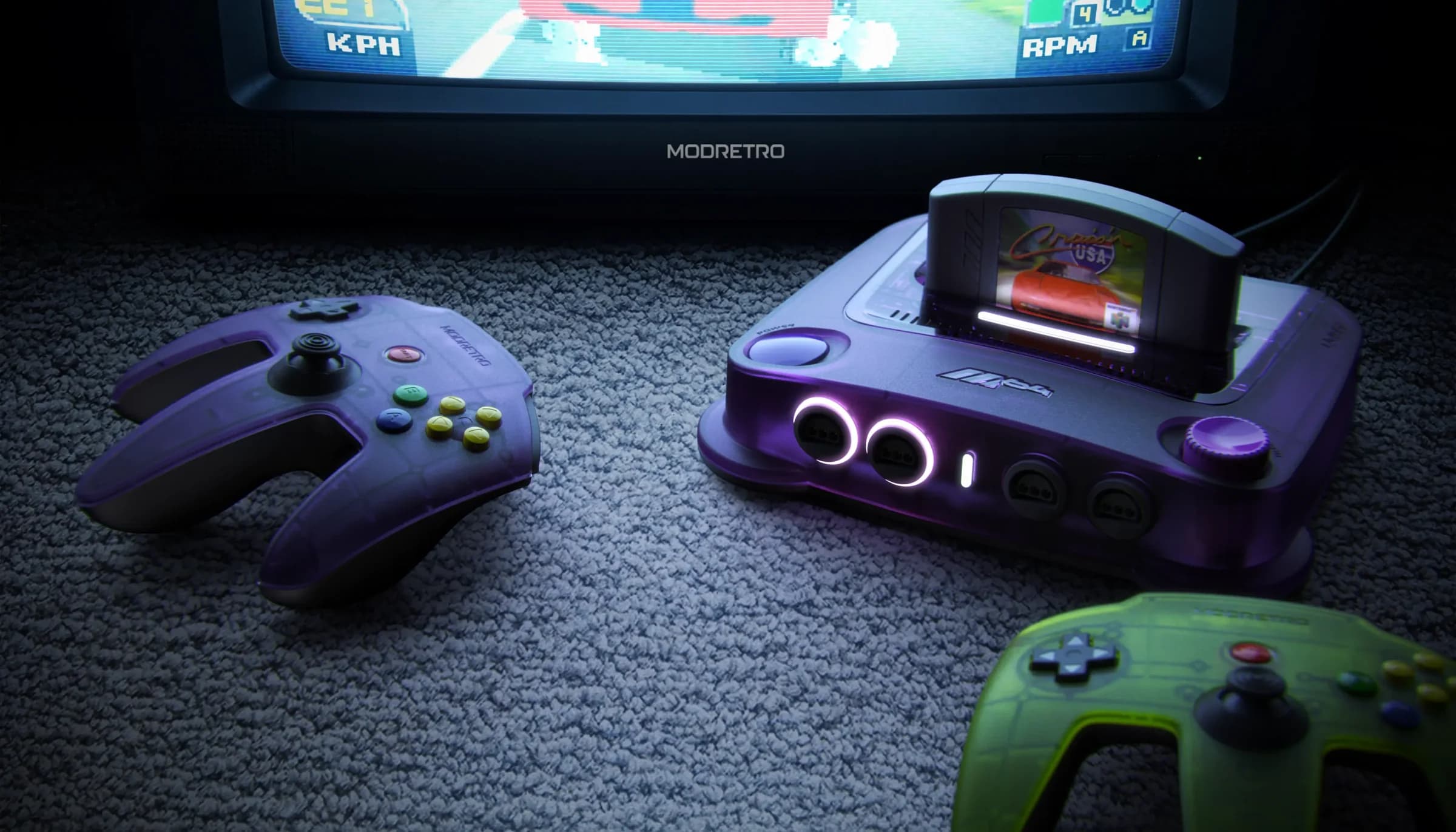
The Chromatic was the warm-up. The M64, shipping July 28, is ModRetro applying the same philosophy to the Nintendo 64 and scaling up dramatically in the process. It is an FPGA console built on an AMD Artix UltraScale+ chip — a partnership notable enough that AMD published its own announcement of it — that plays original N64 cartridges on a modern television over 4K HDMI. The spec sheet reads like a love letter to people frustrated by everything modern hardware has become: it boots to a game in about five seconds with no splash screens, runs completely fanless and silent, uses fast PSRAM instead of DDR memory for lower-latency accuracy, and even has a cart-eject button and an LED that uplights the cartridge label. The redesigned Trident controller revives the N64's three-pronged shape but fixes its single worst flaw, swapping the drift-prone original stick for modern magnetic-resonance thumbsticks that do not wear out.
Two details capture the worldview. First, the M64 is designed with no adhesives — it is meant to be opened and repaired with a screwdriver, a direct rebuke to an industry that glues phones shut to discourage fixing them. Second, ModRetro is open-sourcing the N64 core it built with the FPGA developer behind the community's N64 work, with a stated commitment to chase perfect accuracy over years and let the community follow along. And, as with the Chromatic, the console arrives with new physical cartridge games — returning cult titles and fresh ones — because the platform is the point, not just the box. At a $199 early-bird price undercutting its main rival, with a firm date and a detailed launch list, it is the most confident thing the company has done.
The bet underneath the brushed metal
Step back and the strategy snaps into focus, and it is more interesting than "nice retro toys." ModRetro is making a contrarian wager that craft, permanence, and genuine ownership are an underserved market — that a meaningful number of people are tired of devices that are slow, locked-down, designed to be replaced, and rented rather than owned, and will pay a premium for the opposite. Every design decision serves that bet. The magnesium and sapphire are a durability moat. The no-glue repairability and open-sourced cores are a longevity promise. The physical cartridges are ownership you can hold, hand to a friend, and pull out of a box working a decade later. This is the kind of economic moat that does not come from a patent but from a brand reputation for caring more than anyone else — the hardest kind to copy, because it requires actually caring.
There is a platform play here too. A console plus a first-party library of physical games is a classic platform economics structure — razor and blades, hardware and software reinforcing each other — except ModRetro is building it on formats everyone else wrote off, which means almost no competition for the affection of the people who love them. It is a useful contrast to how most global brands compete today, localizing execution across regions the way digital marketing strategies diverge market by market — ModRetro instead wins by refusing to chase the mainstream at all. The market appears to be noticing: the company has partnered with AMD on silicon and, in 2026, was reported by multiple outlets to be raising at a valuation near $1 billion — venture money betting, much as it once bet on Luckey's other companies, that this contrarian wager pays off. "The Future is Retro" turns out to be a real go-to-market strategy, not a t-shirt slogan — the kind of contrarian positioning that the best startup founder prompts are built to help you pressure-test — and it is working precisely because it runs against the grain of everything else in technology right now.
The honest caveats
Enthusiasm should not blur into advertising, so here is the other side. These are deliberately single-purpose, premium devices: the Chromatic plays only Game Boy and Game Boy Color, the M64 only Nintendo 64, and if you want a cheap box that emulates everything, this is emphatically not it. The prices are real money for narrow functionality, and a small number of N64 cartridges show compatibility quirks the team is still refining. The Chromatic also competes with the well-loved Analogue Pocket, which is more versatile in some respects, and the M64 enters a market where Analogue's 3D already exists. And the politics are real, not abstract. Co-founder Palmer Luckey is a polarizing public figure, and the line between ModRetro and his defense company Anduril is not always kept at arm's length: ModRetro released a limited Anduril Edition Chromatic finished in the same material used on Anduril's attack drones, down to a stainless-steel Anduril logo charm. It sold out in minutes and now resells for four figures — and it also led some respected retro outlets to stop covering ModRetro altogether over its ties to the arms industry. For some buyers that is a dealbreaker; for others it is irrelevant to the hardware in their hands. Either way it is a real part of the story, and worth knowing before you buy. None of this negates the craft. It just means the right buyer is specific: someone who values authenticity, durability, and ownership enough to pay for them.
The Bottom Line
What makes ModRetro worth writing about is not really the games — it is the argument the company is making with objects. In a moment when "innovation" usually means another thing that is faster, thinner, more locked-down, and obsolete in eighteen months, ModRetro is innovating in the opposite direction: toward permanence, repairability, accuracy, and ownership, executed with a craftsmanship that shames products costing five times as much. It is building new old machines that are meant to last forever, and reviving formats the industry left for dead, and somehow turning that into a real and growing business. You do not have to care about the Game Boy to find that thrilling. It is a small, stubborn proof that the disposable future was a choice, not a law — and that a company willing to care more than everyone else can still win. For more companies betting against the consensus, explore the innovation hub.
Explore Related Concepts
Frequently Asked Questions
What is ModRetro?
ModRetro is a hardware company that makes premium, hardware-accurate retro gaming devices and publishes new physical cartridge games for classic formats. Its two flagship products are the Chromatic, a Game Boy and Game Boy Color handheld released in 2024, and the M64, a Nintendo 64-compatible console launching in 2026. It was co-founded by Palmer Luckey, the founder of Oculus, and Torin Herndon, who serves as CEO, and grew out of a console-modding forum Luckey started in 2009.
What is the ModRetro Chromatic?
The Chromatic is a premium handheld that plays original Game Boy and Game Boy Color cartridges. It uses an FPGA for hardware-level accuracy rather than software emulation, a magnesium-alloy shell, and a 2.56-inch, 160x144 backlit IPS screen that recreates the original display without upscaling. It starts at $199.99, with a sapphire-crystal screen option for more.
What is the difference between FPGA and emulation?
Software emulation runs a program that imitates an old console, which can introduce timing errors and lag. An FPGA is a chip that is physically reconfigured to behave like the original hardware at the circuit level, so it does not imitate the console in software — it becomes a functional copy of it. The result is original-hardware accuracy, very low latency, and compatibility with real cartridges and accessories.
What is the ModRetro M64?
The M64 is an FPGA-based Nintendo 64-compatible console launching July 28, 2026, built on an AMD Artix UltraScale+ FPGA. It plays original N64 cartridges on a modern TV with 4K HDMI output, boots in about five seconds, runs fanless and silent, and ships with a redesigned Trident controller using driftless magnetic thumbsticks. Early-bird pricing started at $199, with retail around $230.
Is ModRetro hardware worth the premium price?
It depends on what you want. These are single-purpose, premium devices: the Chromatic plays only Game Boy and Game Boy Color games, the M64 only Nintendo 64. If you want maximum accuracy, build quality, repairability, and the experience of real cartridges, reviewers broadly consider them best-in-class. If you want a cheap, do-everything emulation box, they are not that, by design.