The AI memory supercycle, explained
The AI boom just showed up in a place ordinary people can feel it: the price of memory. Here is why a handful of data-center buyers are making your next phone, laptop and car more expensive — and how long it lasts.
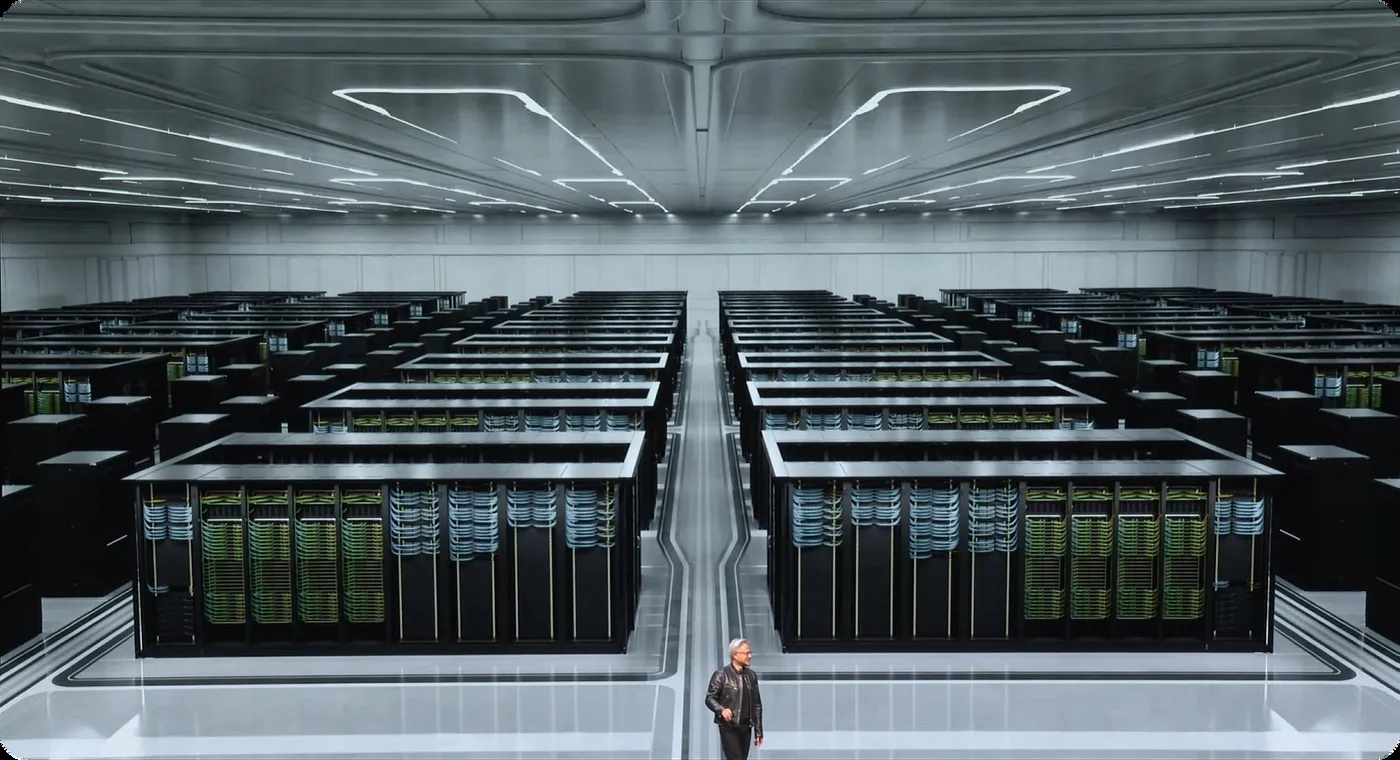
For three years the AI boom lived in places most people never touch — data centers, GPU order books, hyperscaler capital budgets, and the power grid straining to keep it all running. In 2026 it arrived somewhere everyone can feel it: the price of memory. The memory supercycle is the term the industry now uses for what is happening, and the mechanism is brutally simple. AI accelerators are hungry for a specialized component called high-bandwidth memory, the handful of companies that make nearly all the world's memory have pivoted their best capacity toward it, and the commodity memory that goes into phones, laptops, and cars is now scarce and expensive as a result. This is not a glitch in the supply chain. It is the AI build-out reaching into the consumer economy and quietly raising the cost of ordinary electronics.
The short version: a small number of buyers with effectively unlimited budgets have outbid the entire consumer-device industry for a shared input, and the rest of us are seeing it on the price tag.
What is actually happening
Three companies — Samsung, SK Hynix, and Micron — control over 95% of global DRAM production, and all three have shifted manufacturing toward the high-bandwidth memory (HBM) that AI chips require. HBM is DRAM stacked in layers and bonded next to a GPU so data can move fast enough to keep the processor fed; a single high-end AI accelerator can carry many times the memory of a powerful PC, and a full server rack can consume as much memory as a thousand smartphones. The result, as CNBC reported, is that AI demand has effectively sold out memory production for the year.
The crucial point is that this is zero-sum. Cleanroom capacity and wafer output are finite, so every wafer turned into an HBM stack for an Nvidia GPU is a wafer that does not become the low-power memory module in a mid-range phone. Industry estimates put data centers at roughly 70% of all memory consumed, with HBM rising to nearly a quarter of total DRAM wafer output in 2026. Conventional DRAM and NAND flash — the parts in your devices — are competing for what is left, and losing.
Why this one is different
Memory has always been cyclical, lurching between glut and shortage, and the instinct is to wait this one out. That instinct is wrong here. What makes 2026 structural rather than cyclical is the scale and durability of the demand behind it: the largest cloud providers have signed open-ended, multi-year supply agreements, effectively agreeing to absorb whatever the makers can produce, which locks up priority access for years. SK Hynix booked its entire 2026 capacity and, on the strength of AI memory, passed Samsung to become South Korea's most valuable company. The capital flowing in dwarfs prior cycles — hyperscaler infrastructure spending has climbed from roughly $217 billion in 2024 toward an estimated $650 billion in 2026, as Fortune detailed. When demand of that magnitude is contractually committed years out, a normal cyclical correction has nothing to correct against.
The bill lands on consumers
This is where it stops being an industry curiosity. Memory has climbed to roughly 20% of a laptop's hardware cost, up from somewhere between 10 and 18% in early 2025, which means device makers either absorb the hit on margin or pass it on. Forecasters expect them to pass much of it on: smartphone, PC, and tablet prices are projected to rise meaningfully through the end of 2026, with the steepest increases at the low end of the market where margins are already thin and there is no cushion to absorb a component shock. The pain is not theoretical at the top of the market either — Apple's leadership has signaled the squeeze will compress iPhone margins, and executives from Tesla to Apple have flagged memory as a constraint on their plans. For households in price-sensitive markets, the practical effect is longer replacement cycles: people simply keep the old phone another year.
It is worth naming this plainly, because it connects to a larger macro story about inflation in the AI era. The conventional worry is that AI is deflationary — that it lowers the cost of producing things. The memory supercycle is the first large, visible case of AI raising the price of a physical good for ordinary buyers, by competing them out of a shared input.
Who actually wins
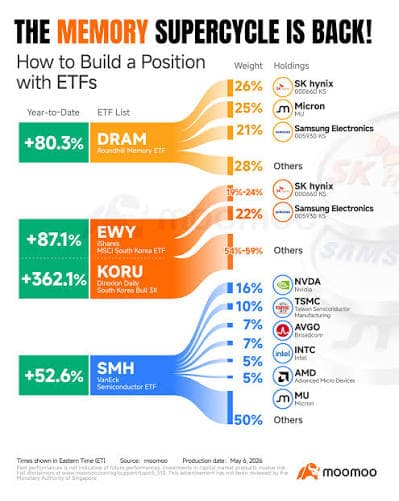 Year-to-date returns and top holdings for memory-exposed ETFs and leveraged plays. Source: moomoo.
Follow the money and the picture inverts — the same question asked more broadly in who profits from the AI buildout. The same dynamic that hurts device buyers richly rewards the memory makers, whose margins on AI-grade memory run well above commodity DRAM. SK Hynix's rise is the clearest case, but the structural tightness benefits the whole oligopoly — and Micron has gone so far as to exit the consumer segment to concentrate on enterprise and GPU-grade memory. For investors, this is the readable signal underneath the consumer noise: a supply-constrained, three-player market selling a sold-out input to buyers with capital-allocation budgets measured in the hundreds of billions is an enviable position, and the market has repriced these companies accordingly. The risk, as always with memory, is that the cycle eventually turns — but the case for "this time is structural" is stronger than it has been in any prior shortage.
How long does it last
Not a quarter or two. New fabrication capacity from Micron, SK Hynix, and Samsung requires roughly 12 to 18 months of ramp and does not reach meaningful volume until 2027 at the earliest, with some industry voices putting real relief at 2028. More striking is the analyst consensus that prices may never fully return to 2024 levels, because the reallocation toward AI memory is permanent rather than a temporary diversion. The base case is therefore not "shortage, then normal" but "shortage, then a higher floor" — elevated memory pricing as the new baseline for as long as AI compute demand keeps growing.
The Bottom Line
The memory supercycle is the moment the AI build-out became legible to people who do not follow it, because it shows up on the price of a phone. The structural read is that AI infrastructure is now large enough to bend the cost curve of a shared physical input against the entire consumer-electronics industry, and that the effect is durable, not transient. For consumers it means paying more and upgrading less. For investors it means the most reliable AI trade right now may not be the model labs at all, but the unglamorous companies selling them the memory they cannot get enough of. For more on how AI's physical footprint reshapes markets, start with the economics hub.
Explore Related Concepts
Frequently Asked Questions
Why are memory prices rising in 2026?
AI data centers need vast quantities of high-bandwidth memory (HBM) to feed their GPUs, and the three dominant memory makers — Samsung, SK Hynix, and Micron — have redirected manufacturing capacity toward those high-margin AI chips. That leaves less capacity for the conventional DRAM and NAND used in consumer electronics, so prices across the board have surged.
What is HBM and why does AI need so much of it?
HBM, or high-bandwidth memory, is DRAM stacked in layers and placed next to an AI accelerator to move data fast enough to keep the chip fed. A single high-end AI GPU can carry many times the memory of a powerful PC, and a full server rack can use as much memory as a thousand smartphones — so the AI build-out consumes a disproportionate share of global supply.
Will the memory shortage make phones and laptops more expensive?
It already is. Memory now accounts for roughly 20% of a laptop's hardware cost, up from 10 to 18% in early 2025, and device makers are warning of compressed margins or higher prices. Forecasters expect smartphone and PC prices to rise through the end of 2026, with the sharpest pain at the low end of the market where margins are thinnest.
When will memory prices come back down?
Not soon. New fabrication capacity from the major makers does not reach meaningful production volume until 2027 at the earliest, and some industry voices do not expect real relief until 2028. Several analysts warn that prices may never return to 2024 levels because the reallocation of capacity toward AI memory is structural rather than a passing cycle.