Why AI Data Centers Are Funding Nuclear's Second Act
Microsoft, Google, and Amazon have committed to nuclear power at a scale no government subsidy ever achieved. The AI power crisis is not abstract: it is rewriting energy economics.
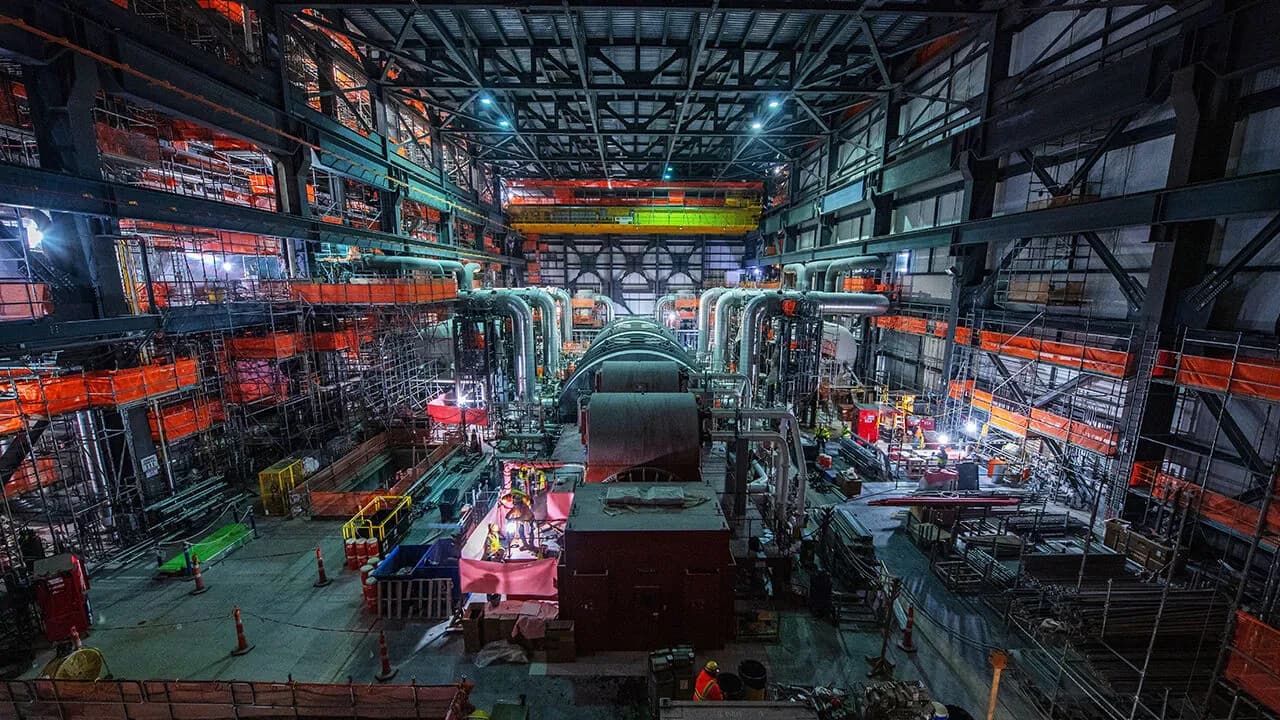
In early 2024, Microsoft signed a twenty-year agreement to restart Three Mile Island Unit 1, the Pennsylvania reactor that had closed in 2019 for economic — not safety — reasons. The deal was not sentimental or symbolic; it was procurement. Microsoft needed firm, dispatchable power for its rapidly expanding AI infrastructure, and the existing grid could not reliably supply it at the required scale. What followed was less a trend than a cascade: Google contracted with Kairos Power for output from small modular reactors, Amazon acquired a nuclear-adjacent data center campus, and a class of institutional investors who had largely vacated the sector began moving capital back toward it. The industry that much of the world spent four decades trying to phase out has found, unexpectedly, its most committed new customers in the economics of AI infrastructure.
AI Overview
Nuclear power is experiencing a demand-driven revival, funded by AI companies that need firm baseload electricity that their intermittent renewable portfolios cannot provide. Long-term power purchase agreements from Microsoft, Google, and Amazon are de-risking reactor economics in ways government subsidies never managed, making restarts of existing plants financially viable and accelerating investment in advanced reactor designs. The near-term supply comes from restarting closed or idled plants; small modular reactors remain a 2030s commercial story. For investing in this cycle, the clearest near-term opportunities are in uranium supply chains, nuclear services firms, and utilities with large existing fleets — not the frontier developers, where the upside is highest and the timelines are longest.
Key Facts
| Category | Detail |
|---|---|
| Content type | Economics analysis |
| Read time | 7 min |
| Search intent | Understanding why AI is driving nuclear power investment |
| Last updated | September 2026 |
| Key sectors affected | Energy utilities, uranium mining, AI infrastructure |
Why It Matters
The convergence of AI infrastructure and nuclear energy is not a niche story. It touches the capital allocation of every major technology company, the investment thesis for utilities and uranium miners, and the speed at which countries can field competitive ai-compute capacity. Understanding the dynamics here is essential context for anyone making long-term decisions about data center strategy, energy-adjacent equity positions, or the structural economics of cloud-infrastructure. The decisions being made now — which plants restart, which reactor designs advance, which countries attract AI infrastructure investment — will compound for decades.
The Power Math Behind AI Infrastructure
Data centers running large-scale AI training and inference are among the most power-intensive facilities ever built. Unlike a manufacturing plant that may run one or two shifts per day, an AI inference cluster operates continuously at full load, twenty-four hours a day, every day of the year. The energy demand does not flex with market conditions or weather events — it simply accumulates, predictably and without interruption. Grid operators across the United States and Europe have revised their load growth forecasts upward repeatedly over the past three years, as the density and scale of AI-driven demand consistently exceeded earlier projections.
The core problem is not aggregate supply — there is enough total electricity generation globally. The problem is the type of supply. Wind and solar are increasingly abundant and competitive at their marginal operating hour, but they are inherently intermittent: a large-scale training run cannot pause when clouds arrive over a solar farm. The data center industry has managed this mismatch with a combination of battery storage, grid-scale procurement, and natural gas backup — a workable arrangement that becomes more expensive and less reliable as load scales up. Nuclear power does not share the intermittency problem. A well-operated reactor runs at roughly ninety percent capacity factor, delivering reliable output regardless of weather, season, or grid conditions. That characteristic — firm baseload power — is exactly what large-scale AI infrastructure requires, and it is in increasingly short supply on grids that have retired significant dispatchable capacity over the past decade. For a deeper look at the grid constraints driving this shift, see Can the Grid Survive AI?.
Why Power Purchase Agreements Changed the Equation
The traditional obstacle to nuclear investment has never been physics or fuel. It has been economics. Large nuclear plants are extraordinarily capital-intensive to build — frequently running two to three times their original construction budgets — and the electricity markets they sell into are too volatile to justify the upfront investment without long-term revenue certainty. Production tax credits, loan guarantees, and capacity market reforms helped at the margins for years, but none of them fully solved the financing problem. The core uncertainty remained: if a plant costs ten billion dollars and twelve years to build, how do you structure the revenue to service that debt?
Power purchase agreements from hyperscalers change this calculus directly. When Microsoft commits to purchasing all output from a restarted reactor for twenty years at a fixed price, it removes the primary revenue uncertainty that makes nuclear financing difficult. That contract becomes structured collateral that operators can take to lenders, compressing the cost of capital and making restarts economically viable. This mechanism is genuinely different from government support — it is commercial revenue certainty derived from a counterparty with an extremely high credit rating and a clear, non-substitutable need for the electricity. The energy-economics of the arrangement work because the buyer actually needs the power and cannot easily replace it with an intermittent alternative. Government subsidies were always working against the grain of a volatile spot market; commercial PPAs are working with the grain of a buyer who has locked in demand.
The Nuclear Restart vs. the SMR Horizon
Two distinct conversations often collapse into one when nuclear and AI are discussed together, and separating them matters for anyone making investment or operational decisions. The first conversation is about restarting and extending existing large reactors — the fleet of plants built between 1970 and 1990 that are still operating, or that closed for economic rather than safety reasons. This is the near-term nuclear story: these plants are already licensed, proven in operation, and staffed by experienced workforces, meaning they can begin delivering power within a compressed timeline once the commercial and regulatory conditions align. The Three Mile Island restart is the clearest example, but multiple utilities are exploring similar arrangements anchored to hyperscaler PPA commitments.
The second conversation is about small modular reactors — a class of designs promising faster construction, modular scalability, and lower per-unit capital costs, but which remain largely in the licensing and demonstration phase. The designs being advanced by Kairos Power, X-energy, Oklo, and others face a regulatory environment that has historically moved slowly. The Nuclear Regulatory Commission has issued initial design certifications for advanced concepts, but the path from certification to commercial operation requires demonstration projects, new supply chain development, and a nuclear construction workforce that does not currently exist at the scale the anticipated pipeline implies. First commercial SMR deliveries extend into the early 2030s, making this a ten-year-plus investment thesis. That is not an argument against the thesis — early-stage infrastructure bets with long timelines have historically produced strong returns — but investors need to hold the two stories clearly separate.
Market Analysis
The capital-allocation response to AI-driven nuclear demand is already visible across multiple asset classes. Uranium spot prices have risen materially from their post-Fukushima lows, driven by supply constraints, nuclear capacity additions across Asia, and the demand narrative emerging from AI infrastructure buildouts. Uranium mining and enrichment companies have attracted renewed institutional attention from investors who had largely vacated the sector after 2011. Utilities with large existing nuclear fleets — particularly in the United States, France, and South Korea — are being re-rated as infrastructure assets with improved earnings visibility rather than aging liabilities with uncertain futures.
The more speculative end of the market — SMR developers, fusion energy startups, advanced fuel cycle companies — has attracted significant venture and growth equity. Most will not deliver on schedule; the ones that do may reshape energy systems over a multi-decade horizon. The pattern echoes early cloud infrastructure investing: the category direction was clearly right, the timeline was underestimated, and winner selection was genuinely difficult. For context on where AI-driven capital expenditure is already producing durable returns, see Who Profits From the AI Buildout and Why Power Is the Real Bottleneck for AI.
The Baseload Dependency Framework
The most analytically useful lens for evaluating nuclear's role in the AI era is what might be called the Baseload Dependency Framework: a way of classifying AI workloads by their tolerance for power interruption, then matching that tolerance to the available generation mix. At one end sit AI inference endpoints serving real-time consumer applications — latency-sensitive but modest in scale, and manageable with a mixed portfolio of renewable energy and battery storage. At the other end sit large-scale training runs and high-throughput inference clusters, which are power-intensive, latency-tolerant in their power sourcing, but absolutely intolerant of interruption: an interrupted training run on a multi-billion-parameter model can waste weeks of compute time and millions of dollars in hardware and energy costs.
For the second workload category, the only commercially available generation source that reliably delivers firm, carbon-free baseload power at gigawatt scale is nuclear. This is the structural reason why hyperscaler procurement has converged on nuclear, and why the investment case is different in the AI era than it was in previous decades. The demand signal is not speculative or policy-dependent — it is derived from the operating requirements of infrastructure that companies are actively deploying right now, at scale, with no viable alternative.
Risks
The nuclear revival faces genuine constraints that capital alone cannot resolve, and investors pricing the space on an optimistic timeline are carrying real execution risk. The most significant constraint is workforce: the nuclear industry lost engineers, operators, and construction workers over decades of slow project development and plant closures, and rebuilding that capacity takes years that do not compress easily under commercial pressure. Regulatory timelines are a second binding constraint — the Nuclear Regulatory Commission has made progress toward faster licensing for advanced reactor designs, but the pace of change still lags the timelines implied by AI infrastructure demand. A third risk is cost overrun on new construction: large nuclear plants have a long history of materially exceeding their original budgets, and that history does not disappear because the demand signal has improved. New construction is a fundamentally different risk profile from restarting an existing plant, and investors should price those separately.
The Bottom Line
The nuclear revival is real, but it is narrower than the headlines suggest. The near-term story is about restarting and extending existing plants, underwritten by commercial contracts from AI companies that need firm power at industrial scale — a demand signal that government subsidies never managed to replicate. The SMR story is real but a decade from commercial proof; the groundwork being laid now will determine what that decade looks like. The binding constraints are workforce and regulatory capacity, not capital or physics. For investors, the clearest near-term opportunities are in uranium supply chains, nuclear services firms, and utilities with large existing fleets — not the frontier reactor developers, where the upside is highest and the timelines are longest. The AI industry did not plan to revive nuclear power. It simply needed power that the grid could not reliably provide, and nuclear was the only available answer that matched its operating requirements.
Sources
- Constellation Energy / Microsoft: Three Mile Island Unit 1 restart PPA, announced September 2023
- Google / Kairos Power: SMR power offtake agreement, announced October 2024
- U.S. Nuclear Regulatory Commission: advanced reactor licensing status reports, 2024–2026
- U.S. Energy Information Administration: Nuclear energy statistics and capacity reports
- International Energy Agency: Nuclear Power and Secure Energy Transitions, 2022
Explore
- Can the Grid Survive AI? — how AI-driven load is testing the existing grid
- Why Power Is the Real Bottleneck for AI — the shift from chips to electricity as the scarce input
- Who Profits From the AI Buildout — the picks-and-shovels investment map across AI infrastructure
Explore Related Concepts
Frequently Asked Questions
Why are AI companies buying nuclear power?
AI training and inference clusters run continuously at full load, requiring firm baseload power that nuclear provides. Wind and solar are cheaper per marginal hour but intermittent; a training run cannot pause when clouds arrive over a solar farm.
What is a power purchase agreement in the nuclear context?
A power purchase agreement (PPA) is a long-term contract where a buyer commits to purchasing electricity at a fixed price. For nuclear operators, a twenty-year PPA from Microsoft or Google provides the revenue certainty needed to justify restarting a reactor or extending its operating license.
Are small modular reactors ready for AI data centers?
Not at commercial scale. Most SMR designs are still in licensing or early demonstration phases, with first commercial deliveries extending into the early 2030s. The near-term nuclear revival relies on restarting and extending existing large reactors, not on new SMR construction.
What is the investment case for nuclear in the AI era?
Near-term opportunities are in uranium supply chains, nuclear services and maintenance firms, and utilities with large existing fleets. SMR developers carry higher risk but potentially stronger long-term upside if licensing timelines compress — a pattern that resembles early cloud infrastructure investing.
Is nuclear power carbon-free?
Operationally, yes. Nuclear plants emit no carbon dioxide during electricity generation. They do produce radioactive waste that requires long-term managed storage — a cost that does not appear in the per-kilowatt-hour price but is real, ongoing, and ultimately borne by ratepayers and governments.