Who Owns the Web? The Copyright War Over AI Training Data
Foundation models were trained on hundreds of billions of copyrighted words, images, and lines of code. Now the courts are being asked whether that was legal — and the answer will restructure the entire AI supply chain.
The foundation models driving the artificial intelligence boom were not built from licensed datasets or purpose-gathered proprietary corpora. They were built from the internet — scraped, filtered, and ingested at a scale that would have been inconceivable a decade ago. That web contains the accumulated creative output of generations: journalism, novels, forum posts, academic papers, software repositories, and photography, virtually all of it copyright-protected and virtually none of it licensed. For two years the industry ran fast and assumed the legal environment would sort itself out in its favor. It is sorting itself out, and the direction matters enormously for everyone building on top of large language models.
The Scale of What Was Ingested
The datasets behind the largest foundation models are staggering in their reach. Common Crawl, one of the most widely used training corpora, contains petabytes of web pages gathered over more than a decade. The Pile, LAION, RedPajama, and similar datasets pull in books, GitHub repositories, academic preprints, Reddit threads, and filtered news archives. These sources do not contain synthetic or public-domain content only — they contain the living output of working journalists, novelists, photographers, and software engineers, most of whom never consented to their work being fed into a commercial AI training pipeline. The suits that followed reflect that reality: the New York Times, a consortium of major book authors, stock photography firms, and several musicians have all filed claims challenging training-data use without license.
What makes these cases structurally different from past technology copyright fights is their scope. When Napster was sued in 2000, the question was whether a platform enabling infringement was liable. Here the question is whether the act of training a model on copyrighted content is itself an infringing act — a question that cuts closer to the core of how every major generative AI system was built.
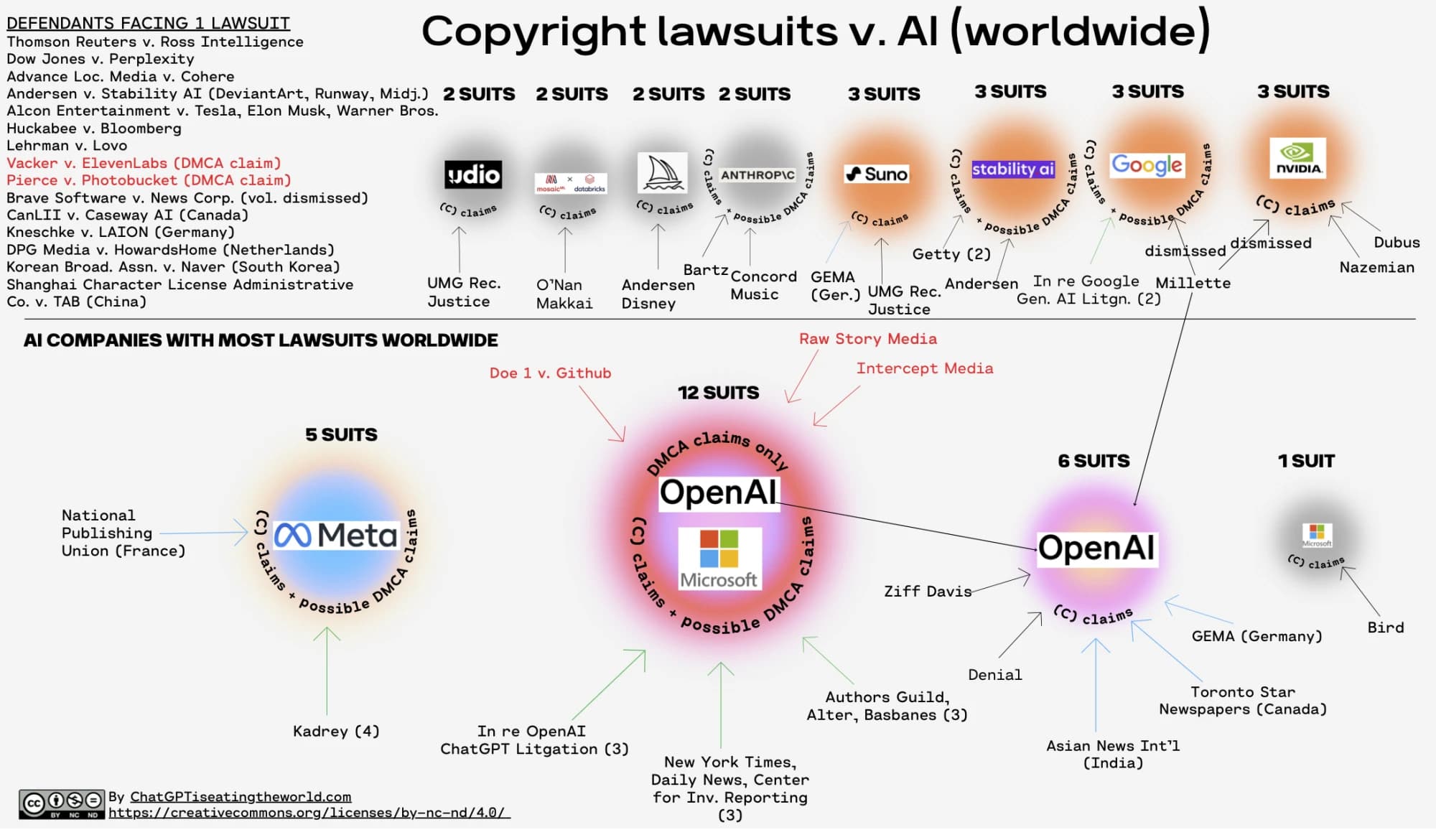
Copyright lawsuits v. AI worldwide, by defendant (as of July 7, 2025). Infographic by ChatGPTiseatingtheworld.com, licensed CC BY-NC-ND 4.0.
Why Fair Use Is Genuinely Uncertain
U.S. copyright law's Section 107 permits copying without a license in four circumstances: when the use is transformative, when it uses only as much of the work as necessary, when the work is factual rather than expressive, and when it does not harm the market for the original. AI companies lean heavily on the transformative-use argument, contending that extracting statistical patterns from a corpus is fundamentally different from reproducing the text itself. Courts have recognized transformative use in contexts from search-engine caching to news commentary, and the argument is not frivolous.
The problem is that the market-harm factor cuts the other way. When a language model trained on New York Times journalism can generate text indistinguishable from Times reporting — reducing a reader's incentive to subscribe — the argument that training did not harm the market for the original becomes difficult to sustain. Courts evaluating this factor weigh substitution effects carefully, and several judges have allowed cases to proceed precisely because the plaintiffs made a plausible market-harm argument. The transformative-use defense that served technology companies well in earlier decades was designed for cases involving a few works, not systems trained on billions. Whether doctrine stretches that far is what the litigation is actually deciding.
The Training Data Liability Stack
The copyright exposure in AI is not uniform across the stack. It concentrates at different layers, and understanding where it sits helps founders and investors assess their actual risk. The table below maps the three principal layers and the legal theory most active at each.
| Layer | What it is | Primary liability theory | Who carries it |
|---|---|---|---|
| Training corpus ingestion | Copying third-party content to construct a training dataset | Direct infringement (reproduction right) | Foundation lab |
| Model weights | Statistical parameters derived from ingested content | Derivative-work argument; stored expression | Foundation lab |
| Inference output | Generated text, images, or code that reproduces training-data fragments | Direct or contributory infringement depending on output | Lab and potentially API consumer |
The key insight this framework surfaces is that most of the liability concentrates at Layer 1 and Layer 2 — both of which sit with the labs that actually ran the training jobs. Companies building products on top of third-party APIs through the artificial-intelligence ecosystem are mainly exposed at Layer 3, and their exposure there is conditional on what their products are doing with model outputs. A company using a language model to summarize legal filings faces a different risk profile than one using it to reproduce news articles verbatim. Knowing which layer your business touches is the first task of any honest due diligence.
What Licensing Deals Already Tell Us
The most revealing signal in this dispute is not the litigation — it is the licensing deals being struck while litigation proceeds. OpenAI signed multi-year content agreements with the Associated Press, Axel Springer, and a range of regional publishers. These deals cover both retrospective use in training and prospective access to real-time content. Their existence implies two things: that OpenAI's legal team assessed the litigation risk as material, and that both sides could find a price that made settlement rational.
The pricing signals from these deals are not public in detail, but structural analysis of the synthetic data economics alongside licensed-content valuations suggests that quality training data from authoritative sources commands a substantial premium over scraped web data. That premium will only increase as the data-quality ceiling matters more than raw volume for the next generation of models. A world in which AI labs compete partly on the quality and breadth of their licensed-content relationships is a meaningfully different competitive landscape than the one that prevailed when everybody scraped Common Crawl for free.
The Investment Overhang
For investors evaluating AI valuations, unresolved copyright liability belongs on the risk register alongside compute costs and competition from open-source models. The problem is asymmetric: the upside from a favorable court ruling or a legislative safe harbor is modest (it confirms the status quo), but the downside from an unfavorable ruling is potentially severe. Statutory damages under U.S. copyright law can reach $150,000 per work for willful infringement, and the sheer number of works in any major training corpus means the theoretical exposure is large enough to matter even on heavily discounted expected-value calculations.
M&A due diligence on AI companies has begun to reflect this reality. Acquirers are requesting documentation of training-data provenance, licensing agreements, and any takedown or opt-out requests the target received and how they were handled. Founders planning an exit who cannot produce clean data lineage face either negotiated indemnification carve-outs or valuation haircuts. Neither outcome is catastrophic, but both are avoidable by teams who have tracked provenance from the start.
Caveats
Several important uncertainties limit how confident anyone should be about the trajectory here. The legal outcomes are not resolved, and fair use analysis is fact-specific enough that similar-seeming cases can go different ways depending on circuit, judge, and the specific works at issue. Non-U.S. jurisdictions are developing their own frameworks at different speeds: the EU AI Act's transparency requirements do not map cleanly onto U.S. fair use doctrine, and Japan has taken a broadly permissive view of AI training that may attract labs seeking regulatory arbitrage. The possibility of a legislative resolution — a statutory licensing framework for AI training data — is real but would require congressional action that has been consistently deferred. Analysts who claim high confidence in any particular outcome are outrunning the evidence.
Sources
- U.S. Copyright Act, Section 107 (Fair Use): https://www.copyright.gov/title17/92chap1.html#107
- EU AI Act, Article 53 (General-Purpose AI Models): https://eur-lex.europa.eu/legal-content/EN/TXT/?uri=CELEX:32024R1689
- U.S. Copyright Office, Copyright and Artificial Intelligence (Part 2 — Copyrightability): https://www.copyright.gov/ai/
- The Authors Guild v. OpenAI, U.S.D.C. S.D.N.Y. (filed 2023)
- The New York Times Company v. Microsoft Corporation and OpenAI, U.S.D.C. S.D.N.Y. (filed December 2023)
- Getty Images (US), Inc. v. Stability AI, Ltd., U.S.D.C. D. Del. (filed February 2023)
Further Reading
- The Economics of AI Model Commoditization — how training-data costs interact with the broader race to the bottom in foundation model pricing
- Synthetic Data and AI Training Economics — when generated data can substitute for licensed corpora and at what quality threshold
- AI Valuation Reality — how unresolved liability fits into the broader picture of AI company valuation risk
- AI Model Commoditization and the large language models concept page for background on how foundation models are structured
The Bottom Line
The AI copyright reckoning is not a threat to the existence of foundation models, but it is a structural adjustment to how they are built and financed. The most likely resolution is a licensing-based equilibrium in which AI labs pay rights holders for access to high-quality, curated training corpora — either through private deals or a statutory framework — and those costs become a standard input into model economics. Labs with the most defensible proprietary data moats will be best positioned; labs that relied entirely on scraped data face the highest restructuring cost.
For founders, the practical implication is narrow: audit your training data provenance, understand which layer of the liability stack your product touches, and make sure your vendor contracts include meaningful representations about data sourcing. For investors, unresolved copyright exposure is a real overhang on AI companies with unclear data lineage, and it should be priced accordingly alongside the more visible risks from model commoditization and compute costs. The courts are writing the rules that will determine the cost structure of AI for the next decade. The smart bet is not on any particular outcome, but on adapting to a world in which training data has a price.
Explore Related Concepts
Frequently Asked Questions
What is the AI training data copyright dispute about?
AI labs scraped massive amounts of copyrighted text, images, and code from the internet to train foundation models. Copyright holders argue this was infringement; AI companies argue it was transformative fair use. Several major lawsuits — including suits by the New York Times, Getty Images, and a class of authors — are working through U.S. courts.
What is the fair use argument in AI training cases?
Fair use under U.S. copyright law permits copying without a license when the use is transformative, does not substitute for the original, and does not harm the market for the original work. AI companies argue that training a statistical model on text is transformative use that creates something fundamentally new from the inputs.
Have AI companies signed licensing deals with publishers?
Yes. OpenAI signed content-licensing deals with several major news organizations including the Associated Press and Axel Springer. Shutterstock partnered with NVIDIA and others on licensed image datasets. These deals suggest that market-clearing prices for AI training data exist and that both sides can find a negotiated floor.
How does training data liability affect AI startup founders?
Founders building on top of third-party foundation models carry lower direct copyright exposure than the labs that actually trained the weights. However, if liability becomes a standard cost item for labs, the increase will flow through in higher API pricing, more restrictive terms of service, and tighter usage policies on fine-tuning and retrieval.
What does the EU AI Act require about training data?
The EU AI Act requires providers of general-purpose AI models to publish a summary of the content used to train their systems. This transparency obligation does not resolve copyright disputes directly, but it makes it substantially easier for rights holders to identify unauthorized use of their work and bring well-targeted claims.
Could AI companies lose these lawsuits?
Yes, and the outcome is genuinely uncertain. A ruling that training-data ingestion was not fair use could expose defendants to statutory damages large enough to threaten their business models. The more likely trajectory is negotiated licensing regimes or a statutory framework similar to the compulsory-license model that governs music sampling.