The One-Person Billion-Dollar Company: How AI Is Rewriting the Laws of Business
A new kind of company is emerging — one where scale is no longer limited by people, but by intelligence itself.

Most revolutions in business did not announce themselves as revolutions — they arrived disguised as efficiency. The factory made production faster. The internet made distribution instant. Cloud computing made infrastructure invisible. Each one quietly reshaped the company without ever declaring war on it.
Artificial intelligence is different. It does not merely improve the company; it replaces the need for the company as it has existed for 200 years. For the first time, the work a business does can be decoupled from the people a business employs — and that single change rewrites the rules underneath everything else.
The End of Organizational Gravity
For most of modern history, companies were constrained by a single force: human coordination. Every function required people, every new customer required more support, and every new market required more staff. Growth was inseparable from organizational expansion. This created what can be called organizational gravity — the heavier a company became, the harder it was to move.
That gravity is now weakening. AI systems are beginning to absorb the functions that once required entire departments, and execution is no longer bound to payroll. A new structure is emerging: a company that scales without expanding its human core.
The Collapse of Headcount Economics
The traditional model of business was built on a simple equation: more revenue requires more employees. This assumption shaped everything — management theory, corporate hierarchy, venture capital, even education. And it is now breaking.
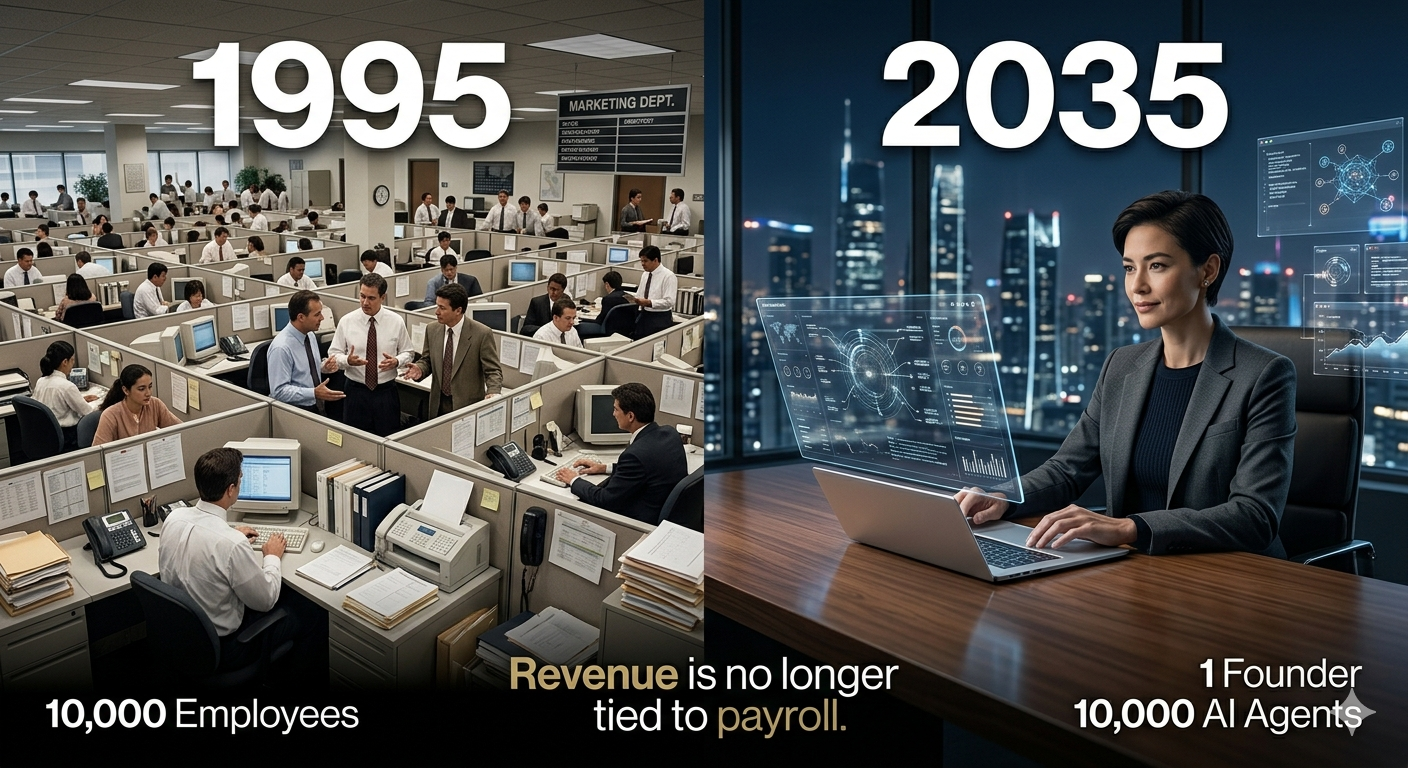
Modern AI systems can already perform work once reserved for specialized teams — writing and distributing marketing campaigns, building and maintaining software, handling customer support at global scale, conducting financial analysis, localizing content, and running endless optimization loops:
- Writing and distributing marketing campaigns
- Building and maintaining software systems
- Handling customer support at global scale
- Conducting financial analysis and reporting
- Translating and localizing content
- Running A/B testing and optimization loops
As the cost of intelligence collapses toward near-zero marginal expense, the value of labor-based scaling declines with it. When intelligence becomes abundant, hiring stops being the default answer to growth.
The AI-Native Company Model
A new organizational form is emerging quietly — not a startup, not a corporation, but something closer to a system orchestrator. In this model, the founder does not hire teams in the traditional sense. Instead, they deploy and coordinate autonomous AI agents, setting direction while the system handles the work — the same skill-matching and clear-objectives discipline behind effective task delegation, just applied to machines instead of people.
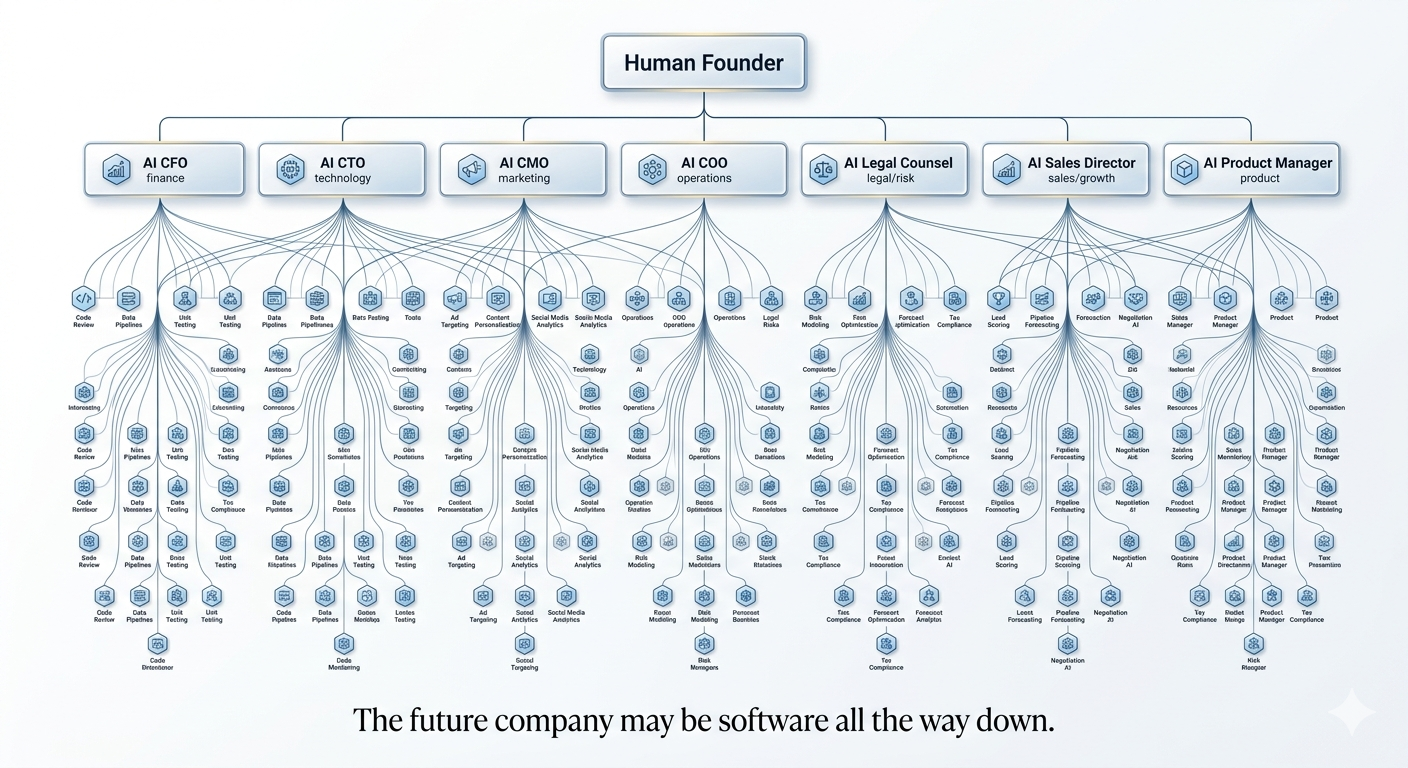
The structure flows from a single human founder, down through an AI strategy layer, into AI execution systems, continuous optimization loops, and finally a global customer interface. The company becomes less like an organism and more like software — something you configure and run, rather than a workforce you manage.
Why Scale No Longer Requires People
In traditional companies, growth creates friction. Communication overhead increases, management layers multiply, decision speed slows, and coordination costs rise. This is why large companies so often become slower over time: each new layer of people adds drag that the previous one did not anticipate.
AI systems invert this dynamic. Instead of adding friction, they reduce it; instead of slowing growth, they accelerate it; and instead of requiring management layers, they replace them with automation. The result is a new kind of scaling curve, where growth triggers more intelligence deployment, which triggers automatic execution, which compounds into stronger systems.
The First One-Person Unicorns
The earliest signals are already visible. Small teams are building companies that would previously have required hundreds of employees — AI-driven SaaS platforms, automated content networks, agent-based marketing systems, and fully automated analytics companies. What is changing is not ambition, but leverage.

A single founder with the right systems can now access enterprise-grade engineering capacity, global marketing distribution, round-the-clock customer operations, and real-time analytics — all without a single hire. The bottleneck is no longer execution. It is direction.
The New Scarcity: Judgment
When execution becomes cheap, judgment becomes expensive. The most valuable skill shifts from doing work to deciding what work should exist in the first place. In a world where any task can be automated, choosing the right tasks becomes the entire game.
This creates a new hierarchy of value, led by strategic clarity and system design, followed by decision quality, taste and prioritization, and only then execution — which is increasingly automated, echoing the case that introverted leaders tend to outperform on precisely these traits — depth over reflex, judgment over volume:
- Strategic clarity
- System design
- Decision quality
- Taste and prioritization
- Execution (increasingly automated)
The future founder is not a manager of people. They are an architect of decisions.
The Economic Implications
If one person can operate what previously required hundreds of employees, several structural shifts follow. Mid-sized companies lose their advantage, large corporations face new structural inefficiency, solo founders gain unprecedented leverage, and capital efficiency becomes extreme. None of this eliminates large companies entirely — but it compresses the middle.
The business world becomes polarized as a result. On one end sit extremely large AI systems; on the other, extremely small high-leverage companies. There is very little left in between, and the comfortable mid-sized firm is the first casualty.
The System Becomes the Company
In the AI-native model, the company is no longer a social structure — it is a technical system. The old flow ran from departments to managers to employees to outputs. The new flow runs from intent to AI systems to outputs to optimization loops, with each cycle feeding the next.
The organization becomes self-adjusting. The founder sets direction, and the system handles execution, learning and correcting as it goes. Management, in the traditional sense, simply dissolves into the architecture.
The Risk of Extreme Leverage
This model introduces a new imbalance. If a single person can control billion-dollar-scale output, the concentration of power increases dramatically — and that raises hard questions. Who governs AI-driven companies? How is accountability enforced when there are no employees to check the founder? What happens when one person controls global-scale systems?
The shift, in other words, is not only economic. It is political and structural, and the tools for overseeing it do not yet exist. As these companies grow, the gap between their reach and our ability to govern them will only widen.
The Historical Pattern
Every major technological shift reduces the amount of human labor required to create value. Agriculture gave way to mechanization, manufacturing to automation, and software to abstraction. Each step reduced our dependency on human effort, freeing people to work higher up the chain.
AI breaks the pattern in one crucial way. It is the first system that reduces dependency not on human muscle, but on human cognition itself. That is what makes the future of work under AI different in kind, not just degree.
The Final Form of the Company
If the trend continues, the company of the future may resolve into a strikingly simple shape: one human founder, thousands of AI agents, zero traditional departments, a fully automated execution layer, real-time global operations, and continuous self-optimization. Everything that used to be an org chart becomes a system diagram.
In that configuration, the founder becomes less of a leader and more of a control system — the single point of intent steering an engine that runs itself.
The Bottom Line
The one-person billion-dollar company is not a prediction of efficiency. It is a prediction of structure. When intelligence becomes abundant, organizations stop being collections of people and become collections of systems, and the role of the human shifts from execution to direction.
The companies that dominate the next era will not be the largest in headcount. They will be the most leveraged in intelligence. In that world, scale will no longer be measured by how many people you employ — but by how much reality you can influence through systems alone.
Explore Related Concepts
Frequently Asked Questions
Can one person really run a billion-dollar company?
Yes. With AI agents handling operations, execution, and scaling tasks, a single founder can theoretically manage global-scale businesses by orchestrating intelligent systems instead of human teams.
What is an AI-native company?
An AI-native company is built from the ground up around automation and autonomous systems, where AI performs most operational functions traditionally handled by employees.
What skills matter most in a one-person AI company?
Judgment, strategic clarity, system design, and taste. When AI handles execution, the founder's value shifts from doing the work to deciding what work should exist and directing the systems that perform it.
Will AI-native companies replace large corporations?
Not entirely. They are more likely to compress the middle — squeezing out mid-sized firms while leaving very large AI systems and very small high-leverage companies. The business world becomes polarized rather than uniformly automated.