Business strategy: the Value Stick
The best companies do not win by beating competitors on price. They win by stretching a single measure — the gap between what customers will pay and what suppliers will accept — wider than anyone else can.
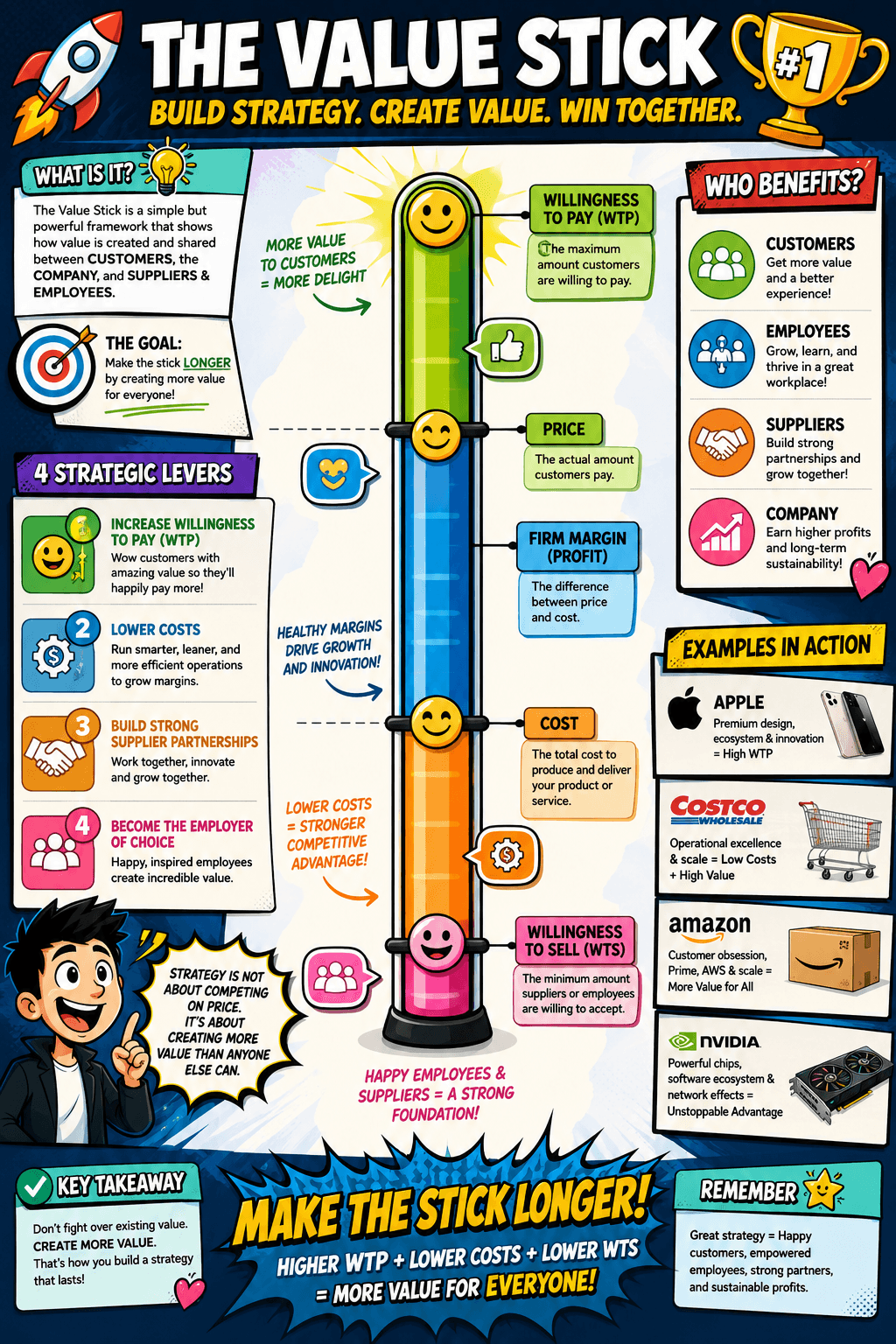
Every durable company, from a disruptive startup to a trillion-dollar incumbent, shares one trait: a deliberate business strategy that creates more value than its rivals and is built to last. The mistake most organizations make is competing on the obvious axis — cutting price or buying more marketing — when the companies that pull away compete on something deeper. They expand the total value available to everyone in their orbit, then defend the gap. The clearest way to see and act on this is the Value Stick, the framework popularized by Harvard Business School professor Felix Oberholzer-Gee in Better, Simpler Strategy. Instead of asking "how do we beat competitors," it asks the better question: how do we create so much value that competitors cannot keep up?
This is a guide to thinking that way — what business strategy actually is, how the Value Stick measures value creation, the four levers it hands you, and how the best companies use it to build advantages that compound.
What business strategy really is
Business strategy is the long-term set of choices that determines how a company creates, delivers, and captures value while holding an advantage rivals cannot easily replicate. It is not a mission statement, an annual plan, or a budget, though it informs all three. A real strategy answers a handful of hard questions: who the ideal customer is, what unique value the company creates, why customers choose it over alternatives, how it earns durable profit, and — the question most often skipped — why competitors cannot simply copy the formula.
The defining feature of strategy is choice, and specifically the choice of what not to do. A company that pursues every opportunity, serves every customer, and matches every competitor move has no strategy; it has activity. Strategy is the discipline of concentrating resources on the few things that generate the most value and deliberately declining the rest, which is uncomfortable precisely because it means turning down plausible options. The trade-offs are the strategy.
The Value Stick framework
The Value Stick reframes strategy as a single, measurable quantity: the total value a company creates, shown as a vertical "stick" with four points on it. At the top is willingness to pay, the most a customer would spend, and the gap down to price is the customer's delight. Below price sits cost, and the gap between them is the firm's margin. At the bottom is willingness to sell, the least suppliers or employees would accept, and the gap up from there to cost is their surplus. The diagram below shows the four points and the three slices of value they divide.
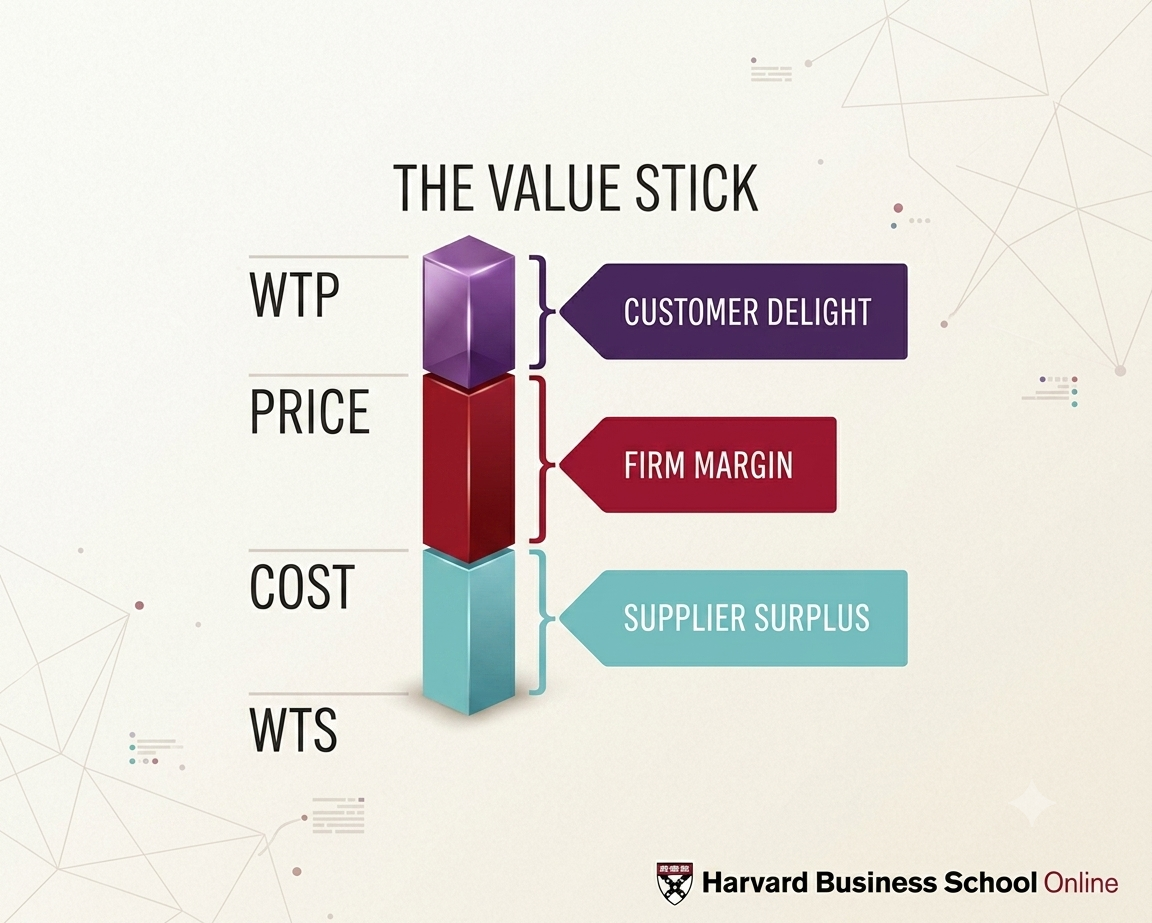
The length of the stick — the distance from willingness to pay down to willingness to sell — is the total value created, and the entire game is to stretch it. Oberholzer-Gee frames value for customers as the gap between how much they appreciate a product and what they actually pay for it; the same logic runs in reverse for the people who supply and build it. As the HBS framing of value-based strategy puts it, the objective is not merely to grab a bigger slice but to make the whole stick longer, because a longer stick gives every stakeholder more to share. Price and cost are then just decisions about how the created value is divided, not the source of the value itself.
The four levers
Because the stick has two ends, you can stretch it from the top or the bottom, which gives strategy four practical levers. Each one moves value to a different stakeholder, and the strongest companies work several at once.
Raise willingness to pay
The most direct way to lengthen the stick is to make customers value the product more, which widens the room above the price. Companies raise willingness to pay through better quality, design, and reliability, but also through brand, trust, experience, community, and ecosystems that make leaving costly. The higher customers value what you offer, the less price-sensitive they become, which is the real foundation of pricing power. The question to keep asking is simple and demanding: why would a customer gladly pay more?
Cut cost without cutting value
Lowering the cost of producing and delivering the product widens margin from the middle without touching what the customer experiences. Automation, lean operations, better logistics, smarter forecasting, and economies of scale all reduce cost in ways the customer never sees or feels. The discipline here is the qualifier: a cost cut that quietly degrades the product is not strategy, it is decline, because it shortens the stick from the top even as it lifts margin from the middle. Strategic cost reduction protects or improves customer value while removing waste behind the scenes.
Lower supplier willingness to sell
Suppliers have their own willingness to sell — the minimum they will accept — and lowering it stretches the stick from the bottom. The counterintuitive part is that the best way to lower it is rarely to squeeze harder on price. Long-term contracts, stable and predictable demand, faster payment, shared forecasting, and joint innovation make a company the partner suppliers most want to work with, which lowers the effective terms they require. Treating suppliers as innovation partners rather than costs to be minimized tends to reduce real operating cost while improving reliability.
Become the employer of choice
Employees are the other half of willingness to sell, and talent has become one of the most decisive advantages a company can hold. As the HBS treatment of willingness to sell explains, firms lower employees' willingness to sell not by paying less but by becoming places people genuinely want to work — through meaningful work, strong leadership, growth, flexibility, and psychological safety. People who want to be there create disproportionate value: more innovation, better customer experiences, stronger execution. The best employees stretch the stick from the bottom and the top at once, because the work they do raises customer willingness to pay too.
Create value, then capture it
The most common strategic error is to obsess over value capture — how much profit the company keeps — before the value even exists. Capture is a question of division: how the created value is split among customers, employees, suppliers, and investors. It matters, but it is fundamentally zero-sum, a fight over a fixed pie.
Value creation is the opposite: it enlarges the pie itself, increasing the total economic value available to everyone in the system. The companies that focus first on creating more value almost always capture the largest profits over time, because a bigger stick gives them room to reward every stakeholder and still keep more. The strategic sequence is therefore creation before capture — stretch the stick, then decide how to share it. This is also where the discipline of capital allocation lives, in choosing which value-creating investments to fund and which to forgo.
The moats that make it durable
Stretching the Value Stick is only half the job; the other half is keeping competitors from stretching theirs to match. This is the work of building economic moats — advantages that are genuinely hard to replicate rather than discounts or campaigns anyone can copy. The strongest of these is the network effect, where a product becomes more valuable to every user as more users join. Marketplaces, payment systems, collaboration tools, operating systems, and developer ecosystems all share this property, and it compounds: every new user raises the value for existing users, which attracts more users, which is why network effects are among the most durable moats in business.
Complements are the other underrated source of advantage. A complement is anything that makes your primary product more valuable — apps for a smartphone, charging networks for an electric car, cloud infrastructure for AI software. Rather than building everything in-house, a company can let an ecosystem of complementary products grow its market for it, which is the logic behind much of modern platform economics. A strong complement raises customer willingness to pay for your core product without your having to lift a finger, and an ecosystem of them is far harder to dislodge than any single feature.
Why most strategies fail
Most strategies fail for the same underlying reason: companies confuse activity with strategy. They compete only on price, which erodes the very margin strategy is meant to protect, or they copy competitors, which guarantees they can never pull ahead. They chase every opportunity instead of concentrating on the few that create the most value, and they fixate on quarterly profit while underinvesting in the employees and suppliers whose willingness to sell determines half the stick.
The deeper failure is the absence of trade-offs. A strategy that requires no hard choices, offends no one, and keeps every option open is not a strategy at all, and it shows up as a company with no real differentiation and no measurable strategic goals. Stretching the Value Stick demands deciding what to be excellent at and, by extension, what to be merely adequate at or to skip entirely. The companies that win are the ones willing to make those calls and then execute them consistently, which is harder and rarer than it sounds. The day-to-day work of turning this thinking into sharper decisions is something we cover in the business strategy prompt library, and the relationship between evidence and these choices in our look at business strategy versus market research.
The Value Stick in the wild
The framework is easiest to see in companies that have stretched their sticks unusually far. Apple raises willingness to pay through design, software integration, privacy, and an ecosystem that makes leaving costly, so customers pay a premium because perceived value runs well ahead of price. Costco works the other ends: relentless operational efficiency keeps cost low while bulk pricing and membership deliver enormous customer value, and predictable high-volume demand lowers its suppliers' willingness to sell.
Amazon expands customer willingness to pay through convenience, logistics, and Prime while its scale drives down cost and strengthens supplier relationships, lengthening the stick from nearly every point at once. NVIDIA combines leading hardware with developer tools, software platforms, and an ecosystem of complements, producing a mix of innovation, network effects, and switching costs that rivals have struggled to replicate. In each case the pattern is the same: durable advantage comes from creating more total value, not from winning a price war, and from building moats that keep the stretched stick stretched.
The Bottom Line
Business strategy, stripped to its core, is the work of creating more value than your competitors and keeping them from catching up. The Value Stick makes that abstract goal concrete: raise what customers will pay, lower what suppliers and employees will accept, cut cost without cutting value, and the gap you open is the value you have created to share. Apply it by identifying who creates value in your ecosystem, measuring your own stick today, finding the largest opportunity to stretch it, and reinforcing the moats — network effects, complements, talent — that keep it from snapping back. The companies built to last are not the ones fighting hardest over a fixed pool of value; they are the ones quietly making the pie bigger for everyone, and capturing the largest share precisely because they do. For more on turning this into decisions, start with the business hub.
Explore Related Concepts
Frequently Asked Questions
What is business strategy?
Business strategy is a long-term plan for how a company creates, delivers, and captures value while building a competitive advantage rivals cannot easily copy. At its core it is a series of deliberate choices about where to compete and, just as importantly, what not to do.
What is the Value Stick framework?
The Value Stick is a framework, popularized by Harvard Business School professor Felix Oberholzer-Gee, that measures value creation along four points: customer willingness to pay, price, cost, and supplier or employee willingness to sell. The total value a company creates is the distance between the top (willingness to pay) and the bottom (willingness to sell).
What is willingness to pay (WTP)?
Willingness to pay is the maximum amount a customer would spend on a product because of the value they perceive in it. Raising willingness to pay — through quality, brand, experience, or trust — is the most direct way to build pricing power.
What is willingness to sell (WTS)?
Willingness to sell is the minimum compensation employees or suppliers will accept to work with or supply a company. Firms lower it not by paying less, but by becoming organizations people genuinely want to work with — through good culture, stable demand, and fair terms.
Why is value creation more important than value capture?
Value capture only decides how a fixed pie is divided, which is a zero-sum fight. Value creation enlarges the pie itself, and companies that consistently create more total value tend to capture the largest profits over time without having to squeeze any single stakeholder.
How do network effects create competitive advantage?
A network effect means a product becomes more valuable to each user as more users join, as with marketplaces, payment systems, and social platforms. This makes the product progressively harder for competitors to displace, because matching the feature is not the same as matching the installed base.