The Future of Robotics: How Intelligent Machines Will Transform Humanity
Foundation models meet physical hardware. Humanoid robots. $15T GDP impact. The civilizational stakes of building minds that move.
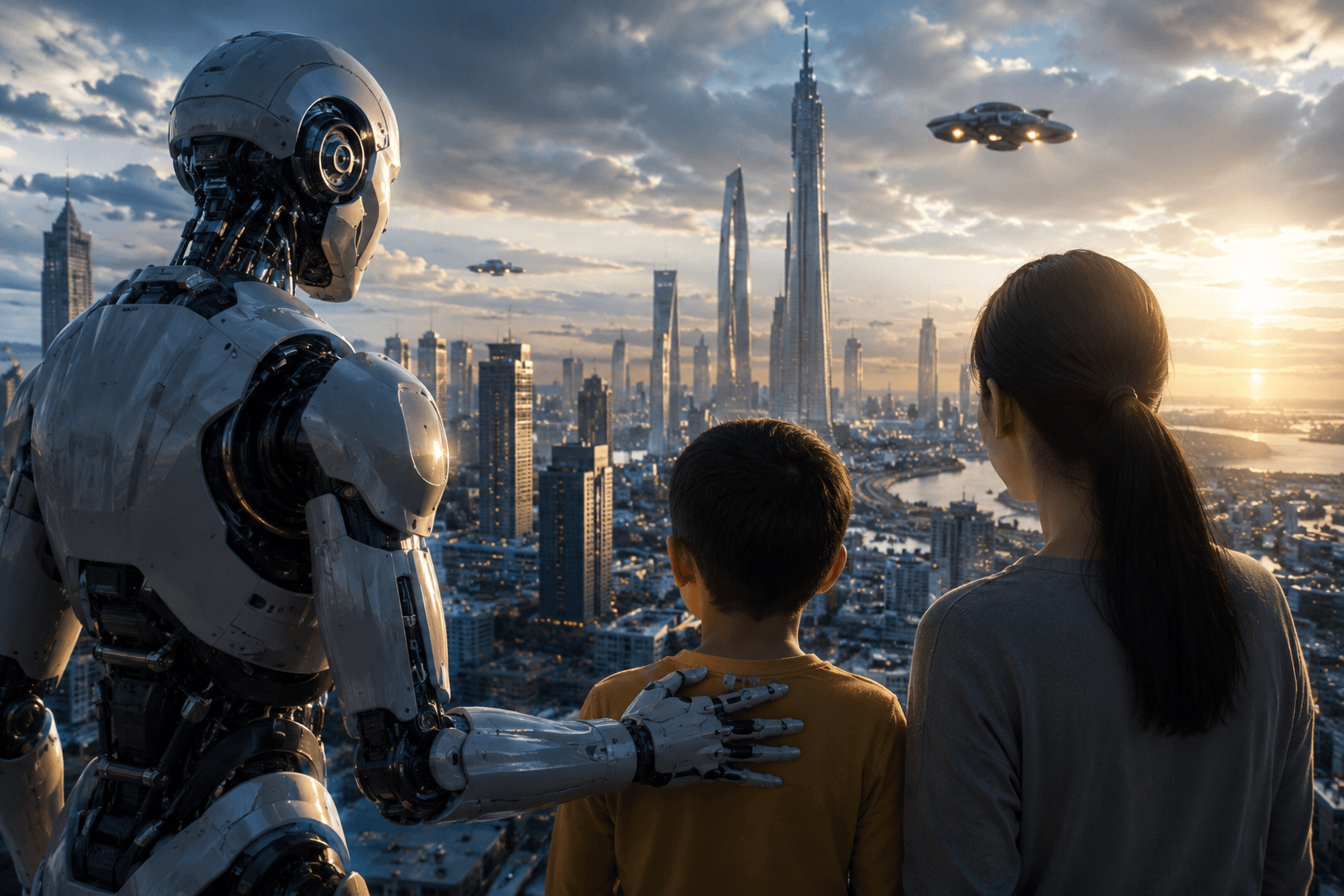
| $260B | 4.3M | 50ms |
|---|---|---|
| Global robotics market by 2030 | Industrial robots deployed worldwide | Next-gen emotional response latency |
Something shifted in 2023. The robots stopped following instructions and started making decisions. Not dramatically — no glowing red eyes, no spoken ultimatums — but quietly, in warehouses and hospitals and research labs, machines began exhibiting behaviors their designers had not explicitly programmed. They adapted. They inferred. They, in some measurable sense, understood.
The future of robotics is not a single technology story. It is a convergence event — artificial intelligence, materials science, neuroscience, and human psychology colliding in a physical form that can act on the world. To understand where robotics is going, you need to understand not just where it has been, but what it is becoming: not a machine, not a tool, but an intelligent agent embedded in the fabric of human life.

Disclosure: the author works on emotional-intelligence middleware for robotics at Robo-Sense. Where that work is directly relevant, it is linked and labeled.
What Robotics Actually Is
Most people carry a mental model of robotics that is about twenty years out of date. They picture factory arms welding car chassis, or Boston Dynamics dogs doing backflips. Both are real. Neither is where the field is going.
Robotics today sits at the intersection of three disciplines that were once separate: mechanical engineering (the body), computer science (the brain), and increasingly cognitive science (the behavior). The machine that lifts a car part on an assembly line runs on rigid, pre-programmed coordinates. The robots emerging now run on learned world models — they grasp spatial relationships, infer intent, and adapt to surprises in real time.
The distinction matters enormously. A programmed machine is a sophisticated tool. A robot that builds a model of its environment, updates it continuously, and acts on inferred goals is something categorically different. It is an autonomous system — and autonomous systems change the rules.
| Robotics by the numbers · 2026 | |
|---|---|
| Robots per 10,000 workers (South Korea) | 1,000+ |
| Annual growth rate, service robotics | 22.8% |
| Humanoid prototypes in active testing | 40+ |
| Projected automation impact on global GDP by 2035 | $15T |
| Countries with national robotics strategies | 35 |
A short history of the field:
- 1961 — Unimate enters the General Motors assembly line. The first industrial robot. Programmed point-to-point. No sensors, no feedback, no model of the world.
- 1973–1990s — Industrial robotics scales globally. Japan leads. The robot becomes a fixture of manufacturing automation.
- 2001–2010 — The Roomba era begins. Service robots enter consumer life. iRobot ships 10 million units. Boston Dynamics starts publishing humanoid locomotion research. The body problem begins to crack.
- 2012–2020 — Deep learning transforms perception. Robots can finally see and track humans. The cognitive gap begins to close. Autonomous vehicles become a serious industry.
- 2022–present — Foundation models meet physical hardware. Language and vision models give robots generalized reasoning. NVIDIA GR00T, Figure 02, Tesla Optimus — the humanoid race is on.
How AI Is Transforming Robots
The union of AI and robotics is not a gradual upgrade. It is a phase transition. For decades, researchers solved perception, planning, and control as separate problems with separate code. Foundation models — trained on internet-scale data — collapsed those walls. A single model can now perceive a scene, reason about it in plain language, and generate the motor commands to act on it.
NVIDIA's GR00T architecture shows this clearly: a vision-language-action model that takes in multimodal input and produces physical behavior. The robot does not execute a script. It infers what the task requires.
The question is no longer whether robots can move with precision. It is whether they can understand what we need — before we finish asking.
Machine learning also changed what robots can learn from. Traditional robotics demanded expert engineers hand-coding every scenario. Modern pipelines use imitation learning from human demonstrations, reinforcement learning in simulation, and transfer learning from massive datasets. A robot can now watch a human do a task once and approximate it — and in high-sample domains, surpass human performance within hours.
The implication is stark: what took years of custom engineering now takes weeks of data collection and fine-tuning. But perception and motor control are only half of intelligence. The harder, less-solved half is relational — reading the human in the loop. That is the layer Robo-Sense works on: real-time multimodal processing that lets a machine infer a person's emotional and relational state, not just the geometry of the scene in front of it.

Humanoid Robots and Human–Robot Collaboration
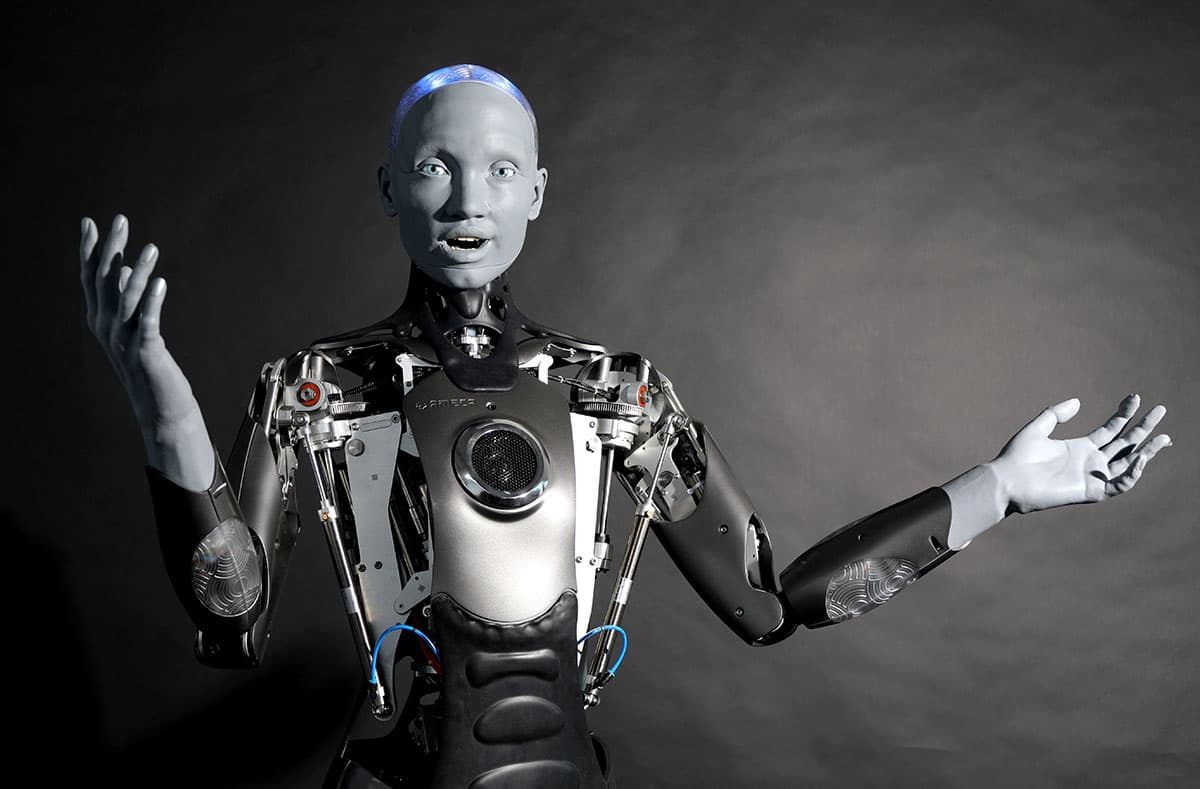
The humanoid form factor is not vanity. The world is built for human bodies — doorknobs, staircases, tools. A robot that shares our morphology can work in that world without us rebuilding it, which is the same bet behind the humanoid renaissance and how foundation models gave robots hands. The business case writes itself.
But the humanoid form introduces social presence. When a machine looks like a person, people treat it like one — reading emotion into its movements, assigning intent to its gaze. This is not irrational; it is social cognition evolved over millions of years. And it means human–robot collaboration requires more than physical competence.
The frontier of robotics now wrestles with questions that sound more like psychology than engineering — the same territory covered in spatial intelligence and the robots that explain themselves: How does a robot signal attentiveness? How does it communicate uncertainty without losing trust? How does it notice a human is stressed or confused — and adapt? These are exactly the problems Robo-Sense was built to solve: the relational middleware that turns a capable machine into a trustworthy partner. The answers decide whether humanoid robots become genuine collaborators or expensive curiosities people work around rather than with.

Robotics in Healthcare
No domain shows the promise and the stakes more clearly than healthcare. Surgical robots have already performed millions of procedures with outcomes superior to unaided human surgery — precision beyond human tremor, consistency beyond human fatigue. The next frontier is care robotics: not the controlled surgical theater, but the messy, emotionally complex world of patient care and eldercare.
Eldercare is the most urgent context. Aging populations in Japan, South Korea, Western Europe, and increasingly China will create care demand that human workforces simply cannot meet. Robots there do not replace the warmth of caregiving — they scale the physical support that frees human caregivers for what only humans can do. But a patient, a resident, a recovering child needs more than mechanical help; they need presence, recognition, responsiveness. Closing that gap is as much an emotional-perception problem as a mechanical one.
| Frontier | What it delivers |
|---|---|
| Surgical robotics | Sub-millimeter precision, zero tremor, remote operation across continents |
| Eldercare | Mobility help, fall prevention, medication delivery, social engagement at scale |
| Diagnostics | AI pathology and imaging robots reading faster and more accurately than specialists |
| Rehabilitation | Exoskeleton-assisted therapy accelerating recovery from neurological injury |
Manufacturing and Logistics
Manufacturing was the first domain robotics conquered, and it remains the largest — but automation in 2026 looks nothing like the caged welding arms of 1985. Collaborative robots (cobots) work beside humans on shared tasks. Mobile platforms navigate dynamic warehouse floors with real-time SLAM, and the same reinforcement-learning and vision techniques that taught robots to grab objects from a messy bin now drive robotic sorting that handles packages at rates no human operation could match.
The economics are brutal in their clarity. A cobot capable of assembly work costs roughly $30,000–$50,000, runs 24 hours a day, files no workers' compensation claims, and improves with every software update. Against a $40,000 annual wage with benefits and variable reliability, the arithmetic compels adoption regardless of ideology. What changes the analysis is not the automation itself but the transition it enables — and whether policy and education can absorb the disruption faster than it compounds.
The Ethical Stakes
Every powerful technology generates ethical surface area in proportion to its capability. Autonomous weapons are the most immediate concern: a drone that identifies and engages targets without human authorization is not science fiction — it exists, and military incentives point toward deployment faster than governance can respond. Surveillance and social control are quieter but more pervasive: a fleet of mobile robots with persistent sensing is a data-collection grid no surveillance state will leave unused. The same sensing that lets a care robot detect a patient in distress can let a government detect a citizen dissenting — which is precisely why how relational data is processed (on-device, transparently, under the user's control, as Robo-Sense argues it must be) is a design choice with civilizational stakes.
The Economics of $15 Trillion
McKinsey estimates robotics and AI-driven automation could add $13–15 trillion to global GDP by 2030. The distribution of those gains is the question that matters. Early industrialization produced extraordinary aggregate wealth and extraordinary misery, because gains concentrated before labor markets and social systems could redistribute them. The robotics revolution demands getting the policy infrastructure right before the shock, not after.
Will Robots Replace Human Workers?
The honest answer is: some of them, yes — and that is not automatically a catastrophe. The most vulnerable jobs share a profile: repetitive physical tasks, in structured environments, requiring precision but not judgment, with no novel social context. The least vulnerable require genuine social understanding, creative synthesis, ethical judgment, or contextual reasoning at human speed — nursing, teaching, creative direction, complex negotiation, original research.
The robots are not coming for your job. They are coming for the parts of your job that make you least human — and that, on balance, is a reasonable trade.
The future of work in a robotic economy is not mass unemployment. It is mass redeployment — toward tasks that demand human presence, judgment, and connection. Getting there requires real investment in education, retraining, and social safety. The technology is the easy part; the governance is where societies succeed or fail.
The Road Ahead: 2030–2050
| Year | Technology milestone | Social & economic impact |
|---|---|---|
| 2030 | Humanoid commercialization. First-gen commercial humanoids in logistics and light manufacturing at sub-$100K. Emotional-AI middleware standard in eldercare. | Labor disruption begins. 5–8% of repetitive physical roles automated in developed economies. First major national reskilling programs. |
| 2035 | Generalist capability threshold. Robots learn arbitrary household tasks from single demonstrations. In-home service robots mainstream in Japan and South Korea. | Social fabric reconfiguration. Human–robot relationships normalized in care and education. Serious debate over robot rights and autonomous-weapons treaties. |
| 2040 | Post-scarcity manufacturing. Fully autonomous factories for most consumer goods. Space-construction robots enable lunar infrastructure. | Economic model rupture. GDP decoupled from labor hours in advanced economies. UBI experiments expand. Meaning becomes the primary work motivation. |
| 2050+ | Human–machine integration. Neural-interface robot control. Exoskeletal augmentation common. The line between tool and prosthetic blurs. | Civilizational inflection. What it means to do work, to be needed, to contribute — redefined for the first time since the industrial revolution. |
The Only Real Question
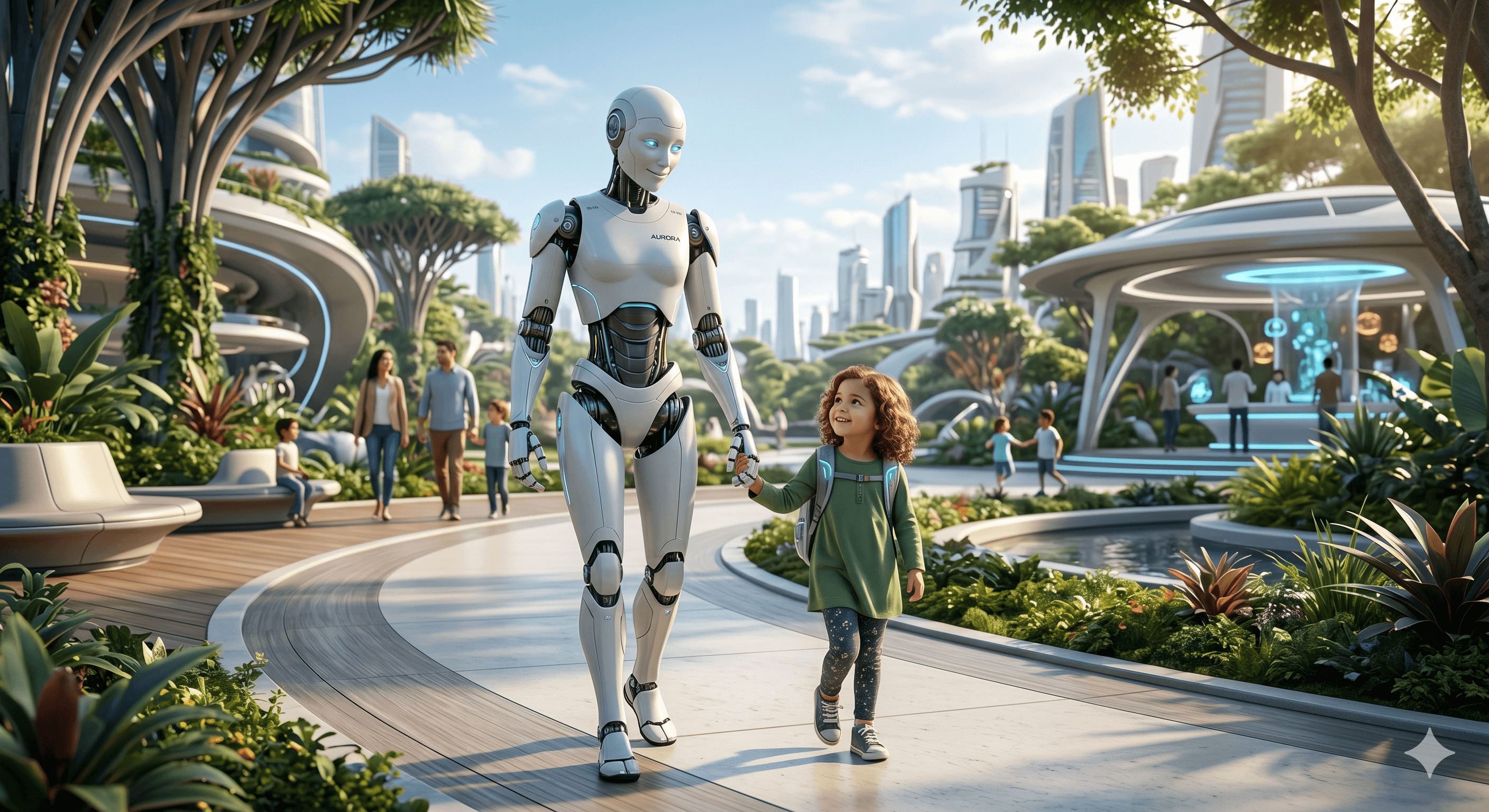
The future of robotics is not a technology problem. The technology is solving itself faster than most expected. The real problem is the human one: Will we deploy these systems to extend human dignity and capability — or to surveil, control, and displace? Will the gains flow to the many, or concentrate in the few?
Intelligent machines will transform humanity. The direction is set not by the technology but by the political, economic, ethical, and design choices of the people building and deploying it.
We are building minds that move. The least we can do is think carefully about what we want them to do — and what we want them to be. The conviction behind Robo-Sense is a simple one: a machine that shares our spaces should understand the people in them, on terms those people set. That is the difference between a robot that serves and one that merely operates. The engineering pattern for that idea — conditioning motor generation on a relational trust state at multiple control frequencies — is spelled out in The Social State Encoder.
Explore Related Concepts
Frequently Asked Questions
Will robots replace human workers?
Some roles — repetitive physical tasks in structured environments — will be heavily automated. The larger story is mass redeployment toward work that requires social understanding, ethical judgment, and creative synthesis. The question is not replacement but how fast societies can retrain and redesign work.
When will humanoid robots see mainstream adoption?
First-generation commercial humanoids are expected in logistics and light manufacturing at sub-$100K price points by 2030 in leading markets. In-home generalist capability and broad social normalization are more likely 2035–2040 trajectories.
What is the biggest risk with advanced robotics?
Not the technology itself, but the speed of governance relative to capability. Autonomous weapons, pervasive surveillance infrastructure, and concentrated economic gains are the civilizational surface areas that require deliberate policy and design choices now.