The Skill-Bifurcation Effect in AI Productivity
Adoption is nearly universal. Measurable productivity gains are not. The gap between those two facts has a name, and real research just gave it one.
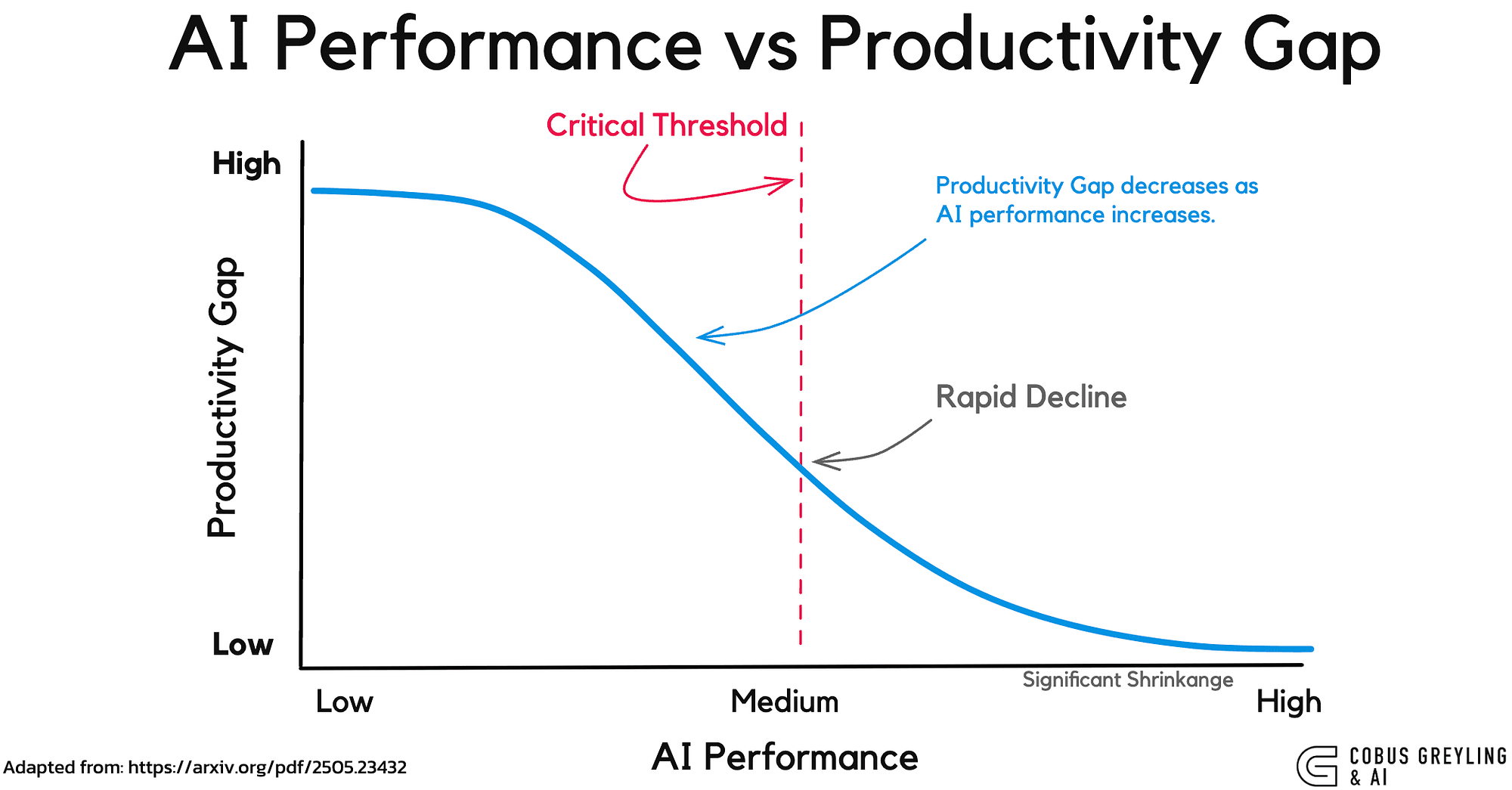
Generative AI has an average productivity effect, and averages are exactly the wrong way to look at it. Two of the most rigorous field studies published on this question both found the same underlying pattern: AI tools lift the performance of less experienced workers substantially, and do little or nothing — sometimes measurably worse — for the most experienced ones. Call it the skill-bifurcation effect. It is the most direct explanation available for a fact that otherwise looks contradictory: adoption of generative AI tools in the workplace is now close to universal, while most organizations report no measurable productivity gain from it at all.
What the Research Actually Found
The clearest evidence comes from a large field study by Erik Brynjolfsson, Danielle Li, and Lindsey Raymond, published through the National Bureau of Economic Research. Studying more than 5,000 customer-support agents given access to a generative AI assistant, the researchers found an average productivity gain of roughly 14 percent — but that average masked a sharp split. Novice and lower-skilled agents saw gains around 34 percent. The most experienced, highest-performing agents saw close to no improvement, and in some measures performed worse with the tool than without it.
A second, more surprising result comes from a 2025 randomized controlled trial by METR, an organization that evaluates AI systems' real-world capabilities. In the study, 16 experienced open-source software developers completed 246 real coding tasks on codebases they already knew well, working with and without AI assistance. The developers predicted beforehand that AI tools would make them roughly 24 percent faster. The measured result was the opposite: they were 19 percent slower using the tools than without them. Simon Willison's summary of the trial captures the core surprise — this wasn't a case of AI failing to help; it was a case of experienced practitioners' own judgment about the tool's benefit being measurably wrong.
Put the two studies side by side and the pattern is consistent even though the tasks and populations are completely different: generative AI compresses skill variance rather than raising every worker's output uniformly. It closes the gap between novices and experts by lifting the former, not by lifting everyone together.
Why This Explains the Adoption-Impact Gap
If the skill-bifurcation effect is real, it predicts something that has otherwise been a puzzle: organizations can have near-universal tool adoption and still report flat productivity numbers. That is exactly the pattern Microsoft's own 2026 Work Trend Index documents — roughly two-thirds of the variation in whether an organization sees real impact from AI traces back to organizational factors like management practice and workflow design, not to which tool was licensed or how many employees have access to it.
This lines up with the macro-level AI productivity paradox: if the real gains are concentrated among an organization's less experienced workers, and if most companies hand out tool licenses without redesigning the workflows those workers operate in, the aggregate productivity signal at the firm or economy level will look muted even while genuine, measurable gains are happening for a specific slice of the workforce. The gains aren't absent. They're uneven, and most measurement approaches average them away.
The Misconception: Adoption Is Not Impact
The most common error in how this topic gets covered is treating "our company uses generative AI" and "our company has become more productive because of generative AI" as the same claim. They are not, and the research above shows exactly where they diverge.
| Claim | What it actually measures | What it doesn't tell you |
|---|---|---|
| "X% of companies use generative AI" | Whether the tool is accessible to employees | Whether performance changed, or for whom |
| "Average productivity rose Y%" | An aggregate across all skill levels | Whether the gain is uniform or concentrated in one group |
| "Our workflows were redesigned around AI" | Whether the organization changed process, not just tooling | Directly predicts measurable impact, per Microsoft's own data |
A company can score high on the first row and still see nothing on the third — which is precisely the combination the skill-bifurcation effect predicts will produce a null result at the aggregate level, even when real, measurable gains exist for part of the workforce.
What This Means for Deploying AI at Work
The practical implication follows directly from the mechanism. If generative AI's real value is concentrated among less experienced workers and the organizations that redesign work around it, then the deployment decisions that matter are not primarily about which model or vendor to choose. They are about where in the organization the tool is deployed, and whether the surrounding workflow changes to use it.
Deploying a coding assistant to a team of senior engineers on a codebase they already know well — precisely the population and setting METR studied — is the case with the weakest evidence for a productivity gain, and some evidence for a loss. Deploying the same class of tool to newer, less experienced staff handling more routine, well-defined tasks — closer to the customer-support setting Brynjolfsson's team studied — is where the strongest documented gains sit. Treating both deployments as the same bet, because they use "the same AI," is the mistake the underlying research keeps surfacing.
The Bottom Line
The productivity story on generative AI is not "it works" or "it doesn't." It is that it works unevenly, in a specific and now well-documented direction: toward less experienced workers, away from the most experienced ones, and only reliably toward organizations willing to change how work is structured around the tool rather than simply distributing access to it. Adoption numbers will keep climbing regardless. Whether that shows up as real productivity, and for whom, depends on whether organizations act on the skill-bifurcation effect or keep measuring around it.
If the scarce input is judgment about what to build rather than raw output speed, that raises a harder question about what expertise is actually for — one we take up in what Steve Jobs would ask ChatGPT.
Related reading: The Artificial Intelligence hub, Building AI Systems That Actually Work, The AI Productivity Paradox: Why the GDP Payoff Is Running Late, AI Agents and the Workforce Shift
Explore Related Concepts
Frequently Asked Questions
Does generative AI actually make workers more productive?
It depends heavily on the worker's existing skill level. Field research on customer-support agents found large gains for novices and essentially no gain — sometimes a loss — for top performers, so a single average productivity number hides a real split rather than describing a uniform effect.
Why do some studies show AI tools slowing experienced workers down?
A 2025 randomized controlled trial of experienced open-source developers found they took 19% longer to complete tasks using AI tools than without, despite predicting the opposite beforehand — a documented case where expert judgment about AI's benefit did not match the measured outcome.
If adoption is so high, why do most companies report no productivity gain?
Adoption measures whether people are using a tool at all; it does not measure whether the surrounding workflow changed to take advantage of it. Research on organizational AI use has found that redesigning workflows around the tool, not just distributing licenses, is what predicts measurable impact.
Is this the same thing as the AI productivity paradox in GDP data?
It is a related but distinct question. The GDP-level paradox asks why AI investment has not yet shown up in macroeconomic productivity statistics. The skill-bifurcation effect operates one level down, inside individual firms, and helps explain why: gains exist for some workers today, but are uneven and often not captured at an organizational level, which is part of why they have not yet aggregated into a clear macro signal.