BestSuperintelligent.com and the Case for Evidence Over Hype
Instead of treating vendor promises as proven performance, BestSuperintelligent.com labels every claim by evidence tier, gives buyers practical selection tools, and makes its own limits visible.
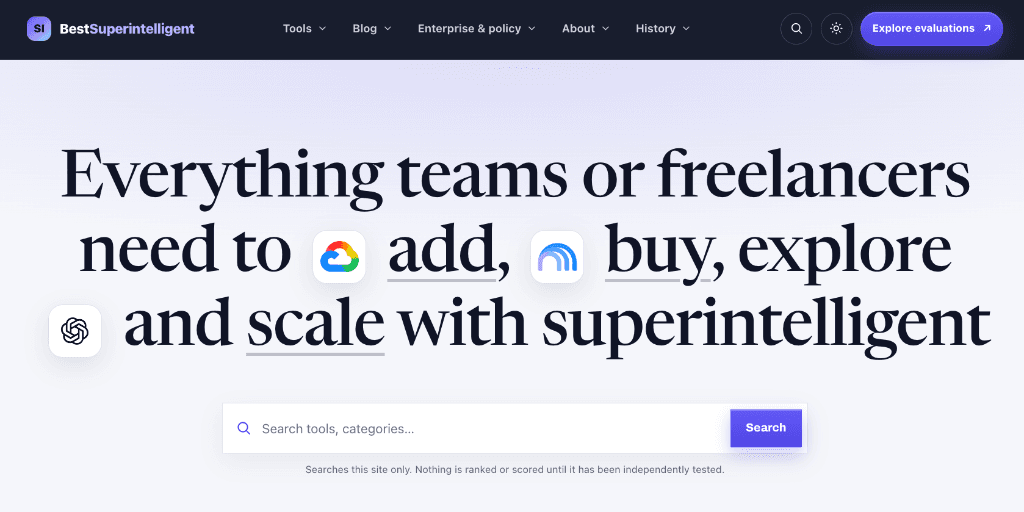
As artificial intelligence reshapes how people write software, conduct research, create content and run businesses, choosing the right tools has become a problem of its own. Developers face an expanding field of coding assistants and autonomous agents. Businesses must weigh competing models, subscription plans, security requirements and operating costs. Enterprise and government buyers face the hardest question of all: how do you justify adopting a system when the evidence behind its advertised capabilities may be incomplete?
BestSuperintelligent.com is an independent AI research and comparison platform built to help people navigate that complexity. It brings AI software discovery, model selection, cost estimation, comparison frameworks, procurement guidance and transparent evaluation standards into one destination. Its defining principle is straightforward: a product claim is not the same as a verified result. Rather than declaring winners in a market where products change weekly, it sets out what can be said, what has been demonstrated and what remains unknown, which makes it look less like a leaderboard and more like a research desk. We also covered the platform on its own terms in our review of the BestSuperintelligent AI review site; this piece looks at the broader case for its approach.
AI Overview
BestSuperintelligent.com is an independent AI research and comparison platform that labels every claim by evidence tier instead of publishing unverified scores. It offers a three-question Model Finder that screens 14 models, a cost calculator, category-based discovery, and procurement and security guidance for organizational buyers. Nine products sit in its evaluation queue, none has completed an independent test, and no category ranking is published until at least two products are fully evidenced.
Key Facts
| Field | Detail |
|---|---|
| Category | Artificial intelligence, tool evaluation |
| Difficulty | Beginner to intermediate |
| Read time | 18 minutes |
| Search intent | Informational and commercial investigation |
| Updated | October 18, 2026 |
Research Before Rankings
Most AI discovery platforms compete to tell users which products are best. BestSuperintelligent.com starts from a more basic question: what evidence would justify calling one AI product better than another? The distinction matters because AI software is unusually hard to judge from marketing alone. A coding assistant might excel at writing new functions yet struggle to modify a large, unfamiliar codebase, and a model that tops a published benchmark can still be unsuitable for a company's security requirements, budget or workflow.
A meaningful comparison therefore needs more than a feature list and a star rating. It needs a defined process, traceable evidence, relevant testing conditions and an honest account of uncertainty. The platform is designed around that idea, and it distinguishes six types of information:
- Vendor-reported: claims published by the product's developer or provider.
- Independently observed: findings documented through direct observation of a product.
- Independently measured: results obtained through an independent test or measurement.
- Third-party research: findings attributed to external research sources.
- Editorial interpretation: analysis and conclusions drawn from the available evidence.
- Unverified: claims that have not been sufficiently substantiated.
Each claim is meant to carry a date and a source, so readers can see where it came from and how recent it is. That separates what a company says its product can do from what an independent evaluator has actually shown, a line conventional comparison pages often blur. The platform also applies the standard to itself: it does not present its brand name as evidence that any existing AI system is superintelligent. The name is an identity, not a technical conclusion.
Why AI Rankings Need a More Rigorous Method
A ranking is only useful when it explains what was compared, how products were tested and which criteria drove the outcome. Without that, a numerical score creates an illusion of precision by blending subjective impressions, vendor specifications and measured results without saying which is which. BestSuperintelligent.com responds by making evaluation status visible and setting a threshold for publishing rankings. Nine products are currently in its evaluation queue and none has completed an independent test, so the queue is presented alphabetically rather than as a ranking, and the stated policy is that no category ranking appears until at least two products have fully evidenced evaluations.
The absence of a ranking is therefore not a missing feature to be hidden; it is information about how mature the evidence is. This echoes the problem we described in the AI coding tools landscape, where vendor benchmarks and real-world results routinely diverge, and it is the same discipline behind model evaluation as a field.
Inside the evaluation queue
The initial queue covers nine recognizable products across software development, research, productivity and creative work.
| AI product | Primary area | What an independent evaluation could examine |
|---|---|---|
| Claude Code | AI-assisted software development | Repository-level changes, debugging, test execution, task completion |
| Cursor | AI-powered code editing | Codebase understanding, editing workflows, developer productivity |
| ElevenLabs | AI voice and audio | Speech quality, voice consistency, latency, supported workflows |
| Gemini Code Assist | AI coding assistance | Code generation, debugging, integration with development environments |
| GitHub Copilot | AI-assisted development | Coding workflows, suggestions, agent capabilities |
| NotebookLM | Research and source-based synthesis | Source grounding, citation quality, synthesis accuracy |
| Notion AI | AI-assisted knowledge work | Information retrieval, document workflows, workspace integration |
| OpenAI Codex | AI coding agents | Task execution, code changes, testing, development workflows |
| Runway | AI video generation | Output consistency, creative control, generation performance |
These are proposed evaluation dimensions, not reported test results. Inclusion in the queue does not mean a product has passed independent testing.
The queue exists to make the research process visible instead of presenting every listed product as a finished review. That matters in a market where new models, integrations and pricing structures arrive constantly and a comparison from several months ago may no longer describe what users can buy today. By recording sources and dates, an evaluation can establish not only what was observed but when it was true. The objective is not to eliminate uncertainty from AI purchasing; it is to make uncertainty visible enough to manage. You can follow the evaluation queue on BestSuperintelligent.com to see each product's status.
The Model Finder: Turning Model Selection Into a Decision
Choosing a model is rarely as simple as picking the most powerful one. A freelancer writing code, a researcher analyzing documents and an enterprise deploying an internal assistant have entirely different requirements. The platform's Model Finder tackles this with a three-question quiz that screens 14 models and returns up to three candidates to test. It does not try to name a universal winner; it narrows a crowded field to a shortlist worth evaluating.
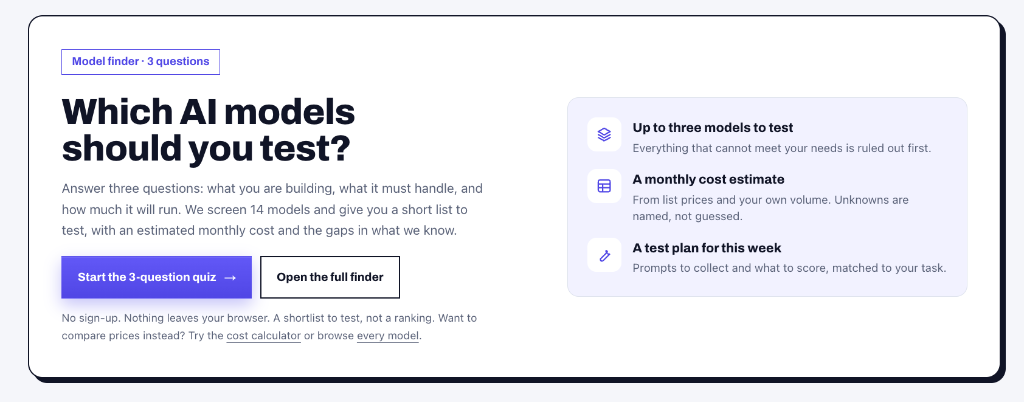
The workflow has three stages. You define the requirements by answering three questions about what you are building, what it must handle and how much it will run. The tool then screens its model set and rules out anything that cannot meet those needs. Finally you review the estimated monthly cost and a suggested test plan before committing. This guards against a common adoption mistake: choosing a model on reputation or benchmark standing without first defining the job it has to do. A small software company, for instance, might need code generation, debugging and repository understanding on a fixed monthly budget, and a model that excels at summarization may serve it worse than one evaluated for coding. For an analyst working through long reports, the reverse could be true. The right starting point is the task, not the leaderboard.
Why a test plan matters more than a recommendation
A shortlist simplifies discovery but cannot prove a model will perform in your environment. A useful evaluation plan defines the tasks the model must complete, the expected quality and acceptable error rate for consequential work, the time each task should take, the total cost under realistic usage, the privacy, security and integration requirements, and the criteria for accepting or rejecting the result. For a coding model, that could mean giving several candidates the same representative issue in a test repository, having them run the available tests and explain their changes. For a research model, it could mean checking whether answers are supported by the supplied documents and whether the citations actually substantiate the conclusions. The Model Finder's value lies in connecting discovery to that next step: testing candidates against the work you actually need done.
The Cost Calculator: Looking Beyond the Advertised Price
AI pricing is deceptively hard to compare. A subscription fee is only one component; depending on the product, you may also face usage limits, API consumption, additional services, infrastructure, team seats and the cost of reviewing or correcting generated output. The platform pairs its model resources with a cost calculator, and a useful cost model starts by defining the workload rather than comparing prices in isolation.
For an API-based model, estimated monthly cost = input tokens × input-token price + output tokens × output-token price, with both counts in the provider's pricing units. If prices are quoted per million tokens, divide the token counts by one million before multiplying. The estimate then expands to cover the other cost components:
| Cost component | What it measures | Why it matters |
|---|---|---|
| Input consumption | Tokens or inputs sent to the model | Workloads with extensive context raise input costs |
| Output consumption | Generated tokens or outputs | Long responses and generated code add up |
| Subscription or seat fees | Recurring access charges | Team plans may cost more than usage alone |
| Additional services | Tools, storage, integrations | The model may not be the whole service cost |
| Human review | Time spent checking and correcting output | Cheap generation is not always cheap completed work |
| Operational overhead | Implementation, monitoring, maintenance | Production deployments need more than model access |
This table is a general cost-analysis framework, not verified calculator fields or current prices from BestSuperintelligent.com.
The last two rows deserve the most attention. If one model produces an acceptable result in a single attempt while another needs several retries and heavy correction, the second may carry a lower advertised price and a higher cost per completed task. Conversely, a pricier model can prove economical if it cuts review time or handles hard tasks more reliably. Pricing data alone cannot settle that; only workload-specific measurement can, which is why a cost estimate is a planning tool and not a guarantee. The better buyer's question is not which model costs less but which delivers sufficient quality for the total cost of the work it does.
The Claim-to-Evidence Framework
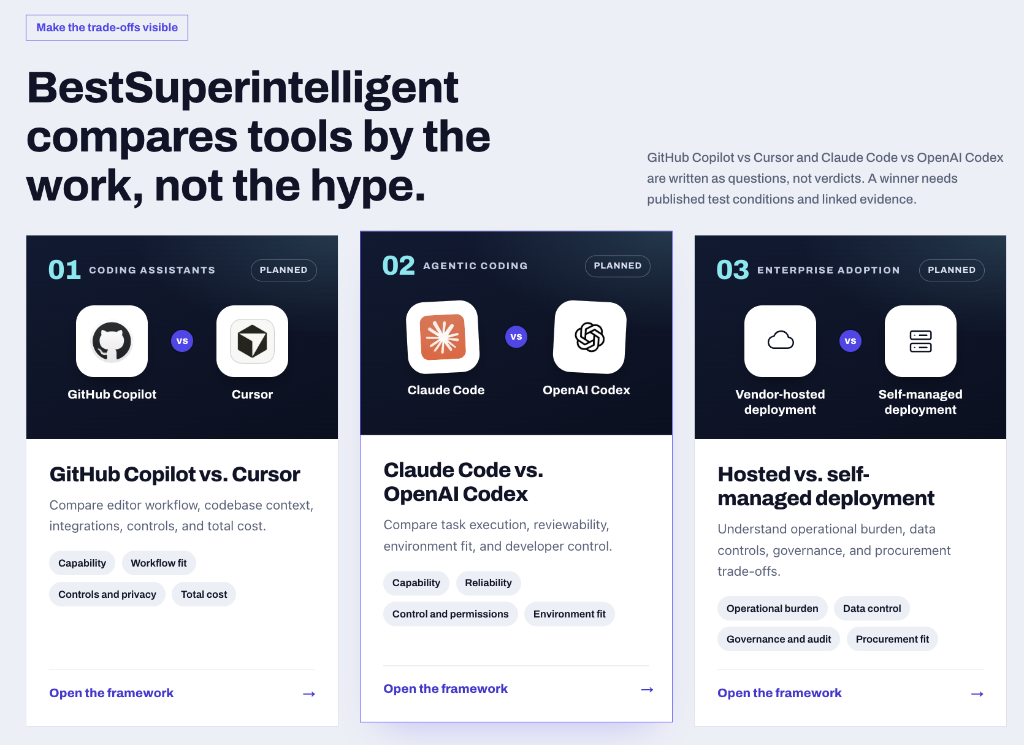
A headline like "Copilot vs. Cursor" or "Claude Code vs. Codex" implies a contest, yet any honest answer depends on what is compared, which versions are tested, what tasks are assigned and how success is measured. BestSuperintelligent.com frames these comparisons as questions accompanied by the evidence needed to answer them, and the existence of a comparison page is never treated as proof that a winner can be named. Its comparison frameworks for GitHub Copilot versus Cursor, Claude Code versus OpenAI Codex, and hosted versus self-managed deployment are all marked as planned.
A credible coding-tool comparison would start with representative tasks, give each product equivalent instructions and resources, and document the conditions. It would then examine task completion, correctness, automated test results, code quality, repository awareness, the human intervention required, time and cost consumed, and whether another evaluator could reproduce the procedure. It would report failures as well as successes and separate a product's native capabilities from results that depend on extra configuration, external tools or particular model settings. The outcome might favor one tool for complex repository changes and another for a different workflow, or find that the evidence shows no meaningful difference, and all three conclusions are useful if they follow from a transparent method. This is also where AI agents are hardest to judge, since results depend heavily on setup.
Why versioning and dates matter
AI systems change fast enough that the identity of the tested product is part of the evidence. A comparison should record the model or product version, the test date, the configuration and the known limitations, and if a product changes materially, earlier results should not be assumed to describe its current performance. The same applies to pricing, security documentation and feature availability, and putting source dates and evaluation status at the center of the research model keeps conclusions accountable to the conditions that produced them.
One Platform, Multiple AI Categories
People now meet AI through research applications, writing tools, speech systems, video generators, data products and enterprise software, not only chatbots and coding assistants. A platform that treats these categories as interchangeable risks recommending tools that solve the wrong problem, so BestSuperintelligent.com organizes its coverage around distinct entry points.
| Platform section | Core purpose | Intended audience |
|---|---|---|
| AI Coding Tools | Software development assistants and coding agents | Developers, engineering teams, technical founders |
| AI Agents | Systems that execute multistep tasks | Developers, operators, automation teams |
| AI Research Tools | Research, document analysis, knowledge work | Researchers, students, analysts |
| AI Writing Tools | Drafting, editing, content production | Writers, marketers, professionals |
| AI Image and Video | Generative visual and video applications | Designers, creators, media teams |
| AI Speech | Voice generation and audio applications | Creators, product teams, accessibility users |
| AI Data Tools | Data and analytical workflows | Analysts, data teams |
| Enterprise and Government | Organizational requirements for adopting AI | Procurement and security teams |
| Models and Data | Model-selection considerations and data | Technical evaluators, AI practitioners |
This table reflects the categories described for the platform; it does not imply that every category has completed independent evaluations.
The key distinction is between discovery and evaluation. A category page helps users understand which products exist and what they are for, while a completed evaluation must examine evidence about real performance. Keeping the two separate lets the platform be useful while its independent research program is still developing. A developer's path might run from coding tools through a comparison framework to the Model Finder, whereas a government buyer's might run from enterprise requirements to security evidence and procurement guidance. In both, the tool should fit the task and the evidence should fit the decision.
The Enterprise Question: Can This AI Tool Be Trusted?
For an individual, a poor AI recommendation means a wasted afternoon or an unneeded subscription. For an organization, an unsuitable tool can introduce operational, contractual, privacy and security risk, and a product that performs well in a technical evaluation can still be wrong for a given buyer because of its data handling, access controls, contract terms or deployment model. BestSuperintelligent.com addresses this through procurement guidance, security-evidence standards and policy tracking. A responsible assessment should cover four areas:
- Data handling and privacy: what the system collects, whether submitted data trains models and under what conditions, what retention and deletion controls exist, and which subprocessors may receive the data.
- Security and access control: the authentication and authorization mechanisms, administrative controls for the intended deployment, available security documentation and independent assessments, and how vulnerabilities and incidents are handled.
- Governance and contracts: commitments on data use and confidentiality, audit and oversight options, applicable legal and internal policy requirements, and what happens to your data if the service is discontinued.
- Operational suitability: integration with the existing environment, monitoring of usage, performance and spend, availability and support commitments, and whether the system can be safely trialed before wider rollout.
No single certification or vendor statement settles all of these, and the evidence required depends on the product, the data involved and the organization's risk profile. A developer trying a public coding assistant has different needs from a bank processing confidential information or a ministry handling sensitive records. The important distinction is between a vendor having documentation and that documentation establishing suitability for a specific deployment. Our look at the agentic AI pilot-to-production gap shows how often that gap is where enterprise projects stall.
Transparency Is Also a Product Feature
Comparison sites routinely ask readers to trust their recommendations. BestSuperintelligent.com argues that trust should be supported by information about how recommendations are produced, and its described framework includes a methodology page, an editorial policy, an affiliate disclosure and a dated corrections log. Together these answer questions any independent research publication should expect: how products are selected, what evidence is needed before a claim is treated as established, how editorial conclusions are kept apart from measured results, which commercial relationships could influence coverage, and how errors are corrected.
The commercial question matters because the platform states that affiliate and sponsorship relationships may generate revenue, and that its scores are computed by code that takes no commercial input. That is a specific, testable design principle, though it deserves ongoing scrutiny: funding does not by itself prove bias, and a disclosure does not by itself prove independence. What counts is whether readers can see the relationship, inspect the methodology and weigh the evidence. A transparent method does not end disagreement, but it makes disagreement more productive.
Why the corrections log matters
An editorial policy describes the rules a publication intends to follow; a corrections log records what it does when it gets something wrong. In AI research that difference is practical. Capabilities change, vendors update documentation, and later tests can expose problems an earlier evaluation missed. A dated record lets readers tell apart an article that was wrong, one that has become outdated, and one whose conclusions changed as evidence emerged. The strongest trust systems make those changes visible instead of quietly replacing the original claims.
Research Designed for People and Answer Engines
Another dimension of the platform is how information is organized. As users turn to AI assistants and answer engines for product research, publishers need findings that both people and extraction systems can understand. The platform's structure of separated product information, explicit evaluation labels, question-led comparison frameworks, tables, practical guides and a glossary supports that, and it reflects familiar principles of search-friendly publishing: answer the question clearly, identify the subject, explain the evidence and link to supporting material. Clear structure is not a guarantee of Google rankings or inclusion in AI-generated answers; visibility depends on content quality, technical accessibility, competition, reputation and usefulness.
A page that serves both audiences gives a direct answer, attributes each claim to a vendor, an independent test or editorial interpretation, links to traceable evidence, defines its scope by version, configuration, date and use case, states what the evidence does not establish, and connects to related comparisons and methodology. A page comparing two coding assistants should not simply say one is faster; it should say which tasks were measured, under what conditions, with what metric and what limits. The platform's wider structure of guides, a glossary, procurement resources and a policy tracker is meant to form a knowledge system rather than isolated product pages, though its long-term value will depend on whether those pages hold original, current and well-supported information, not merely on whether the sections exist.
Can a Small Platform Compete With the Industry's Biggest Names?
The challenge is real. The AI market moves quickly, and the companies making the products also control much of the technical information needed to understand them. Independent evaluation takes time, expertise, reproducible testing and constant maintenance. The platform's queue makes that visible: nine products are identified and none has yet completed an independent test. That limitation should stay explicit, because a queue is not a substitute for completed research and a well-designed Model Finder cannot independently prove product quality. Credibility will depend on turning the stated methodology into a sustained body of evidence, and five developments would matter most:
- Reproducible, task-based testing. Published evaluations should include objectives, product versions, configurations, scoring criteria and enough detail to see how conclusions were reached, ideally with representative test cases and results.
- Meaningful historical records. Dated evaluations and version histories show whether an observed difference persists across product updates.
- Stronger evidence for high-stakes decisions. Enterprise and government buyers need documented security, privacy, governance and operational information, and a structured framework that separates missing documentation, vendor assertions, independent verification and unresolved requirements.
- A clear line between discovery and proof. Editorial recommendations, preliminary assessments and completed evaluations should stay distinct so the site is never tempted to present every recommendation as a proven result.
- Commercial independence that can be examined. Disclosures and code-based scoring are a start; their value grows when readers can understand the scoring method and verify that commercial considerations do not determine outcomes.
None of this is automatic, and each item takes sustained editorial and technical work. Together they describe a credible path for an independent AI research publication: build trust through a growing record of documented findings instead of authority claims.
Why It Matters
So what should an AI recommendation be worth? The industry has spent years making systems more capable, accessible and easy to use. The next challenge is helping people decide which capabilities are real, which are relevant and which justify the cost and risk of adoption. A developer needs to know whether an assistant can solve a particular class of problems. A researcher needs to know whether a model can synthesize documents without inventing support. A business needs to understand how quality, operating cost and human oversight trade off, and an enterprise needs to know whether a system meets its security and governance requirements. These are related questions that demand different kinds of evidence.
BestSuperintelligent.com brings them into one research environment: category pages for discovery, the Model Finder to narrow options, a cost calculator for the economics, comparison frameworks that name the evidence needed, and procurement and security resources for organizational adoption. Underneath is the idea that an independent publication should explain not only what it recommends but why, on what evidence, and with what limitations. It has not yet built a body of completed independent evaluations, so its methodology and tools are best read as the foundation of an intended research service, not proof that it has already delivered better results. That honesty is central to the story and to the standard it is trying to set.
If it can turn evidence-first principles into reproducible testing, transparent comparisons and current documentation, it could become a genuinely valuable resource in an increasingly confusing market. Its most important contribution would not be another list of supposedly superior products but helping readers understand what better means, how to measure it, and when the evidence is strong enough to justify a decision. The future of AI discovery may depend less on finding the loudest recommendation and more on finding the evidence that makes a recommendation worth trusting. Start with BestSuperintelligent.com, and see more of our work in the Artificial Intelligence hub.
Limitations
This article rests on the platform's own description and the pages visible in October 2026, not on an independent test of its tools, and its evaluation status, tools and policies should be rechecked against the live site. The BestSuperintelligent author is affiliated with its publication, so its claims about its own independence are stated positions, not verified facts. No rankings, test results or performance claims are reported here, and the cost framework above is a general model, not the platform's calculator.
Related Articles
- Review of the BestSuperintelligent AI review site: our earlier look at the platform and its evidence labels.
- AI Coding Tools Landscape: the broader field of developer assistants and IDE agents.
- Agentic AI: The Pilot-to-Production Gap: why enterprise agent projects stall.
- Model Evaluation: the concept behind benchmarks and test design.
References
- BestSuperintelligent.com: the platform's homepage, model finder and comparison frameworks.
- Claude Code, GitHub Copilot and OpenAI Codex: vendor product pages for the coding tools in the queue.
- Cursor and Gemini Code Assist: vendor product pages for two further coding tools in the queue.
The Bottom Line
An AI recommendation is only worth what the evidence behind it is worth. BestSuperintelligent.com's contribution is to make that evidence, its source, its date and its gaps, visible before any score appears. Whether it becomes the standard it aims for depends on completing the independent tests it has queued, but the question it asks is the right one for anyone buying AI today.
Explore Related Concepts
Frequently Asked Questions
What is BestSuperintelligent.com?
An independent AI research and comparison platform focused on software discovery, model selection, evaluation methods and purchasing decisions. It labels information by source and status instead of publishing unverified scores.
Does BestSuperintelligent.com rank AI tools?
Not yet. Its stated policy requires at least two fully evidenced, independent evaluations in a category before a ranking is published, and none of the nine queued products has completed one.
What is the Model Finder?
A three-question tool that screens 14 AI models and returns up to three candidates to test, with an estimated monthly cost and a suggested test plan.
Does the name mean the listed products are superintelligent?
No. The platform treats the name as a brand identity, not a technical claim about the intelligence of any product.
How does the platform make money?
It discloses that affiliate and sponsorship relationships may generate revenue, and states that its scores are computed by code that takes no commercial input.