Business strategy vs market research
They are constantly confused, and confusing them is expensive. Market research reduces your uncertainty about the world; business strategy commits your resources despite the uncertainty that remains.

Market research and business strategy are constantly used as if they were the same thing, and the confusion is more than semantic — it produces companies that collect insight they never act on, and companies that act on conviction they never tested. The cleanest way to hold the distinction is this: market research reduces your uncertainty about the world, while business strategy commits your resources in the face of the uncertainty that remains. Research is a diagnosis; strategy is a decision. You need both, and you need to keep them separate in your head, because the failure modes of mistaking one for the other are quiet, common, and costly. This piece lays out exactly what each does, how they feed each other, and where teams go wrong.
The short version is that research gives you knowledge and context, and strategy gives you direction and execution — but the interesting part is what happens when one is missing or when the two are collapsed into each other.
The core difference
The simplest framing is that research answers "what is true about this market?" and strategy answers "what are we going to do about it?" One is analytical and backward- or present-looking, evaluating the state of customers and competitors as they are. The other is prescriptive and forward-looking, dictating the moves the company will actually make. The table below makes the contrast concrete.
| Market research | Business strategy | |
|---|---|---|
| What it is | Gathering and interpreting information about a market | A plan of action to compete and create value |
| Primary focus | Information, data, and insight | Decisions, resource allocation, and execution |
| Key question | What do customers want, and what are competitors doing? | How will we win, and where do we commit resources? |
| Orientation | Diagnostic and analytical | Prescriptive and action-oriented |
| Output | Reports, personas, trend analysis | Vision, business model, roadmap, KPIs |
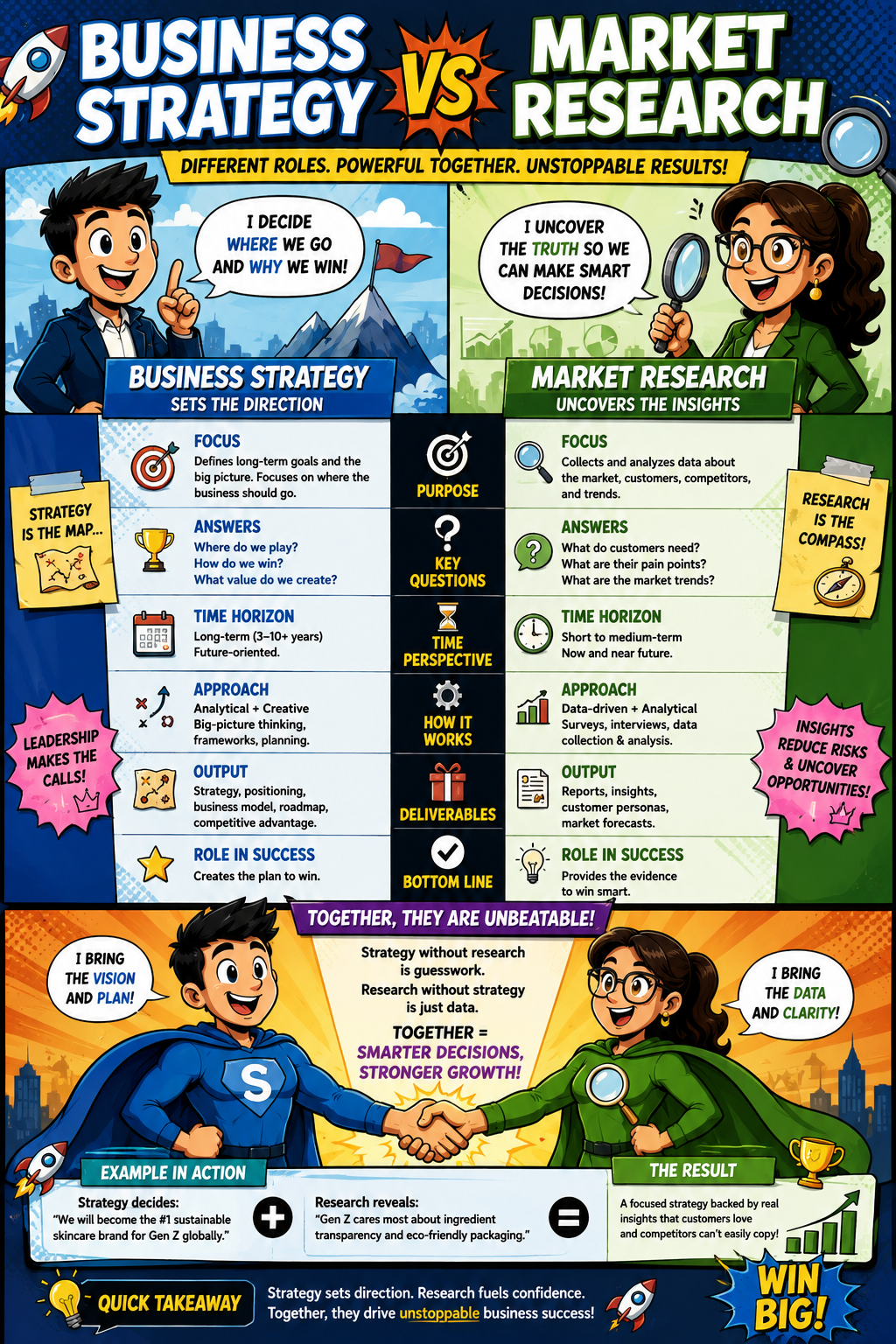
The orientation row is the one that matters most. Research can be perfectly executed and still leave you exactly where you started, because describing a market is not the same as choosing a position within it. The leap from the left column to the right — from "here is what is true" to "here is what we will therefore do" — is the act of strategy itself, and no amount of data makes it for you.
Market research: reducing uncertainty
Market research is the disciplined process of finding out what is actually true about your market rather than what you assume is true. It surfaces who your customers are, what they value, what they will pay, and what your competitors are doing, and it does so with evidence rather than instinct. Its single greatest contribution to a business is the reduction of uncertainty: every reliable finding shrinks the range of things that might be true, and a narrower range is a better foundation for a bet.
A concrete example is willingness to pay. Understanding the maximum a customer will spend is one of the inputs the Harvard Business School framing of business strategy treats as central to pricing and margin, and it is precisely the kind of thing you cannot know from the inside of the building. Research can also reveal market gaps — an underserved segment, an unmet need, a competitor blind spot — that become the raw opportunity a strategy is built around. But notice that none of these findings tell you what to do; they tell you what is, and what is possible.
Business strategy: committing under uncertainty
Business strategy is the set of choices about how the company will compete and where it will concentrate its finite resources to build durable advantage. It is fundamentally about commitment: choosing this market over that one, this customer over another, this way of winning rather than a dozen plausible alternatives. Strategy is where the abstract findings of research become decisions with consequences — a pricing model adopted, a segment targeted, a capability built, a roadmap funded.
Crucially, strategy operates under uncertainty that research can never fully remove. No study tells you with certainty how competitors will respond, how a market will shift, or whether a bet will pay off, which is why strategy is a matter of judgment rather than calculation. The discipline of capital allocation lives here: deciding what to fund and, harder still, what to starve. So does the question of economic moats — research can show you an opportunity, but only strategy decides how to defend it once you have captured it.
How the two reinforce each other
The relationship runs in both directions, and the best companies keep it in constant motion rather than treating it as a one-time hand-off.
Research informs the strategy
Before you can decide how to win, you have to understand the field you are playing on. Research feeds strategy the picture of customer demand, competitive positioning, and market structure that any sound decision depends on. A strategy built without it is a guess; a strategy built on it is a calculated bet.
Strategy directs the research
You cannot research everything, so your strategic goals decide which questions are worth the spend. If the strategy is geographic expansion, the research focuses on regional demographics and local competitors; if the strategy is lowering production costs, it pivots toward supplier markets and material alternatives. Without a strategy pointing the way, research sprawls and produces volume instead of relevance.
Strategy turns findings into action
Research might tell you that most of your target audience prefers sustainable products — a clean, useful finding. It is strategy that then figures out how to source greener materials, rework the supply chain, adjust pricing, and market the change without destroying the margin. The insight is inert until a strategy decides what to build around it; this is the step where knowledge becomes value, and it is the step research alone can never take.
Where teams get it wrong
The two most common failures are mirror images of each other, and both are everywhere. The first is research without strategy: an organization that runs survey after survey and dashboard after dashboard, accumulating insight it never converts into a decision, mistaking the feeling of being informed for the act of choosing. These companies are rich in data and poor in direction, and they are often the slowest to move precisely because more research always feels safer than commitment.
The second failure is strategy without research: leadership that prizes conviction and treats evidence-gathering as a delay, betting the company on assumptions it never bothered to test. This looks decisive and is often celebrated as bold, right up until the assumption turns out to be wrong and the misallocated resources cannot be recovered. The fix for both is the same discipline — research is an input to a decision, never the decision itself, and a strategy is a bet that should be informed by evidence, never replaced by it. The general work of turning market evidence into sharper choices is something we cover in depth in the business strategy prompt library, and the research side in the technology research prompt library.
The Bottom Line
Market research gives you knowledge and context; business strategy gives you direction and execution. Research validates and de-risks a strategy, and a strategy is what makes the research worth paying for — but the line between them is not a formality. The moment data starts substituting for a decision, you have stopped doing strategy; the moment a decision ignores available evidence, you have stopped using research. Keep them distinct, keep them in dialogue, and treat every finding as the start of a choice rather than the end of one. That is how the compass and the flight plan actually get you somewhere. For more, the business hub goes deeper on both.
Explore Related Concepts
Frequently Asked Questions
What is the difference between business strategy and market research?
Market research is the process of gathering and analyzing information about a market — customers, competitors, and trends. Business strategy is the plan of action that decides how a company will compete and where it will allocate resources. Research produces knowledge; strategy produces decisions.
Does market research come before or after business strategy?
It works in both directions. Research informs strategy by revealing what the market wants and where the gaps are, and strategy directs research by deciding which questions are worth investigating. In practice the two run in a continuous loop rather than a fixed order.
Can you have a business strategy without market research?
You can, but it is a bet placed with your eyes closed. Without research, a strategy rests on assumptions that may be wrong, and the cost of being wrong is paid in misallocated resources. Research does not remove the bet — strategy always involves uncertainty — but it shrinks it.
Is market research a substitute for strategy?
No, and treating it as one is a common and expensive mistake. Research describes the world; it does not decide what to do about it. A company drowning in customer data but unable to choose where to compete has done research and skipped strategy.
Who uses market research and who sets strategy?
Market research is typically run by analysts, insights teams, or external agencies who specialize in data collection and interpretation. Strategy is owned by leadership — founders and executives who make the resource-allocation calls. The two functions are most effective when they are in constant dialogue rather than working in sequence.