Red Gold & the Scarcity Trap
How a Peruvian desert became the world's winter mango capital — and why scarcity still didn't pay.

Northern Peru's mango industry turned a rainless desert into the world's winter mango capital — and then learned, across two brutal seasons, that being indispensable to global supply is not the same as being profitable. In August 2025, barely 30 percent of the Kent trees in the San Lorenzo valley had flowered. Cold nights rescued the crop. Nothing rescued the price. This is the story of "red gold": how a market that should reward scarcity managed to squeeze nearly everyone in the chain — a cautionary counterpoint to the rosier numbers in the full investment case for a 100-hectare Kent mango farm.
The Calendar Monopoly Nobody Planned
Start with the geography, because the geography is the whole business. Peru's mango industry is overwhelmingly northern: Piura alone accounts for 65-80 percent of national output, with Lambayeque (centred on Motupe) and Áncash (centred on Casma) filling out the map. Casma harvests latest — into March and April — quietly extending Peru's shipping calendar by a full month. Total planted area is roughly 40,000-42,000 hectares.
These are deserts, and that is the point. Piura is arid, sun-blasted, and almost rainless — which sounds like the worst place to grow a tropical fruit and is in fact close to ideal. Aridity suppresses anthracnose and other fungal diseases that plague humid mango regions. Sandy loam soils drain fast and prevent root rot. The trade-off is total dependence on engineered water: drip irrigation drawn from reservoirs like San Lorenzo, delivered tree by tree.
The commercial magic is the calendar. Peru's export season runs October through April, and its sweet spot is December to April — the gap that opens after Mexico winds down and before the next cycles ramp up. For those months, Peru is the largest offshore supplier of mangoes to the United States. When supermarkets in Chicago and Rotterdam stock Kent mangoes in February, there is a good chance they left a Piura orchard six weeks earlier.
The global supply calendar shows why this matters. Peru peaks December through February, when Mexico and Brazil are off-season and only Ecuador briefly overlaps in November. No other origin reliably fills the deep-winter window at this quality and volume.
| Origin | Sep | Oct | Nov | Dec | Jan | Feb | Mar | Apr | May | Jun | Jul | Aug |
|---|---|---|---|---|---|---|---|---|---|---|---|---|
| Peru (Kent) | · | on | on | PEAK | PEAK | PEAK | on | on | · | · | · | · |
| Mexico | on | on | · | · | · | · | on | on | PEAK | PEAK | on | on |
| Ecuador | · | on | PEAK | on | · | · | · | · | · | · | · | · |
| Brazil | on | on | PEAK | on | · | · | · | · | · | · | · | · |
| Thailand | · | · | · | · | · | · | PEAK | PEAK | on | · | · | · |
The Hero of the Story Is a Variety
If Piura is the setting, the Kent mango is the protagonist. Kent is large, low-fibre, sweet, and carries the red-and-gold blush that retail buyers read as "ripe and premium." But its decisive trait is engineering, not aesthetics: Kent travels. It holds firmness and finishes ripening over the three-to-four-week sea voyage to the US East Coast or Northern Europe — the only reason ocean-freight mango economics work at all.
Air freight is fast but ruinously expensive; the entire fresh-export model rests on a fruit that can sit in a controlled-atmosphere reefer container for a month and arrive eating perfectly. Kent is less a cultivar than a logistics solution that happens to be delicious. The mango on a Brooklyn counter in February is not a miracle of refrigeration alone. It is a variety selected, over decades, to leave the tree slightly early, cross the equator, and peak on arrival.
This is the core competitive moat. Kent plus Piura's December-to-April window equals the only origin reliably supplying premium fresh mango to the Northern Hemisphere in deep winter — an economic moat built from geography and a cultivar, not capital alone.
The Scissors Squeeze: When Scarcity Stops Paying
The textbook says low supply means high prices. The 2024/25 season taught Peruvian growers the brutal opposite. Driven partly by water stress that pulled the harvest forward, volumes exploded — between January and October 2025, Peru shipped roughly 282,000 tonnes worth US$399.5 million: a 52 percent jump in value but a staggering 179 percent surge in volume against the year before. The market drowned.
Average export prices fell 46 percent. Fruit that fetched around US$1.27 per pound in January 2024 was selling near US$0.54 by year-end. So when El Niño-linked heat pointed toward a smaller 2025/26 crop — forecasts converging at roughly 240,000 tonnes, down 15 percent — growers held out for a real farmgate price. It rose. But international demand didn't follow.
Ecuador's November overlap kept export prices capped. By January 2026, the price of a 21-kilo box fell sharply in a single week, pushing many Piura operations below production cost. Growers suspended harvest and sales for five days to stop the bleeding. A scarce crop, with a high farmgate price, still couldn't produce a profitable season for most producers — after two hard years, the hope for fair prices clashed with the reality of the international market, and the market cleared against them on both ends.
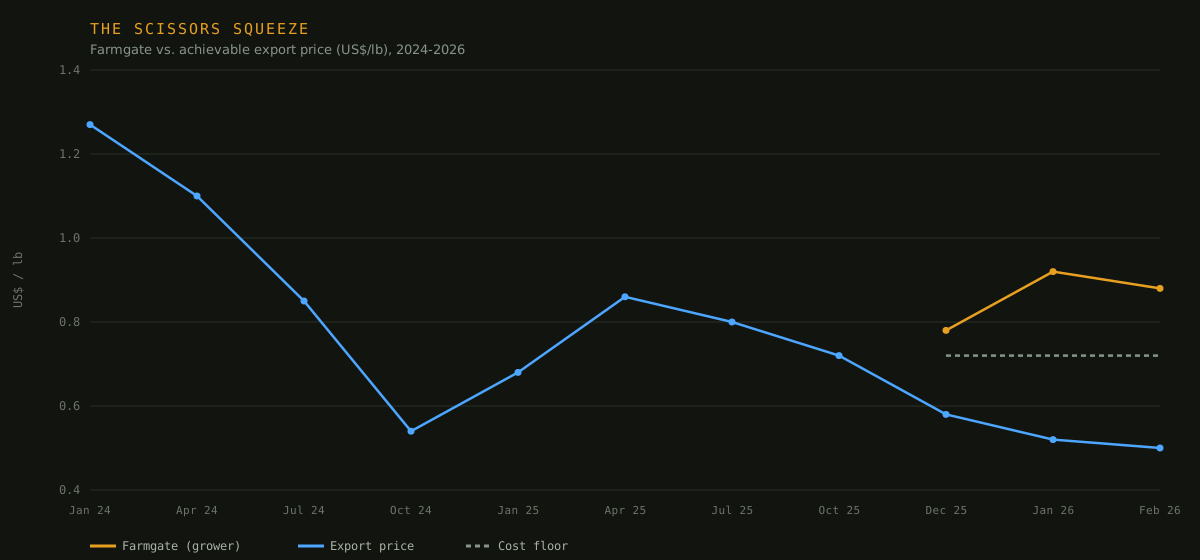
| Period | Export price (US$/lb) | Farmgate (US$/lb) | Cost floor (US$/lb) |
|---|---|---|---|
| Jan 2024 | 1.27 | — | — |
| Oct 2024 | 0.54 | — | — |
| Apr 2025 | 0.86 | — | — |
| Dec 2025 | 0.58 | 0.78 | 0.72 |
| Jan 2026 | 0.52 | 0.92 | 0.72 |
| Feb 2026 | 0.50 | 0.88 | 0.72 |
What It Actually Costs
Capital intensity keeps top-end export mango from being a smallholder's game, even though thousands of smallholders grow the fruit. A serious export operation carries heavy fixed costs before a single box ships: drip-irrigation infrastructure and the water rights to feed it, land preparation, and — non-negotiable — a packing facility certified to international standards.
SENASA, Peru's agricultural health authority, governs the phytosanitary protocols that gate access to foreign markets. Fruit-fly control is the line item that can end a season: a single interception can trigger commercial restrictions, reputational damage, or the permanent loss of a market. Compliance is not overhead; it is the price of the door. Layer on season-by-season price volatility and the picture for a mid-sized grower is stark — high, fixed, front-loaded costs against income that can swing 46 percent on volume alone. It is capital allocation under genuine uncertainty.
Getting It There in One Piece
Logistics is where Peruvian mangoes are won or lost. The mechanics are unforgiving: a three-to-four-week ocean transit demands controlled-atmosphere shipping — regulated temperature, oxygen, and CO₂ inside the reefer — to slow ripening and cut post-harvest losses. Get the cold chain right and the fruit lands premium. Break it anywhere and you ship garbage at full freight cost.
The journey runs from a Piura orchard through a precision harvest (Brix measured, colour graded, picked slightly early), into a SENASA-certified packhouse, out through the port of Paita in a controlled-atmosphere reefer, across a 3-4 week transit where the fruit ripens en route, and into Rotterdam or Newark arriving eating-ready. The highest-risk stages are the dock and the handoffs — solar heat loading containers, and every break in the cold chain.
The Markets: Where the Mangoes Go
In January-October 2025, Peru shipped mangoes worth US$399.5 million, and the destination map is concentrated. The United States anchors the business at 36 percent of value, the Netherlands routes Europe at 20 percent, and Spain, Canada, South Korea, and the UK are meaningful secondaries.
But the product-form split is the real revelation: fresh fruit is only 55 percent of export value. Frozen pulp alone accounts for 38 percent — nearly US$152 million in stable, contract-based income that never touches a retail fruit display. The rest is dried product and purée. The headline business is fresh Kent; the quiet, resilient business is everything made from the fruit that doesn't ship whole.
| By destination | Share | By product form | Share |
|---|---|---|---|
| United States | 36% ($145M) | Fresh Kent | 55% ($220M) |
| Netherlands | 20% ($78M) | Frozen pulp | 38% ($152M) |
| Spain | 7% ($28M) | Dried / purée | 7% ($28M) |
| Canada + UK | 9% ($35M) | ||
| South Korea | 5% ($20M) | ||
| Other | 23% ($94M) |
The Global Market: A $73 Billion Opportunity
Peru does not sit in a stagnant commodity market. The total global mango market — fresh and processed — was valued at US$73 billion in 2025 and is projected to reach US$107 billion by 2030, growing 8.1 percent a year. The processed sub-market alone was worth roughly US$23-25 billion in 2025 and is on track for US$36-41 billion by 2034.
This growth is structural, not cyclical: health awareness, clean-label demand, tropical-flavour adoption by mainstream buyers, and the explosive growth of functional food and beverage categories that need a natural tropical base ingredient. Mango pulp already accounts for nearly 39 percent of all tropical fruit flavours used in the global beverage sector. The demand side is a network effect — every new beverage and snack format that adopts mango widens the base for the next.
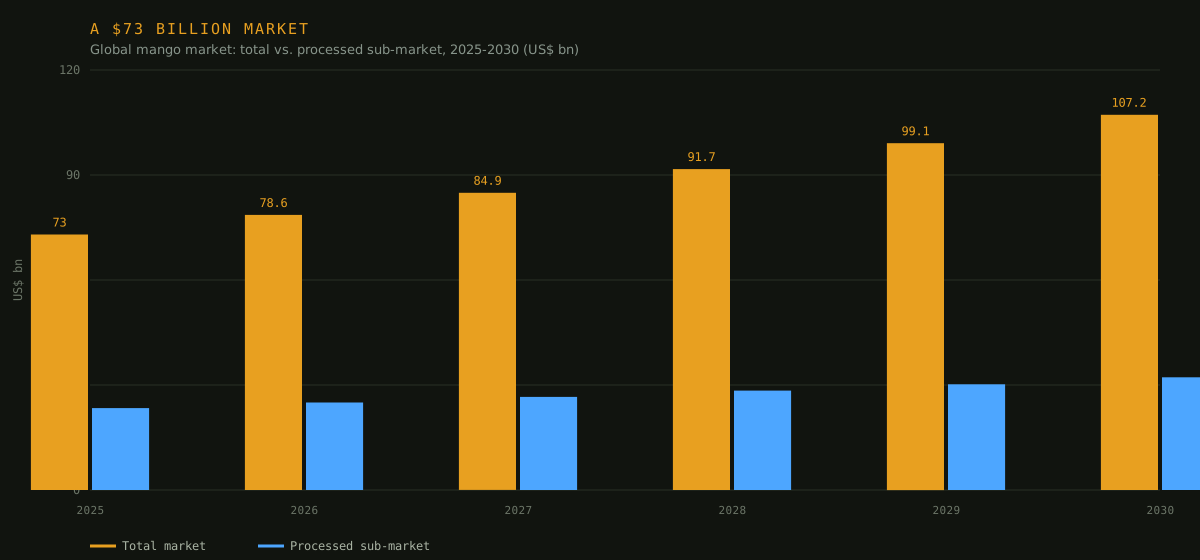
| Year | Total market (US$ bn) | Processed sub-market (US$ bn) |
|---|---|---|
| 2025 | 73.0 | 23.4 |
| 2026 | 78.6 | 25.0 |
| 2027 | 84.9 | 26.6 |
| 2028 | 91.7 | 28.4 |
| 2029 | 99.1 | 30.2 |
| 2030 | 107.2 | 32.2 |
What the World Does With Peruvian Mango
Fresh Kent is the flagship, but far from the whole story. The industrial application map is wider, more valuable, and more resilient to price shocks than most growers have yet exploited. Each application below is a buyer who needs year-round, standardised, certified supply. Peru has the supply; the gap is processing capacity and commercial relationships.
- Natural juices — mango is the #1 tropical flavour in global beverages (39% of tropical juice SKUs); aseptic pulp drives the category at industrial scale.
- Ice cream & sorbet — dairy and plant-based producers need standardised pulp; the vegan-dessert surge makes this fast-growing.
- Baby food — mango purée is a core infant-food ingredient, requires HACCP and organic certification, and commands the highest per-kilo price of any processed form.
- Dried & dehydrated — no cold chain, 12-month shelf life; Gen Z and Millennial snacking is the primary growth engine.
- Smoothies & bowls — frozen chunks are the #1 ingredient in açaí bowls and blended formats.
- Mango powder — a small but ultra-high-margin niche (nutraceuticals, supplements) with zero cold-chain requirement.
The Consumer: Who Actually Buys This Fruit
The global wellness economy was worth US$2 trillion in 2025, growing 4-5 percent a year, and mango sits at the intersection of every trend driving that number: tropical flavours, natural sweetness, clean-label ingredients, and a strong nutritional profile. The buyer base is more distinct by channel than most produce marketers have mapped.
Millennials are the primary buyers of fresh and premium fruit, paying up for provenance and certification. Gen Z drives snacks and processed forms — dried mango and smoothie packs, 31 percent of which now sell via e-commerce. Industry is the largest-volume buyer: beverage, dairy, and bakery manufacturers needing year-round standardised pulp under contract. And Asia-Pacific is the emerging premium frontier — South Korea is already a top-five market, while Japan demands zero-defect quality and full traceability.
The Processed Hedge: The Industry's Best-Kept Secret
Nearly 45 percent of Peru's mango export value already comes from processed forms that never see a retail fruit display. These products sidestep cold-chain fragility and the brutal fresh-price swings. They are not Plan B. In a rational industry structure, processed mango would be the core business — with fresh Kent as the premium-margin topper on a stable processed base.
The economics make the case plainly. Fresh Kent carries high price risk, a critical cold chain, and stable-at-best growth. Frozen pulp, dehydrated slices, aseptic purée, mango powder, and baby-food-grade product all carry lower price risk, lighter or no cold-chain demands, and faster growth. The fruit that can't cross an ocean whole is, paradoxically, the safer business.
| Product form | Price risk | Cold chain | Margin | Competition | Growth |
|---|---|---|---|---|---|
| Fresh Kent | HIGH | CRITICAL | MEDIUM | HIGH | STABLE |
| Frozen pulp | LOW | STANDARD | HIGH | MEDIUM | ↑ Growing |
| Dehydrated slices | LOW | NONE | HIGH | LOW | ↑↑ Fast |
| Aseptic purée | MEDIUM | STANDARD | MEDIUM | MEDIUM | ↑ Growing |
| Mango powder | LOW | NONE | VERY HIGH | LOW | ↑ 5.8% CAGR |
| Baby food grade | LOW | REGULATED | PREMIUM | LOW | ↑ Stable |
Price, Brand, and Market Education
One structural weakness stands out in 2026 industry reporting: Peru has no national quality brand for its mango. India has Alphonso. Mexico has Ataulfo. Peru has Kent — but Kent is a variety name shared by growers worldwide, not a Peruvian provenance brand. Closing that gap matters because brand is how a commodity escapes commodity pricing.
In the US and Europe, the average consumer has little awareness of where their February mango originated — a missed premium. In Japan and South Korea the gap is more acute: buyers will pay extraordinary premiums for branded, certified, traceable fruit, but they require category-introduction investment first. Peru's avocado sector made exactly this investment in Asia in the 2010s. The mango sector has not yet followed. A Peruvian quality seal — variety, origin, and certification — could command a 15-25 percent retail premium in provenance-driven markets.
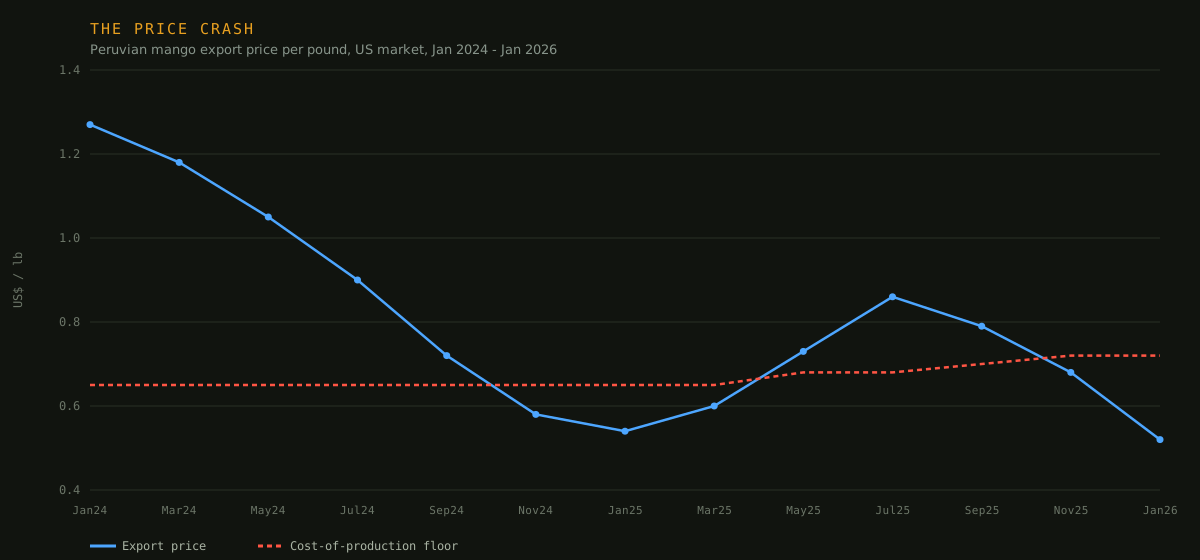 Export price per pound (US market) vs. the cost-of-production floor, Jan 2024 - Jan 2026. Without a provenance brand, the fruit clears at commodity prices that twice approached or breached the cost floor.
The Future: Data, Asia, and the Freezer
The August 2025 flowering scare was a forecasting failure: trees that wouldn't flower on schedule in abnormal heat, read with traditional knowledge in a climate that no longer behaves traditionally. The response now taking hold is precision agriculture — sensors, drones, and predictive models to anticipate flowering under high heat, time irrigation tree by tree, and measure Brix at harvest rather than by eye.
The other two vectors are Asia and the freezer. Asia-Pacific is where the unclaimed premium lives, contingent on the brand and market-education work the avocado sector already modelled. And the freezer — the processed hedge — is the structural answer to a fresh market that punishes both gluts and shortages. The industry's resilience runs through the products that don't depend on a perfect four-week voyage.
The Bottom Line
Peru built a genuine moat: a desert calendar and a cultivar that together own the Northern Hemisphere's deep-winter mango. But two seasons proved that a supply moat does not guarantee pricing power. A record glut crashed prices 46 percent; the scarce crop that followed still cleared below cost. The escape isn't more fruit or better luck — it's the two things Peru hasn't built at scale: a provenance brand that lets the fruit out of commodity pricing, and a processed-product base that doesn't live or die on a four-week voyage. The fresh Kent is the story everyone tells. The freezer and the brand are the story that pays — and they are the same structural risks any investor underwriting a Peruvian mango farm needs to price in before committing capital.
Explore Related Concepts
Frequently Asked Questions
Why is northern Peru the world's leading mango exporter?
Northern Peru — primarily Piura and Lambayeque — exports 90%+ of Peru's mangoes thanks to an arid desert climate that suppresses fungal disease, engineered drip irrigation, and a December-to-April harvest window that fills the gap when Mexico and Brazil are off-season. The Kent variety, which holds firmness over 3-4 weeks of ocean transit, makes long-haul export economics viable.
Why did Peru's 2025/26 mango season underperform despite lower supply?
El Niño-linked heat delayed flowering, pointing to a 15% volume cut to ~240,000 tonnes. Growers expected higher farmgate prices, which materialised — but international demand didn't follow. Overlapping supply from Ecuador kept export prices capped, and by January 2026 the price of a 21-kilo box fell below production cost in a single week, forcing a 5-day harvest suspension.
What processed products can be made from Peruvian mango?
Peruvian mango is processed into frozen pulp (38% of 2025 export value), aseptic purée, dehydrated slices, juice concentrate, mango powder, and baby food. These forms sidestep cold-chain fragility, carry higher and more stable margins, and serve a global processed mango market valued at $23-25 billion in 2025, growing 5-8% annually to 2034.
What is the global mango market size and growth rate?
The total global mango market (fresh and processed) was worth roughly $73 billion in 2025 and is projected to reach $107 billion by 2030, growing at 8.1% CAGR. The processed sub-market alone was valued at $23-25 billion in 2025, on track for $36-41 billion by 2034.