The Platform Didn't Beat the Hotel. The Balance Sheet Did.
Every platform origin story gets told as a technology story. It isn't one. What let Uber out-scale every taxi fleet and Airbnb out-room every hotel chain wasn't an app. It was refusing to own anything.
AI Overview
The durable advantage behind Uber, Airbnb, and Amazon Marketplace is a balance-sheet structure rather than a software one. Linear businesses must buy an asset before they can rent it out, so every unit of growth consumes capital and adds depreciation, payroll, and utilisation risk. Platforms sell the introduction instead of the asset, which converts growth from a capital problem into a network problem — and network problems get cheaper at scale rather than more expensive. The defensibility that follows comes from two-sided liquidity, accumulated trust records, and data drawn from transactions that never close, none of which a new entrant can rebuild quickly even with identical software. The model's weak point is not competition or regulation of prices, but any legal change that stops the supply side from absorbing asset risk, because that is the mechanism the entire cost structure rests on.
In short
- What it is: a structural argument that platform defensibility comes from refusing to own the underlying asset, not from technology.
- Why it matters: it explains why well-capitalised incumbents with competent engineering teams still lost to platforms.
- Who benefits: operators, founders, and investors trying to distinguish a real moat from a temporary product lead.
- Biggest takeaway: the asymmetry — being the only party in the transaction with nothing to lose if it goes badly — is the moat. Everything else is packaging.
Key Facts
| Category | Business · Opinion |
| Difficulty | Intermediate |
| Read time | 8 minutes |
| Search intent | Informational |
| Updated | August 17, 2026 |
Uber has never owned a car. Airbnb has never owned a bed. Between them they command more ride capacity and more room inventory than the incumbents they replaced ever built with a century's head start and, at various points, entire national governments on their side.
That is not a technology gap. Marriott can write software. Hertz can write software. What Marriott and Hertz cannot do — structurally, permanently, by the nature of what they are — is stop owning the thing they rent out. A platform can. That single refusal is worth more than every feature a platform ever shipped.
Why it matters
The mistake is expensive in both directions. Incumbents that read the threat as a technology problem responded by building apps, which addressed the visible layer and none of the structural one. Investors that read asset-light as inherently superior funded marketplaces in categories with no liquidity dynamics at all, where the model has no advantage to offer. Understanding which layer actually carries the defensibility — the economic moat rather than the interface — is what separates the two outcomes.
Why does a business that owns nothing beat one that owns everything?
Because ownership is a cost centre dressed up as an asset. A hotel chain's balance sheet is a liability waiting to happen: buildings depreciate, staff need paying whether or not the rooms fill, and every dollar of growth requires a dollar — or ten — of capital first.
A platform inverts this by design. It does not buy the room; it buys the right to introduce a room to a traveller, and it charges for the introduction. Growth stops being a capital problem and becomes a network problem, and network problems get cheaper to solve as they get bigger.
Airbnb ran this play against real estate directly: zero owned property, more sleeping capacity than the largest hotel groups on the planet, and a cost structure that scales with software rather than construction (Airbnb business model breakdown).
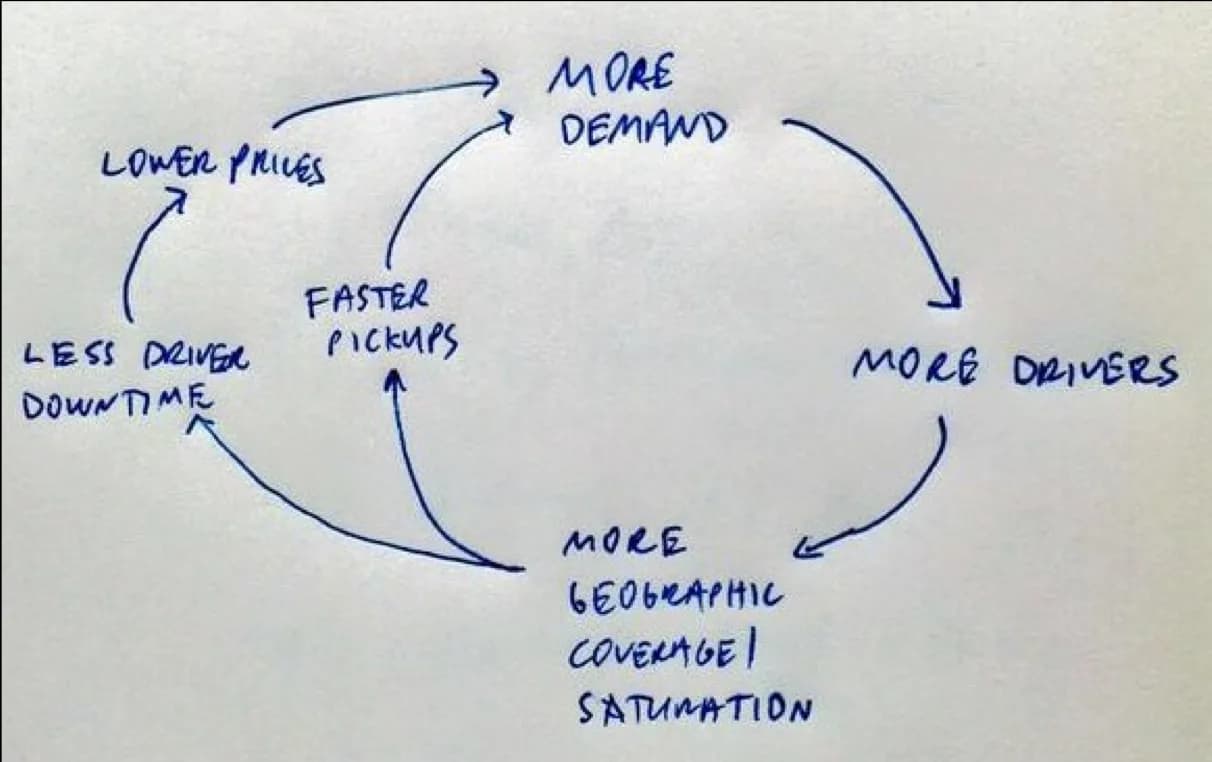
The loop above is the mechanism in its simplest form. Each turn makes the next turn cheaper — more drivers means denser coverage, denser coverage means shorter waits and less unpaid downtime, and lower prices pull in demand that starts the cycle again. Nothing in that diagram requires the platform to own a vehicle.
If it is just middleman economics, why can nobody copy it?
Because the moat is not the app, and it never was. Two-sided liquidity — enough live buyers and enough live sellers, at the same time, in the same place — is brutally hard to replicate from a standing start.
A new ride-hailing app can be built in a weekend. Ten thousand drivers who already trust the brand, and a base of riders who already have the habit, cannot. That is before switching costs: leaving a platform means losing rating history, review trail, and accumulated trust, which are the exact things that made a participant worth matching with (defensibility in digital platforms).
Multi-homing makes this worse for the challenger rather than better. The friction of running two apps at once is usually enough to stop users from seriously trying the alternative, so the incumbent's liquidity keeps compounding while the challenger's stays theoretical.
Is the data advantage real, or just the pitch-deck version?
It is real, and it compounds in a way linear businesses structurally cannot match. A department store learns from the transactions it completes. A platform learns from every transaction it almost completes — every search that did not convert, every listing passed over, every price point that triggered hesitation — across an entire market rather than one shelf.
Amazon Marketplace turned this into a second business. The data advantage funded Fulfilment by Amazon, which locked in sellers on one side and Prime shoppers on the other, at which point the marketplace stopped competing with other marketplaces and started competing with the concept of a supply chain (multi-sided platform economics; when platforms attack).
The Nothing-to-Lose Asymmetry Framework
Here is the framework the rest of this argument reduces to. In any transaction, count which party carries the downside if the transaction goes badly.
| Party | Owns the asset | Carries downside on a failed transaction | Cost of adding one unit of supply |
|---|---|---|---|
| Hotel chain | Yes | Empty room, fixed payroll, servicing debt | Cost of building a room |
| Rental fleet | Yes | Idle vehicle, depreciation, insurance | Cost of buying a car |
| Platform host or driver | Yes | Idle asset, unpaid time, own insurance | Their own capital |
| Platform | No | A match that did not convert | Effectively zero |
The bottom two rows are the entire model. The asset risk did not disappear when the platform arrived — it moved onto the supply side, which now carries it in exchange for access to demand. The platform kept the leverage of ownership and shed the liability of it.
This is why the model resists imitation by incumbents specifically. Marriott cannot adopt it without ceasing to be Marriott: its assets are the business. And it is why the model is more fragile than it looks, because it depends on a legal classification rather than a technical one.
Economic Framework
Regulation struggles with this model for a structural reason. Because winner-take-all dynamics that look like network effects from inside a boardroom look like monopoly formation from outside one — and traditional antitrust was built to catch a different crime. It was built to catch high prices. Google is free. Amazon is often cheaper than the store it replaced.
So the fight has been relearned around monopsony: not what a platform charges its users, but what it can extract from, or withhold from, suppliers who have nowhere else to go. That is the argument underneath the European Union's Digital Markets Act — interoperability mandates, a ban on self-preferencing, and a demand that gatekeepers stop grading their own homework.
Limitations
This is an opinion piece, and the framework above is an interpretation rather than a measurement. Three caveats matter.
The argument generalises across categories that behave differently. Ride-hailing liquidity is local and rebuilds city by city; Airbnb's is closer to global. A model that describes both loosely will describe neither precisely.
Asset-light is not automatically superior. In categories without genuine two-sided liquidity dynamics, the structure offers no defensibility at all, and a decade of failed marketplaces demonstrates it.
Finally, the profitability record is mixed and long-contested. The claim here is about structural defensibility, not about whether any given platform earns an acceptable return — those are separate questions and conflating them is the most common error in this genre.
What actually threatens the model?
Not the press coverage. The independent-contractor line.
Every advantage above depends on the supply side absorbing asset risk: the car, the apartment, the insurance, the downtime. Courts reclassifying gig workers as employees do not merely raise costs — they attack the mechanism that made the low-cost structure possible. If the supply side stops being independent, the platform starts to look, financially, like the linear business it replaced.
References
- Digital Markets Act — European Commission — the regulation's official hub
- When Platforms Attack — Harvard Business Review — platform versus linear competitive dynamics
- Defensibility in Digital Platforms — Samaipata — liquidity and switching costs as moats
- Multi-Sided Platform Economics — FourWeekMBA — the marketplace model explained
- Airbnb Business Model — RadicalStart — asset-light inventory mechanics
Explore related coverage
- Back to the business hub
- The orchestration layer is the new moat
- The data moat in the AI era
- How the Digital Markets Act is dismantling the platform moat
- 30 essays that shaped tech and economics
Final thoughts
The pattern across every example here is the same one wearing a different industry's clothes. It was never really about connecting buyers and sellers more efficiently — plenty of linear businesses do that too. It was about being the only party in the transaction with nothing to lose if the transaction goes badly.
That asymmetry is the actual moat. Everything else — the app, the algorithm, the surge pricing — is packaging. Which is also why the model's defenders should watch employment law far more closely than they watch competitors.
Explore Related Concepts
Frequently Asked Questions
Why is an asset-light business model more defensible than owning the assets?
Because ownership converts growth into a capital problem. A hotel chain needs buildings, staff, and financing before it can add a room, and those assets depreciate whether or not they are occupied. A platform charges for the introduction rather than the asset, so adding supply costs it almost nothing. Network problems get cheaper to solve at scale; capital problems get more expensive.
If platform economics are so simple, why cannot competitors just copy them?
The software is trivial to copy; the liquidity is not. A competing ride-hailing app can be built quickly, but a base of drivers who already trust the brand and riders who already have the habit cannot. Switching costs compound the problem, because leaving the platform means abandoning ratings, review history, and accumulated trust — the exact assets that made a participant worth matching in the first place.
What is the difference between monopoly and monopsony power in platform regulation?
Monopoly power is about what a firm charges its customers, which is what traditional antitrust was designed to detect. Monopsony power is about what a firm can extract from its suppliers. Platforms are frequently free or cheaper than the incumbents they replaced, so the consumer-price test finds nothing wrong. The leverage shows up instead in the terms imposed on drivers, hosts, and third-party sellers who have no comparable alternative.
How would reclassifying gig workers as employees change the platform model?
It would attack the mechanism rather than the margin. The model depends on the supply side absorbing asset risk — the car, the apartment, the insurance, the idle time. If that supply side becomes employed labour, the platform takes on payroll, benefits, and utilisation risk, and starts to resemble the capital-heavy linear business it was built to avoid.
Does the asset-light model work in every marketplace category?
No, and assuming it does is a common and expensive error. The structure only confers defensibility where genuine two-sided liquidity exists — where buyers care how many sellers are present and sellers care how many buyers are present, in the same place at the same time. In categories without that dynamic, owning no assets simply means owning no advantage, which is why a decade of marketplace startups in thin categories failed despite copying the model exactly.