SpaceX's First 100 Days: The Pop, the Plunge, the Price of a Dream
The biggest IPO in history rose 67% in days, gave all of it back, and now faces a calendar of share unlocks. What the first hundred days of SPCX reveal about the price of a long-dated dream.
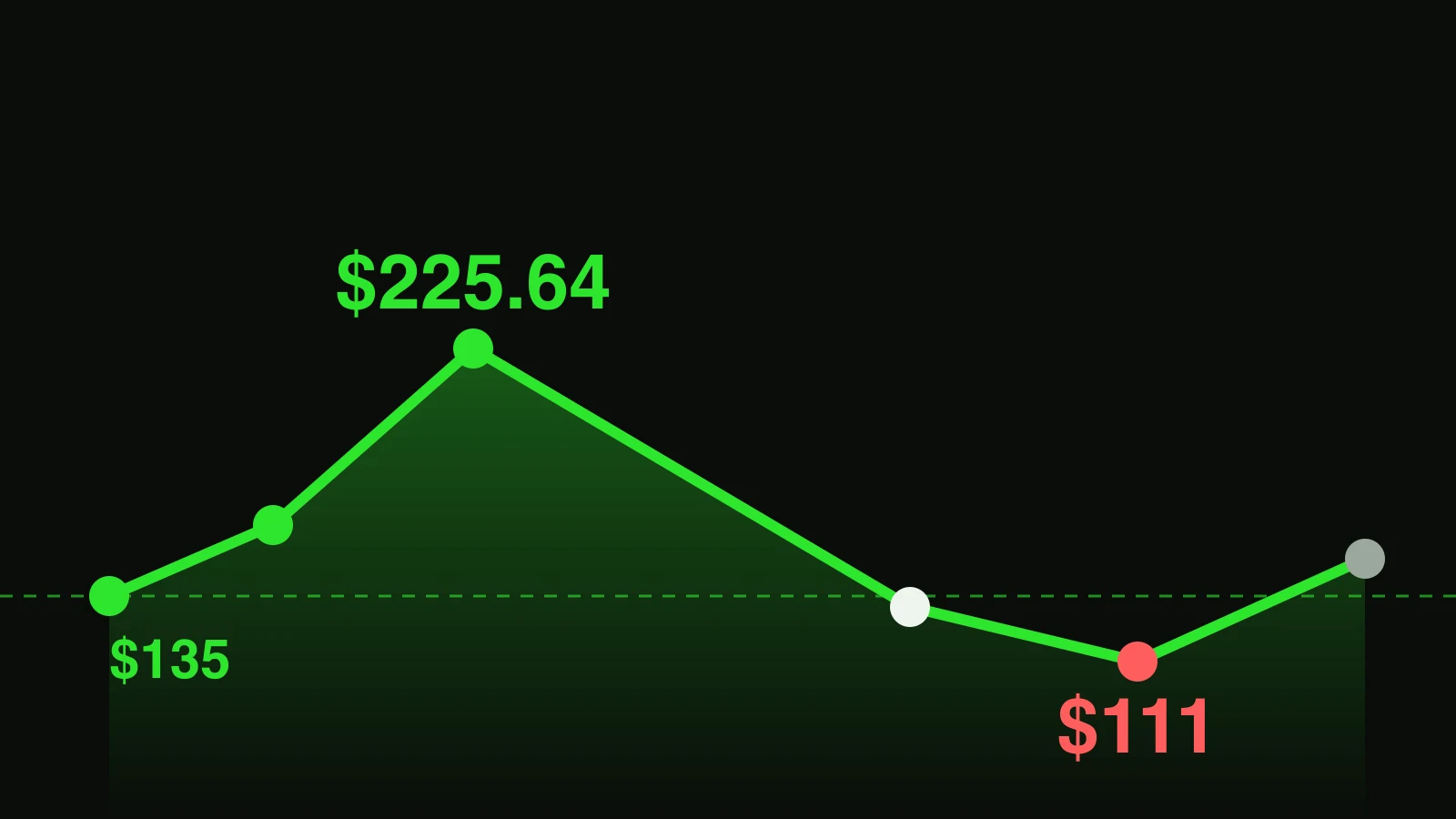
On the morning of June 12, a company that had spent twenty-four years answering to almost no one began answering to everyone. SpaceX had priced its shares at $135. They opened at $150 and closed the day at $160.95, a 19% pop that put its market value at about $2 trillion. It was a record-setting debut, and for three trading sessions it felt like the start of something permanent.
It was not. By the third session the stock had touched $225.64, a 67% gain on the offer price. By August 6 it closed at $111, 18% below it. The hundred days in between are a case study in what happens when the supply of a story runs ahead of the evidence for it.
AI Overview
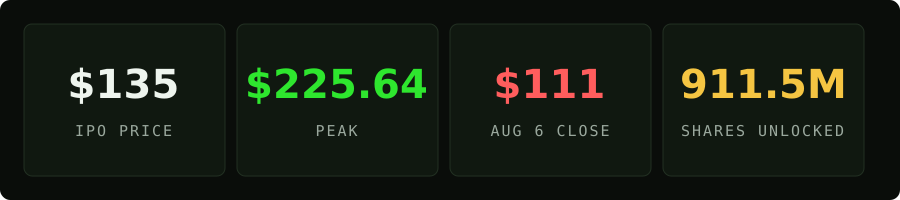
SpaceX listed on Nasdaq on June 12, 2026 at $135, raised about $86 billion, and peaked at $225.64 within three sessions. It then fell to $111 by August 6 as a heavy-spending first earnings report and a 911.5-million-share unlock tested the valuation, with more supply scheduled through December.
The Pop
Before the first trade, the warnings had already been written. Some of the sharpest came from people who had studied how IPOs are built, and they were less interested in the company than in the machinery around it.
"Every piece of evidence we have is that the IPO is being engineered to rise very rapidly after it prices, and then fall very dramatically after that."
— George Pearkes, investment strategist
Scott Galloway, the NYU professor, called it "the greatest degree of manufactured scarcity we've ever seen in an IPO." Michael Burry said "nothing in that S-1 suggests it is worth $1 trillion let alone $2 trillion." The Financial Times' Robin Wigglesworth needed only four words: "The price is nuts." These quotes are compiled on Wikipedia's page on the IPO, which also records Aswath Damodaran calling the AI market-size assumption "beyond plausible."
The mechanics gave the critics something to point at. Only about 639 million shares were sold, roughly 30% of the offering went to retail investors, and Musk kept 82% to 85% of the voting power. A small float, a motivated crowd and a founder who could not be outvoted is a setup that rewards momentum first and scrutiny later. The bulls were not silent either: Morgan Stanley rates the stock Overweight with a $300 price target, according to TradingKey.
The Slide
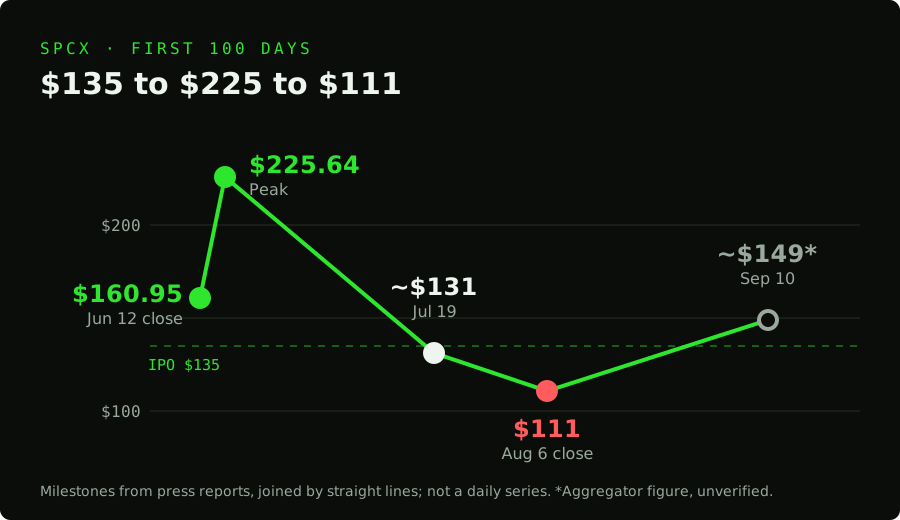
The shape tells the story better than any paragraph. A 19% gain on day one became 67% at the peak, and then the market spent the summer taking it back. By July 19 the stock was near $131, about 42% below its high and already under the offer price, according to The Motley Fool. Anyone who bought the $150 open and held to August 6 was down about 26%.
The Quarter That Cost $18 Billion
On August 4, SpaceX reported its first quarter as a public company, and on paper it was excellent. Revenue rose 92% to $7.81 billion. Adjusted EBITDA jumped 191% to $3.54 billion. Then came the other number: about $18.4 billion of spending in the quarter, mostly on AI, and a net loss of roughly $541 million. The stock fell about 14% the next day.
The market was not questioning whether SpaceX can grow. It was asking who pays for the growth. Starlink, the part of the business that makes money, earned $4.4 billion in operating income last year, according to the S-1 as reported by Fortune, from roughly 10,000 satellites serving about 10 million people in 150 countries. The question for shareholders is how much of that cash gets reinvested into a spending race against better-funded AI rivals. It is a capital allocation decision as much as a technology bet.
Two Days, 911 Million Shares
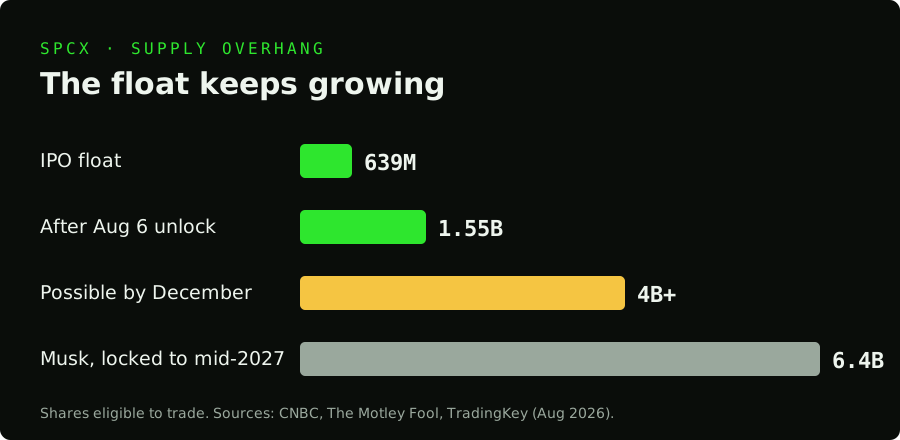
The most-feared date came two days later. On August 6, 911.5 million shares, about 20% of restricted supply, became eligible to sell, more than the entire IPO. The stock opened at $105, its low of the day, and then did the unexpected: it closed at $111, up 2.6%, as buyers soaked up the supply. The tradable float jumped from about 639 million to roughly 1.55 billion shares.
Surviving the first unlock did not end the overhang, it only scheduled it. TradingKey reports another 319 million shares eligible from August 12, tranches of about 7% of lock-up shares every two to three weeks through late October, a further 28% after the third-quarter report, and the standard expiry in early December. More than 4 billion shares could be tradable by year end, and Musk's own 6.4 billion stay locked until mid-2027.
A Company With a Mission Statement
Few IPO prospectuses say what this one says. SpaceX told investors, in the filing's words:
"We do not want humans to have the same fate as dinosaurs."
— SpaceX S-1, as reported by Fortune
The proceeds, it said, would fund projects to put people on the Moon and Mars. Musk's stock awards vest on milestones such as a permanent human colony on Mars with at least one million inhabitants, Fortune reported, and he can earn more for building orbital data centers. It is a compensation plan that reads like a mission, which is exactly how it is meant to read.
The route has already changed once in public. In February, Musk wrote on X that SpaceX had shifted its focus to a self-growing city on the Moon.
"Will still do Mars in parallel, but the critical path to a self-growing Moon city is faster."
— Elon Musk, on X, as reported by Yahoo Finance
He added that the Moon city "can be made to be self-growing in less than half the time of Mars." For a shareholder, a change of timeline that large arrived as a social media reply. It is an extraordinary thing to price, and the market is still working out how.
The Matter, Motion, Intelligence Framework
My view is that the market still prices SpaceX as a rocket company with a satellite business attached, when the better lens is a single system built from three layers. This is an opinion, not a company forecast, but it explains why the three Musk companies keep converging.
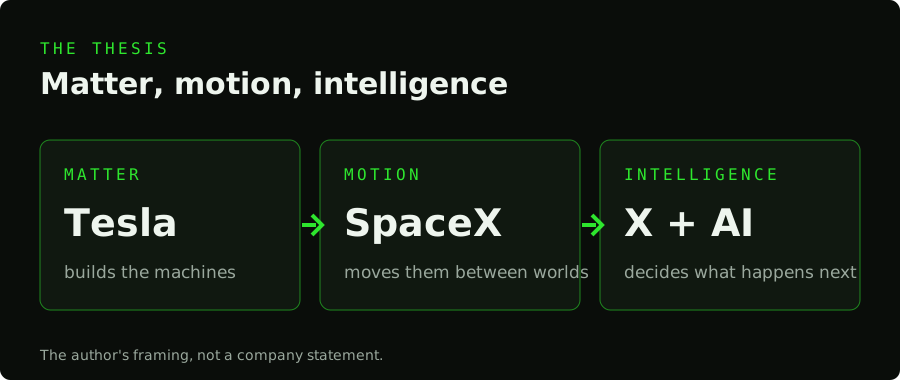
- Matter: anything that occupies volume and has mass. Tesla is the factory that turns raw material into machines.
- Motion: how matter responds to forces such as gravity and electromagnetism and changes over time. SpaceX is the transportation layer that moves matter between worlds.
- Intelligence: the laws of nature, self-organization and the way complex systems such as evolution or ecosystems think their way forward and adapt. X, with its AI work, is the cognition layer.
Read this way, the heavy AI spending that hurt the first earnings reaction is not a distraction from the rocket business. It is the cognition layer being paid for up front, and it is the reason the three companies look less like separate businesses and more like one entity that mirrors nature.
Ten Years Out: Robots on the Moon and Mars
Here is where I picture the company a decade from now: hundreds of Tesla robots operating on the Moon and Mars, doing research and laying the groundwork for long-term human habitation. Robots go first because they do not need life support, can be built in volume and can prepare terrain, power and shelter before people arrive. That is the practical link between robotics and the launch business, and why the labor-economics questions in Humanoid Robots and the Economics of Labor matter to this story.
It is an optimistic scenario, and a great deal has to go right: Starship cadence, robot reliability and a balance sheet that can fund years of heavy spending on the way. It is the same long-duration bet that defines venture capital, now sitting inside a $2 trillion public company.
Key Facts
| Item | Detail |
|---|---|
| Ticker / exchange | SPCX / Nasdaq |
| IPO date and price | June 12, 2026 at $135 |
| Raised / valuation | About $86B / about $1.77T |
| Day-one close | $160.95 (+19%) |
| All-time high | $225.64, within three sessions |
| Aug 6 close | $111, about 18% below the IPO price |
| Float | About 639M at IPO, about 1.55B after Aug 6 |
| Voting control | Musk 82% to 85% |
Investment Thesis
The bull case is simple to state: SpaceX owns the only proven reusable heavy-lift system, a satellite network that already earns an operating profit, and an AI division that could become a third engine. The bear case is the entry price. At the IPO valuation the company was priced at roughly 95 times its 2025 revenue of $18.7 billion, with a founder holding 82% to 85% of the votes and a register built for momentum.
My own approach is sequencing, not heroics. I would let the unlock calendar finish before sizing anything meaningful, and I would size any position so that a 40% drawdown is an inconvenience rather than an event.
Competitive Landscape
No other company combines reusable heavy launch, a global constellation and in-house AI at this scale, and that triple stack is the core of the moat. Rivals exist in each layer, from other launch providers and satellite networks to frontier AI labs, but none competes across all three at once. The danger is not a single competitor. Each layer is capital-hungry, and the AI layer in particular is a spending race against better-funded players, which makes AI compute the line item to watch.
Why It Matters
Every large IPO is a referendum on a story, and this one carried the biggest story ever offered to public markets: reusable rockets, satellite internet, frontier AI and a colony on another world under one ticker. How SPCX trades through the unlock calendar will shape how the next mega-listings are priced, and how much investors will pay for decades-long visions. It is also the cleanest live test of market efficiency in years, a stock whose supply, demand and narrative can all be watched in real time.
What to Watch Next
| Date or window | Catalyst | Why it matters |
|---|---|---|
| Late Aug to late Oct | Tranches of about 7% of lock-up shares every 2 to 3 weeks | Steady supply into the market |
| After Q3 report | Release of about 28% of lock-up shares | The largest single unlock to date |
| Early December | Standard lock-up expiry | More than 4B shares could be tradable |
| Mid-2027 | Musk's 6.4B shares unlock | The final overhang |
| Ongoing | Starship cadence and Starlink margins | Evidence for the ten-year scenario |
Limitations
- Sources disagree. The peak price, net loss and segment revenue differ across outlets, so some figures are omitted and others use the value supported by two or more sources.
- Price data is partly secondary. The early-September price comes from market-data aggregators and may be out of date by the time you read this.
- Quotes are compiled. The skeptic quotes are as compiled on Wikipedia's IPO page, and Musk's Moon quotes are as reported by Yahoo Finance.
- The ten-year section is opinion. It is a scenario, not a prediction from the company or a financial forecast.
The Bottom Line
The first hundred days of SPCX showed that a great business and a good entry price are separate questions. The stock rewarded believers for three sessions, then spent the summer repricing the future it had already assumed, and a calendar of supply will keep testing it into 2027. The Moon-and-Mars scenario may well be reachable. What matters to a shareholder is what they paid for it. This is educational analysis, not investment advice.
Related
- Humanoid Robots and the Economics of Labor
- The Humanoid Renaissance
- The Future of Robotics
- More in Investing
References
- Wikipedia: Initial public offering of SpaceX
- CNBC: SpaceX IPO takeaways, SPCX closes at $161
- CNBC: SpaceX sets earnings date that triggers first share unlock
- CNBC: SpaceX faces test as shares unlock
- The Motley Fool: SpaceX's IPO lockup starts expiring in August
- TradingKey: SpaceX first lockup passed without a crash
- Fortune: SpaceX IPO reads like a Hollywood fantasy version of the future
- Yahoo Finance: Elon Musk pivots SpaceX to the Moon from Mars
Explore Related Concepts
Frequently Asked Questions
When did SpaceX go public and at what price?
SpaceX listed on Nasdaq under the ticker SPCX on June 12, 2026. It priced at $135 a share, raised roughly $86 billion at a valuation near $1.77 trillion, and closed its first day at $160.95.
How high did SPCX stock go, and how far did it fall?
It reached an all-time high of $225.64 within three trading sessions. By mid-July it was about 42% below that peak, and on August 6 it closed at $111, below the $135 IPO price.
What happened at the first earnings report?
On August 4 SpaceX reported revenue up 92% to $7.81 billion and adjusted EBITDA up 191% to $3.54 billion, with heavy spending of about $18.4 billion in the quarter, mostly on AI. The stock fell about 14% the next day.
What is the lock-up and why does it matter?
A lock-up bars insiders and early investors from selling for a set period. The first release on August 6 made 911.5 million shares eligible, more than the 639 million sold in the IPO, with further tranches scheduled through December and Musk locked until mid-2027.
Who controls SpaceX after the IPO?
Elon Musk holds roughly 42% of the shares but 82% to 85% of the voting power through super-voting Class B stock, so public shareholders have limited governance influence.
Is this investment advice?
No. This is an educational review of public reporting plus the author's opinion. Do your own research or consult a licensed advisor before buying any security.