Spec-driven development beats prompts
You have been writing prompts. You should have been writing specs. Here is why the most effective developers in the AI era design clear systems instead of crafting clever requests — and the one honest objection to it.

For two years the advice for getting good software out of AI has been to write better prompts, and it has quietly been the wrong advice. Spec-driven development is the correction: instead of hoping a coding agent understands what you mean, you define exactly what the software should do before a single line of code is written. The reason the prompt era hit a wall is simple once you see it — prompts are requests, and software is not built from requests, it is built from requirements. A request like "build me a modern SaaS dashboard, responsive, secure, scalable, production-ready" sounds thorough and specifies almost nothing, which is why the workflow that follows is so familiar: generate, test, something breaks, reprompt, repeat, until the conversation is three hundred messages long and even the model has forgotten why it made half its decisions. This piece explains what spec-driven development is, why constraints make AI better rather than worse, and the one honest objection worth taking seriously.
The short version: stop treating the coding agent like a search engine you query, and start treating it like a literal-minded pair programmer you brief. The brief is the spec.
The prompt problem
The failure mode of prompt-based development is not that the AI writes bad code; it is that it writes plausible code against an underspecified request and fills every gap with a guess. Sometimes the guess is right and sometimes it is not, but you do not find out until you test, and by then the model has made dozens of architectural decisions you never approved. This is the loop the industry has started calling vibe coding — describe a goal, get a block of code that looks right, discover it does not quite work, and prompt again.
The deeper cost is that every reprompt changes the context and every rewrite introduces inconsistencies, so you spend more time fighting the AI than building software. The conversation accumulates contradictions because nothing in it is authoritative; there is no fixed definition of "done" that the model can check itself against. A prompt cannot serve that role, because a prompt is a momentary instruction, not a durable source of truth. What is missing is a document that says, unambiguously, what success looks like.
What spec-driven development is
Spec-driven development puts a specification at the center of the process and makes the code subordinate to it. Instead of asking the AI to "build a CRM," you begin with a spec that defines what you are building and why, who uses it, the business rules, the user flows, the data model, the API behavior, the security and performance requirements, the edge cases, and the acceptance criteria that determine when it is finished. Only once that exists does the AI generate code. It is the difference between handing an architect blueprints and telling them to "build a nice house."
This is not a thought experiment; it is now tooling. GitHub open-sourced Spec Kit, a toolkit that runs a structured workflow — specify, plan, break into tasks, then implement — across more than thirty AI coding agents including Copilot, Claude, Cursor, and Gemini. As GitHub frames it in its introduction of the toolkit, the shift is from treating code as the source of truth to treating intent as the source of truth, and what makes that possible now is that AI turns a specification into something executable. The spec is no longer scaffolding you discard once the "real work" begins. The spec is the real work, and the code is its continuously regenerated output.
Prompt versus spec
The contrast is easiest to feel side by side. A prompt is one line — "Create a task management app using React" — and everything else is left to the model. A specification pins the same project down to something the agent can execute rather than imagine.
Project: Lightweight task-management SaaS for small teams.

Users:        Admin · Manager · Employee
Core:         Auth · Projects · Tasks · Comments · Notifications

Business rules:
  - Managers can assign tasks.
  - Employees cannot delete projects.
  - Archived tasks are read-only.
  - Deadlines trigger reminders.

Stack:        React · TypeScript · Tailwind · Node · PostgreSQL · Prisma · REST
Performance:  Page loads under 2 seconds.
Testing:      Unit · Integration · End-to-end
Definition of done: all acceptance tests pass.
With the first version, the AI is guessing at roles, permissions, data model, and stack. With the second, it is executing against decisions you have already made, and — crucially — every coding agent you point at the spec produces consistent output, because they are all working from the same blueprint instead of their own interpretation. The spec does not just improve one generation; it makes the whole project reproducible.
Why constraints make AI better
There is a stubborn intuition that creativity needs freedom, and software engineering is the place that intuition breaks. With a coding agent, the more precise the constraints, the better the implementation, because precision is what removes the model's license to invent. "Build authentication" is an invitation to improvise; a real auth requirement is not.
Authentication requirements:
  - OAuth (Google) and email/password
  - Password reset flow
  - JWT with refresh tokens; access token expiry enforced
  - Rate limiting on auth endpoints
  - Role-based authorization; admin dashboard restricted to admins
  - Session timeout: 30 minutes
Against that, the model has almost no room for interpretation, and the output stops drifting from what you actually needed. Coding agents are extraordinary at pattern recognition and poor at reading minds, so the job of the spec is to convert intent into instructions explicit enough that pattern recognition produces the right pattern. This is the same discipline that separates a usable result from a generic one when working with any large language model: you get back exactly as much precision as you put in.
The workflow flips
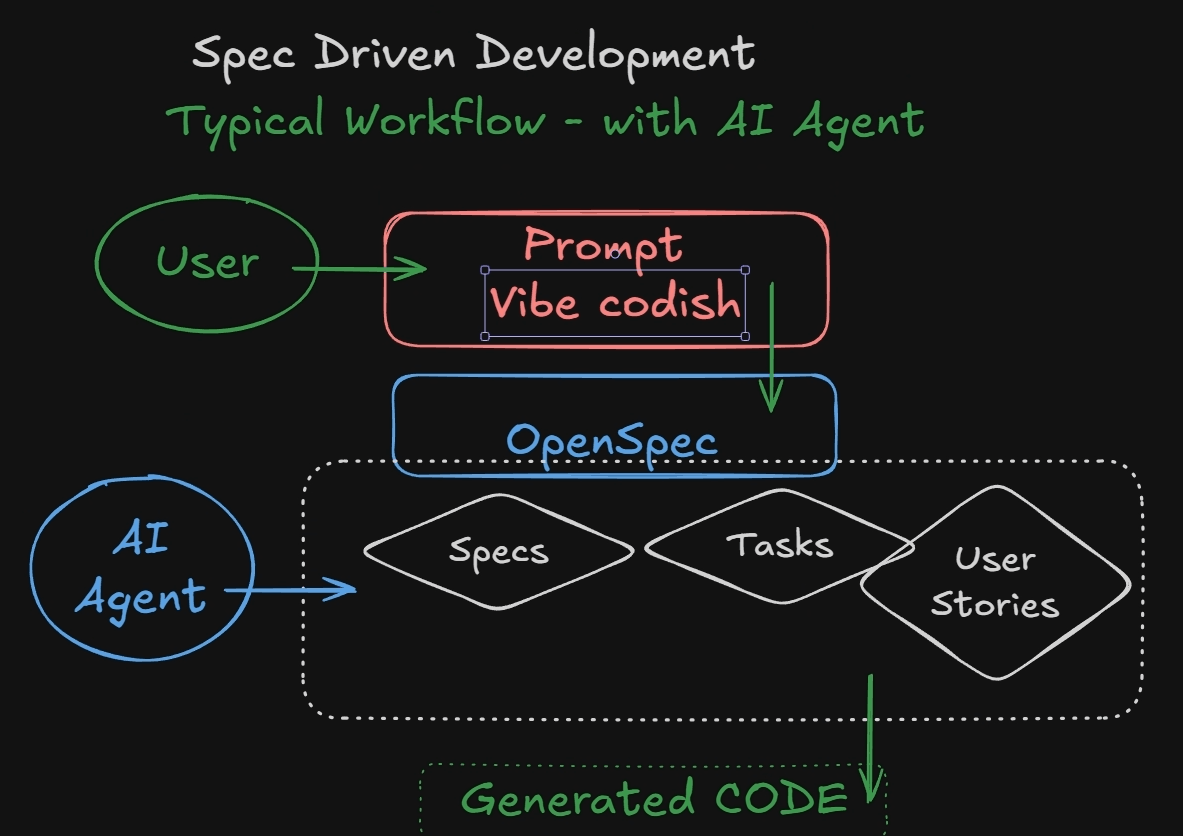
Adopt this and the shape of the work changes. Instead of coding first and thinking through edge cases when they break, you think first — idea, requirements, specification, architecture, tasks — and code generation appears near the end, not the beginning. Coding stops being the activity and becomes the last mile, the step where a settled intent gets rendered into a language a machine runs.
The spec also stops being throwaway and becomes a living asset that serves several purposes at once: documentation, product requirements, technical reference, onboarding guide for new team members, and persistent context for the AI agents doing the implementation. Because it is version-controlled alongside the code, there is a visible trail from original intent to shipped behavior. This is where the approach earns its keep on serious work — large applications with hundreds of components, multiple APIs, permissions, migrations, and background jobs are exactly the cases an AI cannot hold in working memory, and the spec externalizes that complexity so it does not have to. It is also why spec-driven methods shine on legacy modernization: you capture the essential business logic in a fresh spec, design a clean architecture, and let the agent rebuild without carrying forward inherited debt.
What a great spec answers
A strong specification answers every important question before coding begins, which is most of why it works. It states the purpose — why the application exists at all — and the users who will rely on it. It defines the features and the user flows that complete real tasks, and the business rules that draw the line between what is allowed and what is not. It specifies the data model, how systems communicate through APIs, and what happens when things fail, because error handling left implicit is error handling left out. It nails down security across authentication, authorization, validation, and rate limiting, sets concrete performance and scalability targets, and — the part teams most often skip — defines the acceptance criteria that make "done" an objective fact rather than an opinion. The practical companion to this, the prompts that turn each of these stages into reliable output, lives in our AI coding prompt library, which opens with exactly this specify-before-you-build discipline.
The honest counterargument
Spec-driven development is not a free lunch, and the most serious objection comes from people who have seen this movie before. Writing exhaustive requirements upfront and treating them as the source of truth bears an uncomfortable resemblance to Waterfall, the methodology agile was explicitly built to escape, and critics warn that over-applied, the approach can re-import the rigidity and false-certainty that early-stage software work suffers under. The risk is real: a spec frozen before anyone has learned anything is just a more elaborate way to be wrong.
The defense is that a spec is meant to be iterated, not carved in stone — you update the spec, regenerate the plan, and let the agent rebuild, which is far cheaper than reworking a large codebase by hand. The discipline is therefore not "specify everything perfectly once" but "keep the stable what separate from the flexible how, and revise the what as you learn." Used that way it is closer to behavior-driven development taken to a new level than to Waterfall revived. It also genuinely is overkill for small work: a throwaway prototype, a landing page, or a quick script rarely justifies a full spec, and pretending otherwise just adds bureaucracy. The skill is knowing when the project is large or long-lived enough that the spec pays for itself, which is most serious software and very little weekend tinkering.
The Bottom Line
Prompt engineering taught us how to talk to AI; spec engineering teaches AI what to build, and that is the more durable skill. As coding agents get more capable, the bottleneck stops being their ability to write code and becomes the clarity of the instructions they are given — which means the leverage moves from crafting clever prompts to designing clear systems — though a well-built set of AI coding prompts still helps operationalize each stage of a spec. The most effective developers in this era will not be the ones with the best phrasing; they will be the ones who can specify exactly what success looks like before a line of code exists, and who keep that spec alive as the project changes. Stop treating the agent like a genie to be coaxed and start treating it like an engineer to be briefed. Write the spec first. For the prompts that operationalize every step of it, start with the technology hub and the coding library it points to.
Explore Related Concepts
Frequently Asked Questions
What is spec-driven development?
Spec-driven development is an approach to AI-assisted programming where you write a detailed specification — what to build, the rules, the data model, the edge cases, and the acceptance criteria — before any code is generated. The specification becomes the single source of truth that the AI coding agent implements against, rather than an ad-hoc prompt.
How is a spec different from a prompt?
A prompt is a request that leaves most decisions to the model's imagination; a specification is a complete definition that leaves little room for guessing. "Build a task app" is a prompt; a document defining the users, business rules, stack, performance targets, and definition of done is a spec. The first invites improvisation, the second invites execution.
Does adding constraints make AI write worse code?
No — the opposite. Coding agents excel at pattern recognition but still need unambiguous instructions, so more precise constraints generally produce better, more aligned output. Vague freedom is where models invent architectures and edge-case handling you never asked for.
Is spec-driven development just a new name for Waterfall?
It is a fair concern. Critics note that taken too far, writing exhaustive specs upfront can reintroduce the rigidity agile methods were designed to escape. The difference in practice is that specs are meant to be iterated — you update the spec, regenerate the plan, and let the agent rebuild — rather than frozen before work begins.
When should I use spec-driven development?
It pays off most on serious, multi-component, or long-lived projects, and on legacy rebuilds where the original intent has been lost. For quick prototypes, a throwaway landing page, or a small script, a good prompt is often enough — the overhead of a full spec is only worth it when consistency and scale matter.