The Configuration
Six axes, scored against the cohort. The shape is the signal.
Scores are interpretive editorial assessments per the methodology rubric, not measured data. Facts throughout are grounded in named, published sources.
Origins
Where the system came from, and how it escalated.
Identity
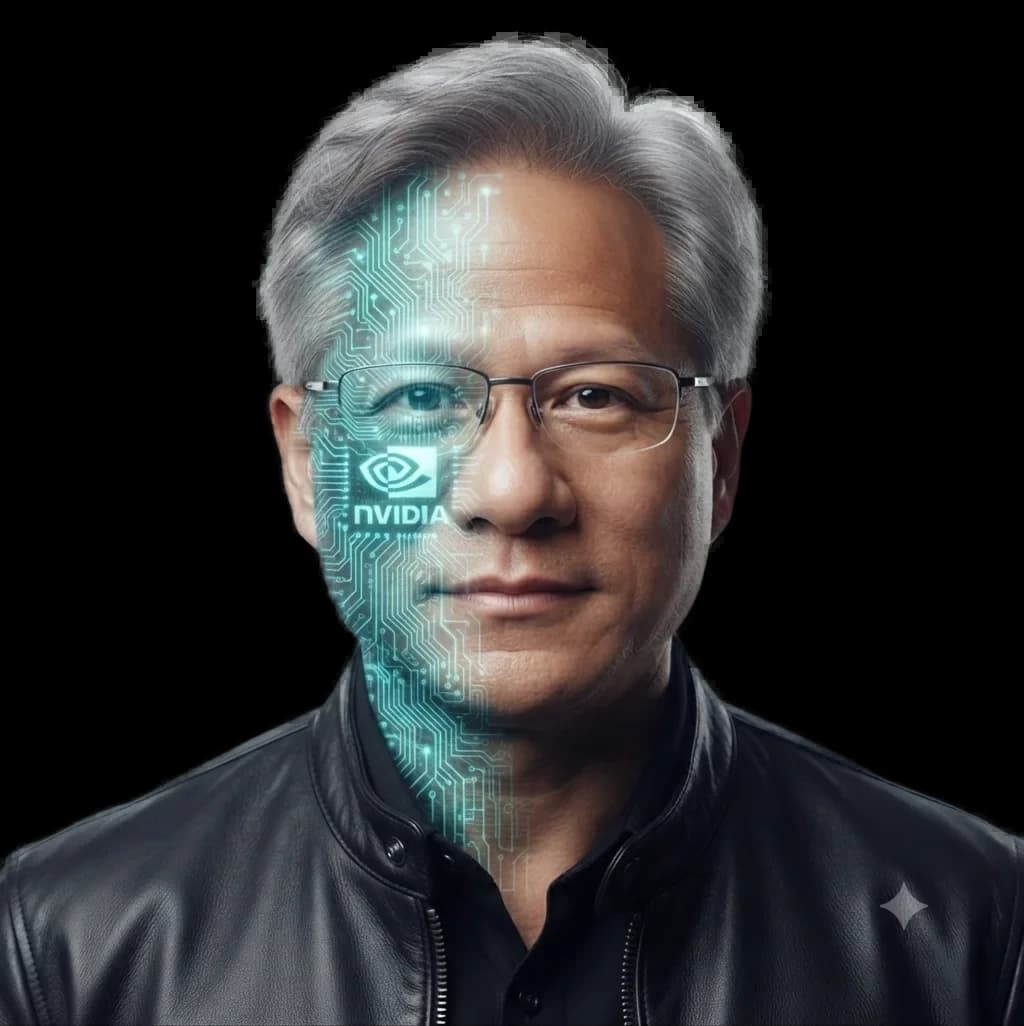
Born in Taiwan, emigrated to the United States as a child, and was for a period sent to a rural Kentucky boarding school before his family settled in Oregon; studied electrical engineering at Oregon State University and earned a master's degree from Stanford, and worked as a chip designer at LSI Logic and AMD before co-founding NVIDIA in 1993. (Wikipedia, 2026)
The formation is engineering-first and iterative — unlike a purely visionary founder narrative, Huang spent years as a working chip designer at established semiconductor companies before founding his own, giving the eventual bet on parallel computing a specific, practiced technical grounding.
Where Jobs's formation was aesthetic and self-taught, Huang's is the most conventionally technical of this cohort — a completed engineering education followed by years as an employed chip designer before founding anything.
Trajectory
Co-founded NVIDIA in 1993 to build graphics accelerator chips for gaming and multimedia; took the company public in 1999; over the 2000s and 2010s progressively repositioned NVIDIA's graphics processing units as general-purpose parallel computing hardware through the CUDA software platform, launched in 2006, well before external demand for AI training hardware existed at scale. (Wikipedia, 2026; Wikipedia, 2026; Wikipedia, 2026)
The defining move is a single, sustained repositioning bet held for roughly two decades before it paid off at scale — CUDA existed for years as a niche developer tool before the deep-learning boom made it the industry's default computing substrate.
Where most founders pivot in response to an already-visible market signal, Huang committed engineering and capital to general-purpose GPU computing roughly a decade before large-scale AI training created the demand that eventually justified it.
The Machine
How the businesses are built — and what they did to their industries.
Business Model
NVIDIA sells graphics and AI-accelerator hardware paired with CUDA, a proprietary parallel-computing software layer that most AI training and inference software is written against, creating a hardware-software lock-in that competitors' raw chip specifications alone do not overcome. (Wikipedia, 2026; Wikipedia, 2026; Wikipedia, 2026)
The model pairs a hardware sale with an entrenched software ecosystem — the moat is not the chip's performance in isolation but the fact that the dominant AI software stack is written and optimized against CUDA specifically, raising the switching cost for any customer far above the hardware price alone.
Where Jobs's vertical integration closes a consumer hardware-software loop, Huang's closes a developer-tooling loop — the lock-in operates on the programmers building on top of the platform, not on the end consumer.
Impact
NVIDIA GPUs became the hardware substrate for the deep-learning breakthroughs of the 2010s, including the 2012 AlexNet result that is widely credited with catalyzing the modern deep-learning era, and subsequently became the primary hardware supplier underpinning the large-scale generative-AI systems built from the early 2020s onward. (Wikipedia, 2026; Wikipedia, 2026)
The impact is infrastructural rather than product-facing — most consumers never buy an NVIDIA AI chip directly, but the AI systems and products they do use are trained and served on that hardware, making the impact indirect but foundational across an entire technology wave.
Few hardware companies became the default substrate for an entire subsequent technology era (deep learning, then generative AI) built by thousands of unrelated companies on top of their platform, rather than shipping their own end-user product.
The Mind
How problems get decomposed and irreversible choices get made.
Cognition
Public remarks and profiles describe a recurring framing in which Huang treats "accelerated computing" as a multi-decade platform shift rather than a product category, and describes NVIDIA's strategy in terms of anticipating a computing paradigm before the market has named it, rather than responding to already-quantified demand. (Wikipedia, 2026; Wikipedia, 2026)
This is platform-first reasoning: the unit of analysis is the entire computing paradigm over a decade-plus horizon, not a single product cycle, which explains a willingness to fund an unprofitable software platform (CUDA) for years before its market existed.
Where Buffett applies patience to capital allocation and Bezos to customer trust, Huang applies the same multi-decade patience to a specific technical thesis — that general-purpose parallel computing would eventually subsume specialized computing — held years before it was provable.
Behavior
Widely described as maintaining an unusually flat organizational structure with dozens of direct reports rather than a conventional management hierarchy, and for personally delivering the first DGX-1 AI supercomputer to OpenAI in 2016 rather than treating the delivery as a routine logistics event. (Wikipedia, 2026)
The flat-reporting structure is a deliberate anti-hierarchy choice, keeping Huang personally close to technical decisions across the organization rather than delegating through layered management — a structural echo of the same close, personal involvement visible in the DGX-1 delivery.
Where Buffett's behavioral signature is deliberate distance from operating detail, Huang's is the opposite — an organizational structure explicitly built to keep him personally close to technical decisions at a scale most CEOs delegate away entirely.
Decision Architecture
NVIDIA's multi-decade repositioning from graphics chips to general-purpose accelerated computing involved sustained R&D and software investment in CUDA for years without a clearly quantifiable near-term market, a bet that persisted through several periods when NVIDIA's stock and business faced significant pressure before the deep-learning and generative-AI waves validated it. (Wikipedia, 2026; Wikipedia, 2026)
The architecture tolerates a long, unvalidated investment period as the default cost of a platform bet — rather than requiring near-term proof before committing further resources, the framework accepts years of unclear payoff as the price of being positioned correctly when a paradigm shift eventually arrives.
Where Bezos's framework optimizes for correctly classifying decision reversibility, Huang's optimizes for tolerating years of unclear validation on a single platform thesis — the risk being managed is patience under uncertainty, not speed of individual decisions.
The Person
Temperament, influence and the values underneath the bets.
Personality
Frequently profiled for a distinctive personal style, including his signature black leather jacket at public appearances and keynotes, and described in coverage as an intense, technically detailed public speaker who often walks through architecture diagrams and roadmaps directly rather than delegating technical explanation to other executives. (Wikipedia, 2026)
The public personality blends a distinctive, consistent visual identity with genuine technical fluency delivered personally — the showmanship is real, but it is paired with direct engineering explanation rather than substituting for it.
Unlike Jobs's staged product-reveal keynote format built around a controlled reality-distortion narrative, Huang's keynote format is built around direct, extended technical exposition — the show is the depth of the explanation itself.
Power & Influence
Influence runs primarily through NVIDIA's own developer conference (GTC) keynotes, which have become closely watched industry events for AI infrastructure roadmaps, and through NVIDIA's position as a primary supplier to nearly every major AI lab and cloud provider building large-scale AI systems. (Wikipedia, 2026)
This is influence through supply-chain centrality combined with a recurring public technical briefing — being the primary hardware supplier to an entire industry gives the keynote itself outsized weight, since roadmap changes there directly affect nearly every AI lab's planning.
Where Buffett's annual event explains decisions already made and Jobs's unveiled finished consumer products, Huang's keynote functions as a forward-looking infrastructure roadmap that much of the AI industry directly plans around.
Value System
Public remarks attributed to Huang emphasize a stated willingness to "run toward" difficult, unglamorous engineering problems rather than avoid them, and a repeated framing of NVIDIA's multi-decade survival through several near-collapse periods as central to the company's identity and his own leadership narrative. (Wikipedia, 2026; Wikipedia, 2026)
The stated hierarchy prizes technical resilience and survival through adversity over smooth, uninterrupted growth — the near-death periods are treated as formative and load-bearing to the company's identity, not as embarrassments to minimize.
Where Bezos's values are customer-first and Buffett's are anti-dynastic, Huang's are survival-and-resilience-first — a value system explicitly built around having nearly failed multiple times and treating that as evidence of durability, not fragility.
The Record
The frictions, the polarization, and what is already permanent.
Friction & Constraints
NVIDIA has faced sustained scrutiny over export restrictions on advanced AI chips to certain countries, concentration risk from reliance on a small number of very large AI-lab and cloud customers, and broader industry debate over whether AI infrastructure capital spending is outpacing demonstrated commercial returns. (Wikipedia, 2026)
The friction is geopolitical and macroeconomic rather than personal — export controls and customer-concentration risk follow directly from NVIDIA's position as critical infrastructure for a strategically contested technology, not from any individual conduct issue.
Where Jobs's major friction was internal governance and Bezos's was regulatory scrutiny of market power, Huang's central friction is geopolitical — NVIDIA's product has become a subject of export-control policy between national governments.
Public Perception
· recency-sensitivePublic perception shifted substantially from "gaming graphics-chip CEO" through the 2000s and 2010s to "the person supplying the picks and shovels of the AI boom" following the generative-AI buildout of the 2020s, with NVIDIA becoming one of the most closely watched companies in global markets as a bellwether for AI infrastructure spending. (Wikipedia, 2026; Wikipedia, 2026)
The shift tracks an external technology wave (generative AI) more than any change in Huang's own strategy, which had been consistent for nearly two decades before external demand caught up to it. This layer is recency-sensitive and should be re-sourced to current reporting before publishing.
Where Bezos's perception shift tracked his own company's growth into dominance, Huang's tracked an external technology wave validating a strategy that had already been in place, largely unchanged, for roughly twenty years.
Legacy Vector
Co-founded and has led NVIDIA continuously since 1993, steering it from a gaming-graphics chip maker through several near-collapse periods into the primary hardware and software platform underlying the generative-AI buildout, with CUDA functioning as a durable software standard independent of any single hardware generation. (Wikipedia, 2026; Wikipedia, 2026)
The legacy hypothesis is the platform-before-demand thesis vindicated at maximum scale — building the software standard years ahead of the market, and having the patience to sustain it through multiple near-failures, until an entire new computing era arrived that needed exactly what had already been built.
Most hardware-company legacies are measured by a single dominant product generation; Huang's is measured by a software standard (CUDA) that has outlasted several hardware generations and shaped which computing paradigm an entire industry eventually adopted.
Voice
“I'd rather have a mission than a job.”
On leadership and purpose · public remarks“Pain and suffering is a good thing. It's a great thing, actually, if you can survive it.”
On NVIDIA's near-collapse periods · public remarks“The more you buy, the more you save.”
On accelerated computing economics · public remarks“Run toward problems, not away from them.”
Consistent with the configuration: the CUDA bet was sustained through years without clear near-term payoff and multiple periods when NVIDIA's business faced serious pressure, treating the difficulty itself as validation of the thesis rather than a reason to abandon it.
Widely attributed · public remarks and interviewsJensen in 2050
Speculative & for fun — extrapolated from the configuration, not a forecast we'd defend in court.
[Name] —
Wanted to put Jensen Huang on your radar. Short version: he co-founded a graphics-chip company in 1993 and spent roughly two decades funding a general-purpose computing platform (CUDA) years before the market that eventually needed it existed.
The throughline isn't any single chip — it's the patience to sustain an unvalidated platform bet through multiple near-collapse periods until an entire new computing era (deep learning, then generative AI) arrived needing exactly what had already been built.
Why it's worth your time: he thinks in computing paradigms, not product cycles, and he'll walk you through the architecture diagram personally rather than hand it to someone else. Bring a real technical question. Skip the small talk.
I'll let you two take it from here.
— [You]
What This Profile Is Built On
Every factual claim in the Record layers above cites one of these. Interpretation in the Reading layers is ours and is not attributable to any source below.
- Jensen Huang — Wikipedia, 2026 · article
- Nvidia — Wikipedia, 2026 · article
- CUDA — Wikipedia, 2026 · article
- Graphics processing unit — Wikipedia, 2026 · article
- Lisa Su — Wikipedia, 2026 · article
- AMD — Wikipedia, 2026 · article