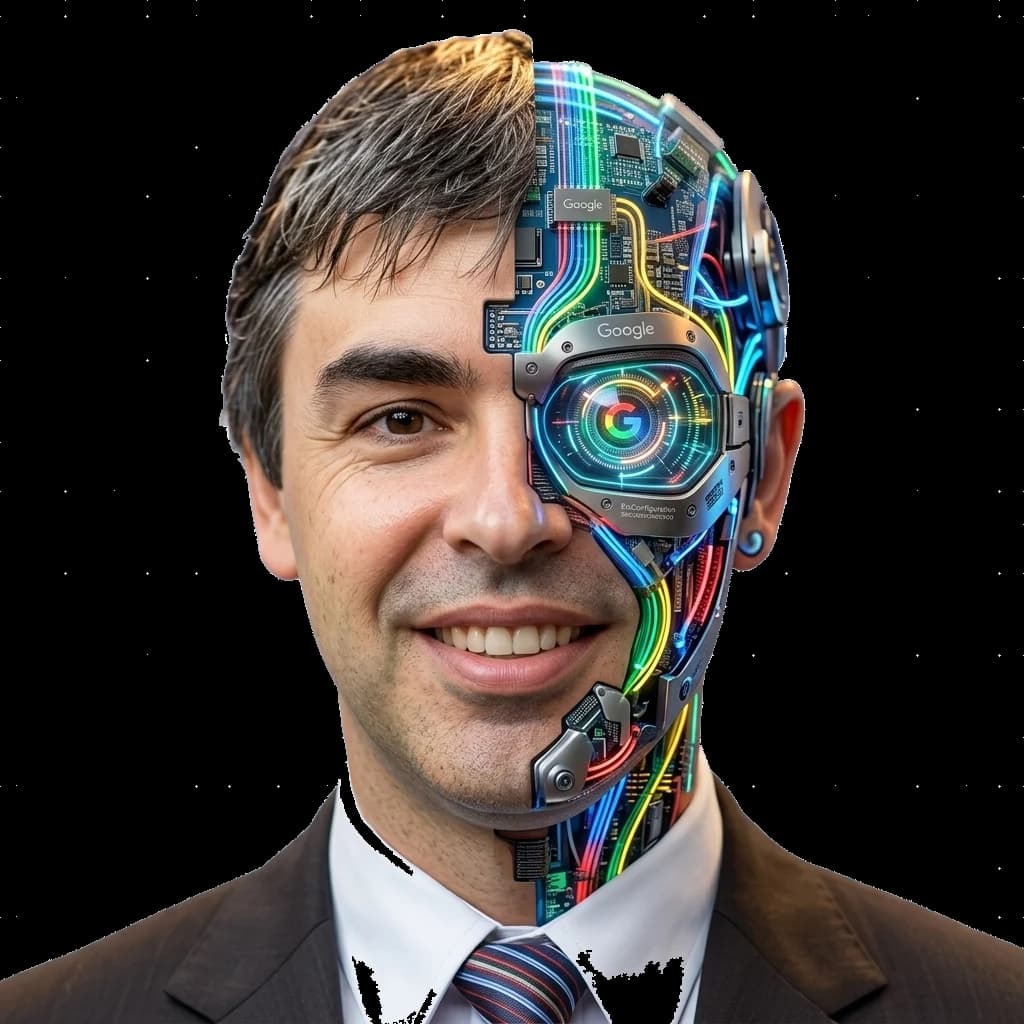
The Configuration
Six axes, scored against the cohort. The shape is the signal.
Scores are interpretive editorial assessments per the methodology rubric, not measured data. Facts throughout are grounded in named, published sources.
Origins
Where the system came from, and how it escalated.
Identity
Raised by two computer-science academics — his father a professor and his mother a computing instructor — and entered a Stanford computer science doctoral program in 1995, where the research project that became Google originated as doctoral work rather than as a commercial venture. (Wikipedia, 2026)
The formation is academic on both sides — a household organized around computing research, followed directly by a doctoral program, with no intervening commercial employment. The company arrives as a by-product of a research question, not as the goal.
Where Bezos and Dell each left an existing commercial context to found a company, Page never operated inside one first — the venture emerged from an unfinished dissertation, and the research framing preceded any business framing.
Trajectory
Co-founded Google in 1998 out of the Stanford research project, served as its first CEO, ceded the role to Eric Schmidt during the company's rapid scaling, returned as CEO in 2011, and in 2015 reorganized the company into Alphabet, a holding structure in which Google became one subsidiary among several, with Page as CEO of the parent. (Wikipedia, 2026; Wikipedia, 2026)
The trajectory cycles between building and stepping back, and each return operates at a higher level of abstraction — founder, then CEO again, then architect of a holding company positioned above the operating business entirely.
Where Jobs's return to Apple was a rescue of the same company in the same form, Page's second act changed the container itself: he came back and then built a new corporate layer above the business he had returned to run.
The Machine
How the businesses are built — and what they did to their industries.
Business Model
The 2015 Alphabet restructuring separated the profitable core Google businesses (search, advertising, YouTube, Android) from a set of unprofitable, long-horizon research ventures — self-driving cars, life sciences, and other "Other Bets" — placing them as distinct subsidiaries under a common holding company with separate financial reporting. (Wikipedia, 2026)
The structure is a funding mechanism disguised as an org chart. Separating the cash-generating advertising business from the long-horizon research bets lets each be judged on its own terms, so speculative ventures are not measured against search-level margins and search is not asked to subsidize them invisibly.
Where most founders defend the core business by keeping speculative projects inside it and hidden from investors, Page did the opposite — he made the unprofitable bets structurally visible and separately reported, which required defending them in public rather than burying them in a single P&L.
Impact
The PageRank algorithm ranked web pages by treating links from other pages as weighted votes of importance, rather than by counting keyword occurrences on the page itself, and became the basis of the search engine described in the 1998 Anatomy paper. (Wikipedia, 2026; Page, 1998)
The impact is epistemic before it is commercial. Deciding relevance from the structure of links between documents rather than the words inside them changed what "authoritative" means on the open web, and that ranking judgment became the default filter through which most people encounter most information.
Unlike peers whose impact is a product category or a market, Page's is a ranking function: a mathematical judgment about which documents matter, applied at planetary scale and largely invisible to the people it governs.
The Mind
How problems get decomposed and irreversible choices get made.
Cognition
The 1998 Anatomy paper frames web search as a problem of modelling the link structure of the entire web as a graph, deriving a page's importance recursively from the importance of the pages linking to it, rather than as a document-retrieval problem solved by matching query terms to page contents. (Page, 1998; Wikipedia, 2026)
The cognitive move is to change the unit of analysis. Everyone else was analysing pages; the insight was to analyse the relationships between pages and let importance fall out of the topology. The hard part was not the mathematics but deciding that the graph, not the document, was the right object to study.
Where Buffett's reasoning applies a stable valuation frame to a changing set of businesses, Page's characteristic move is the inverse: keep the domain fixed and change the frame — re-specifying what the problem is about until the answer becomes computable.
Behavior
Withdrew almost entirely from public speaking, earnings calls and press appearances during and after his Alphabet CEO tenure, and stepped down from that role in 2019 while retaining board membership and, with Brin, controlling voting influence through a dual-class share structure. (Wikipedia, 2026; Wikipedia, 2026)
The behavioral signature is retained control paired with abandoned visibility — the public-facing duties of the office are shed while the decisive structural power is not. Influence is exercised through governance instruments rather than presence.
Where Musk's and Huang's influence depends on continuous public performance, Page's survives its total absence: he can exert control over Alphabet without appearing in public at all, because the control is chartered rather than charismatic.
Decision Architecture
The 2004 founders' IPO letter explicitly warned prospective shareholders that Google would not manage toward quarterly earnings predictability, would make long-term bets that might look unreasonable to public markets, and was adopting a dual-class share structure specifically so the founders could retain decision-making control after the offering. (Brin, 2004; Wikipedia, 2026)
This is decision architecture written down in advance and enforced by charter. Rather than relying on winning each future argument with shareholders, the structure removes their standing to make the argument, converting a repeated negotiation into a one-time structural choice made at the moment of maximum leverage.
Where Su committed publicly to a roadmap and accepted the accountability that followed, Page did the reverse — he pre-emptively removed the mechanism by which outsiders could hold the roadmap to account, and said so plainly in the prospectus.
The Person
Temperament, influence and the values underneath the bets.
Personality
Consistently described in press coverage as reserved and averse to public appearances relative to peers of comparable prominence, with a marked reduction in public communication following his 2019 departure from the Alphabet CEO role. (Wikipedia, 2026)
The temperament reads as genuine indifference to public standing rather than strategic mystique — the withdrawal continued after there was any positional reason for it, which suggests preference rather than tactic.
Among founders of comparable scale, Page is unusual in having no sustained public persona at all: no keynote format, no recurring letter, no interview cadence — the influence is exercised entirely through structure and ownership.
Power & Influence
Retains, together with Brin, a controlling share of Alphabet voting power through the dual-class structure established at the 2004 IPO, despite neither holding an executive position at the company since 2019. (Wikipedia, 2026; Brin, 2004)
The influence is structural and durable in a way personal influence is not — it does not decay with absence, cannot be removed by a board, and requires no ongoing performance to maintain. It is the most transferable form of power in this cohort.
Where Jobs's and Musk's power required their continuous presence to function, Page's persists precisely because he is absent — an arrangement deliberately engineered fifteen years before he used it that way.
Value System
The 2004 founders' letter states an explicit preference for long-term value creation over short-term earnings smoothness, describes Google as not a conventional company, and frames the willingness to pursue speculative projects with uncertain payoffs as central to the company's purpose. (Brin, 2004)
The stated hierarchy puts optionality above predictability — the right to attempt low-probability, high-consequence projects is treated as the thing worth protecting, and governance is designed backwards from that protection.
Where Buffett's values organize around refusing all but the highest-conviction opportunities, Page's organize around preserving the ability to fund many low-conviction ones — opposite postures toward the same problem of scarce attention.
The Record
The frictions, the polarization, and what is already permanent.
Friction & Constraints
Alphabet has faced sustained antitrust scrutiny and regulatory action in multiple jurisdictions concerning the dominance of its search and advertising businesses, alongside recurring public debate over the data-collection practices underlying its advertising model. (Wikipedia, 2026)
The friction is a direct consequence of the mechanism that produced the success — a ranking function that determines what most people see is, by construction, an object of public interest, and its neutrality cannot be verified from outside.
Where Su's central constraint is competitive scale against larger rivals, Page's is the opposite problem: the constraints arrive precisely because no rival is close enough to discipline the business, so regulators substitute for competition.
Public Perception
· recency-sensitivePublic framing of Google shifted over two decades from a widely admired research-driven challenger to an incumbent subject to antitrust and privacy scrutiny, while Page himself largely receded from public discussion following his 2019 departure from the CEO role. (Wikipedia, 2026; Wikipedia, 2026)
Two trajectories diverge here: the company's public standing became more contested while the founder's personal visibility approached zero, so criticism increasingly attaches to the institution rather than to him. This layer is recency-sensitive and should be re-sourced before republishing.
Unlike peers whose personal reputation moves with their company's, Page has become progressively decoupled from Alphabet's public standing — he retains the control without absorbing the scrutiny.
Legacy Vector
Co-authored the ranking method underlying Google Search and co-founded the company that commercialized it, then established the Alphabet holding structure that separated the core advertising business from long-horizon research ventures under common founder control. (Wikipedia, 2026; Page, 1998; Wikipedia, 2026)
The legacy hypothesis is dual: an algorithm that changed how authority is determined on the open web, and a corporate structure demonstrating that a dominant cash business can be chartered to underwrite speculative research indefinitely, provided control is secured before the market can object.
Most technology legacies are a product or a company; Page's is a ranking function plus a governance template — the second of which has been copied by later founders far more deliberately than the first.
Voice
“If you are not doing some things that are crazy, then you are doing the wrong things.”
On long-horizon bets · public remarks“It's often easier to make progress on mega-ambitious dreams than small ones.”
On problem selection · public remarks“Always deliver more than expected.”
On execution · public remarks“Have a healthy disregard for the impossible.”
Consistent with the configuration, and note what it is not: it is not a claim that impossible things are easy. The structural work — dual-class control secured at IPO, a holding company separating the bets from the cash engine — exists precisely because a healthy disregard for the impossible is expensive, and someone has to be unable to stop you funding it.
Widely attributed · public remarksLarry in 2050
Speculative & for fun — extrapolated from the configuration, not a forecast we'd defend in court.
[Name] —
Wanted to put Larry Page on your radar, with the caveat that reaching him is genuinely difficult — he has been almost entirely absent from public life since stepping down as Alphabet CEO in 2019.
Short version: he noticed that links between web pages were votes, turned that into the ranking function behind Google Search, and then built a holding company specifically so the advertising business could fund research bets that no public market would ever approve.
Why it's worth your time: he reframes problems rather than solving the stated one. Bring a question about the shape of a problem, not a proposal. And expect the structural answer, not the product one.
I'll let you two take it from here.
— [You]
What This Profile Is Built On
Every factual claim in the Record layers above cites one of these. Interpretation in the Reading layers is ours and is not attributable to any source below.
- Larry Page — Wikipedia, 2026 · article
- The Anatomy of a Large-Scale Hypertextual Web Search Engine — Sergey Brin and Lawrence Page, 1998 · article
- PageRank — Wikipedia, 2026 · article
- Alphabet Inc. — Wikipedia, 2026 · article
- 'An Owner's Manual' for Google's Shareholders (2004 IPO founders' letter) — Larry Page and Sergey Brin, 2004 · other