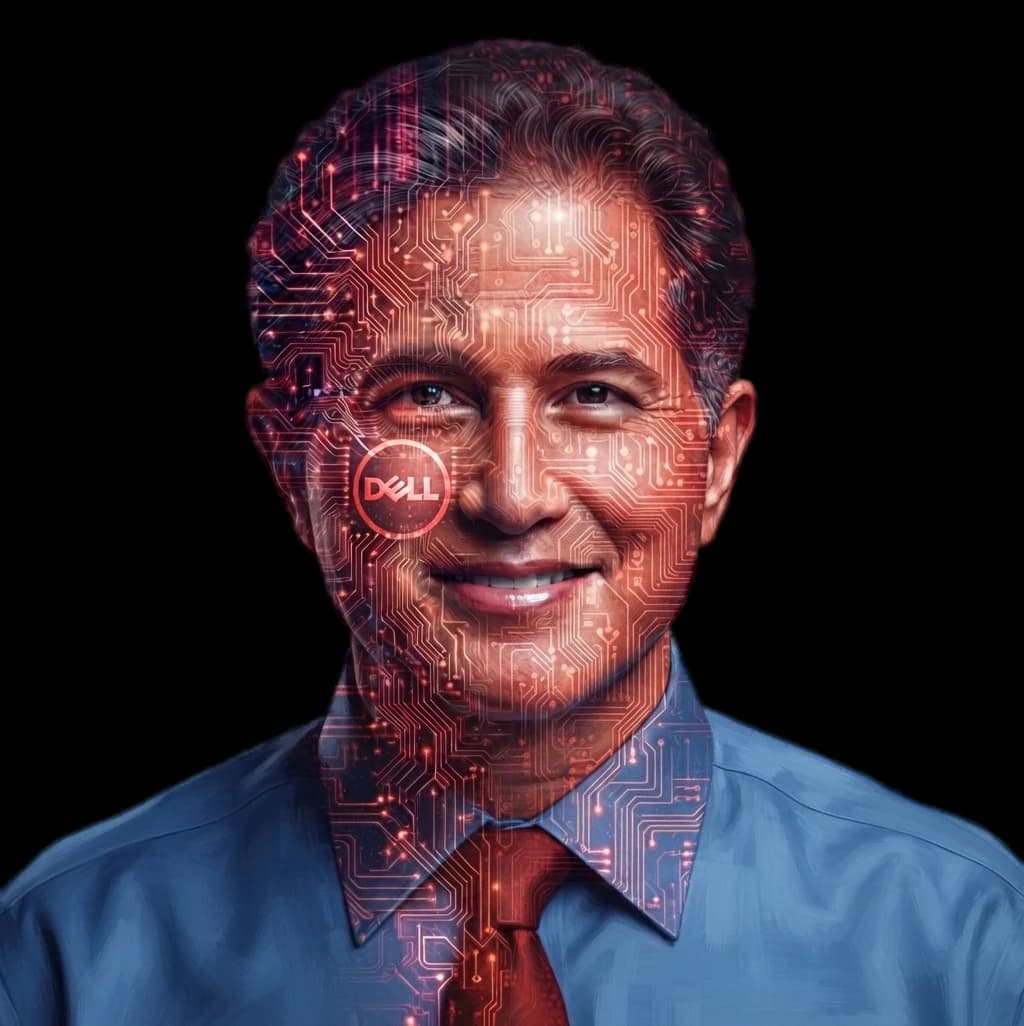
The Configuration
Six axes, scored against the cohort. The shape is the signal.
Scores are interpretive editorial assessments per the methodology rubric, not measured data. Facts throughout are grounded in named, published sources.
Origins
Where the system came from, and how it escalated.
Identity
Founded the company in 1984 at the age of nineteen from a dormitory room at the University of Texas at Austin, selling upgraded personal computers directly to buyers, and left formal education to run the business as it grew. (Wikipedia, 2026; Wikipedia, 2026)
The formation is commercial from the first day and analytical rather than technical — the founding act was noticing a margin structure in how PCs reached buyers, not designing a machine. That distinction determines everything the company later optimizes.
Where Page, Brin and Su each arrived through deep technical education, Dell entered through arbitrage on a distribution channel — the founding insight is about who captures the margin, not about what the product does.
Trajectory
Grew the company from a dorm-room operation to a public company by 1988 and a dominant PC vendor through the 1990s; took it private in a 2013 leveraged buyout, acquired EMC in 2016 to form Dell Technologies, and returned the company to public markets in 2018. (Wikipedia, 2026; Wikipedia, 2026)
The trajectory is unusual in crossing the public-private boundary twice by choice. Most founders treat listing as a terminal state; here it is a reversible condition, entered and exited according to whether public scrutiny helps or hinders the current rebuild.
Where Page secured freedom from public markets via share class at IPO, Dell purchased the same freedom later and at far greater expense — buying the company back outright rather than engineering control before selling any of it.
The Machine
How the businesses are built — and what they did to their industries.
Business Model
The company built computers to order after receiving a customer order and sold directly to buyers rather than through retail distributors, allowing it to hold minimal finished-goods inventory and to collect payment from customers before settling supplier invoices. (Wikipedia, 2026; Wikipedia, 2026)
This is a financing structure wearing a manufacturing costume. Building only after payment inverts the ordinary working-capital cycle: growth funds itself from customer cash rather than consuming capital, so expansion accelerates instead of straining the balance sheet.
Where every other subject in this cohort funded growth from profits, outside capital, or an unrelated cash engine, Dell funded it from the timing gap between being paid and paying — the customers were, in effect, the lender.
Impact
The direct-sales, build-to-order approach became a widely studied model in the personal computer industry during the 1990s, pressuring competitors that relied on retail distribution channels and finished-goods inventory. (Wikipedia, 2026)
The impact is operational rather than inventive — it changed what an efficient PC business looked like and forced rivals to defend a cost structure they had assumed was fixed. The competitive pressure came from the cash cycle, not the machines.
Unlike peers whose impact is a new product category, Dell's is a supply-chain configuration: the industry copied the operating model, and there was no patent standing in the way of them doing so.
The Mind
How problems get decomposed and irreversible choices get made.
Cognition
The founding insight was that personal computers sold through retail carried distribution margins and inventory costs that could be removed by selling directly to buyers and assembling only after an order was placed. (Wikipedia, 2026; Wikipedia, 2026)
The cognitive move is to treat an industry's accepted cost structure as a variable rather than a constant. The technology was commodity and stayed commodity; what was reconsidered was the path the product takes to a buyer and who finances it in transit.
Where Jobs's reasoning starts from the experience of the object and works backward, Dell's starts from the cost of delivering it and works forward — the product specification is an output of the logistics, not an input to it.
Behavior
In 1997 he publicly stated that if he ran Apple he would shut it down and return the money to shareholders, a remark Steve Jobs referenced afterward as Apple recovered; Dell later congratulated Apple as its market value surpassed Dell's own. (Wikipedia, 2026; Wikipedia, 2026)
The 1997 assessment was internally consistent with the model: judged purely on unit economics and inventory efficiency, Apple then was a poor business. It was wrong because the framework does not price brand and product taste — a blind spot the framework cannot see from inside itself.
This is the cohort's clearest documented case of a correct analytical method producing a badly wrong conclusion, and of the author of it publicly acknowledging the outcome afterward.
Decision Architecture
Took the company private in 2013 through a leveraged buyout with Silver Lake Partners, a transaction that faced shareholder opposition, then executed the debt-financed EMC acquisition in 2016 before relisting the combined company in 2018. (Wikipedia, 2026; Wikipedia, 2026)
The architecture treats public-market visibility as a cost to be paid down. A multi-year pivot into enterprise infrastructure would have been punished quarter by quarter, so the scrutiny was removed first, at the price of substantial leverage, and the transformation attempted in private.
Where Buffett avoids leverage as a matter of principle and Su could not access it, Dell used it deliberately as the instrument for buying operational privacy — debt exchanged for freedom from observation.
The Person
Temperament, influence and the values underneath the bets.
Personality
Has led the company continuously since founding it in 1984, through its public listing, its 2013 privatization and its 2018 relisting, remaining chairman and chief executive across four decades. (Wikipedia, 2026; Wikipedia, 2026)
Four decades in the same seat, across two changes of corporate form, indicates a temperament oriented to continuity of control rather than to founding, exiting, or reinventing elsewhere. The company changed shape repeatedly; the operator did not change.
The longest continuous founder-CEO tenure in this cohort, and the only one that spans taking a public company private and returning it to the market under the same leadership.
Power & Influence
Holds a substantial ownership position in Dell Technologies following the 2013 buyout and 2018 relisting, and serves as its chairman and chief executive. (Wikipedia, 2026; Wikipedia, 2026)
The influence is concentrated inside one company and rests on ownership plus operating command together, rather than on public profile — it does not extend far beyond the enterprise-technology sector, and does not need to.
Where Page and Brin retain control while holding no executive role, Dell holds both simultaneously — ownership and daily operating authority in the same hands, which neither of them chose to keep.
Value System
The company's strategic direction under his leadership has consistently prioritized operational efficiency, supply-chain control and direct customer relationships, including through the transition from consumer PCs toward enterprise infrastructure after the EMC acquisition. (Wikipedia, 2026; Wikipedia, 2026)
The stated hierarchy puts operational control and customer proximity above product novelty. Consistent across forty years and two changes of corporate form, which makes it a genuine ordering rather than a slogan attached after the fact.
Where Jobs's values place the artifact first and the operations in service of it, Dell's invert that ordering entirely — the operating system of the business is the thing being perfected, and the product follows from it.
The Record
The frictions, the polarization, and what is already permanent.
Friction & Constraints
The 2013 privatization drew shareholder opposition over the transaction price, and the subsequent EMC acquisition left the combined company carrying substantial debt as it competed in enterprise infrastructure against larger cloud-scale rivals. (Wikipedia, 2026; Wikipedia, 2026)
The constraint is the direct cost of the strategy: leverage bought the privacy in which to transform, and the resulting debt narrowed the room for error in a market where hyperscale cloud providers were absorbing exactly the enterprise workloads being bet on.
The only subject here whose principal constraint was self-imposed and deliberately purchased — the debt was not a misfortune but the agreed price of removing public scrutiny.
Public Perception
· recency-sensitivePublic framing shifted from a 1990s narrative of a disruptive direct-sales challenger, through a period of questioned relevance as PC growth slowed, to renewed attention following the EMC acquisition and the company's repositioning toward enterprise infrastructure. (Wikipedia, 2026; Wikipedia, 2026)
Perception has tracked the category rather than the operator — judged declining when PCs declined, revalued when the enterprise pivot began paying — which suggests the market reads him through his market, not through his method. This layer is recency-sensitive and should be re-sourced before republishing.
Unlike peers whose perception turns on personal controversy or charisma, Dell's has moved almost entirely with the fortunes of a product category he had already decided to move away from.
Legacy Vector
Built a direct build-to-order PC business into a major technology company, executed one of the largest leveraged buyouts in technology to take it private in 2013, acquired EMC in 2016, and relisted the combined enterprise-focused company in 2018. (Wikipedia, 2026; Wikipedia, 2026; Wikipedia, 2026)
The legacy hypothesis is that operational and financial architecture can substitute for product invention as a durable competitive position — and, more unusually, that a founder can un-list and re-list a company as a deliberate instrument for changing what it is.
Most founder legacies rest on an invention or a category; Dell's rests on a cash-conversion cycle and a pair of transactions — a legacy written in working capital and leverage rather than in products.
Voice
“Ideas are commodity. Execution of them is not.”
On execution · public remarks“You do not have to be a genius or a visionary or even a college graduate to be successful. You just need a framework and a dream.”
On starting out · public remarks“Try never to be the smartest person in the room.”
On teams · public remarks“Don't spend so much time trying to choose the perfect opportunity that you miss the right opportunity.”
Consistent with the configuration. The founding decision was not a superior insight about computers — it was acting immediately on an ordinary observation about distribution margins while still a student. The advantage came from the operating discipline applied afterward, not from the quality of the initial idea.
Widely attributed · public remarksMichael in 2050
Speculative & for fun — extrapolated from the configuration, not a forecast we'd defend in court.
[Name] —
Wanted to put Michael Dell on your radar. He started the company at nineteen from a dorm room in 1984 and has run it ever since — through an IPO, a leveraged buyout that took it private in 2013, the EMC acquisition, and a return to public markets in 2018.
The throughline is not the hardware. It is that he treated the supply chain as the actual product: build only after the customer orders, collect before you pay suppliers, and let the cash cycle fund the growth.
Why it's worth your time: he thinks in operating structure and working capital, and he has twice restructured the entire company to get room to execute. Bring an operational problem with numbers attached. He will find the margin.
I'll let you two take it from here.
— [You]
What This Profile Is Built On
Every factual claim in the Record layers above cites one of these. Interpretation in the Reading layers is ours and is not attributable to any source below.
- Michael Dell — Wikipedia, 2026 · article
- Dell — Wikipedia, 2026 · article
- Dell Technologies — Wikipedia, 2026 · article
- Steve Jobs — Wikipedia, 2026 · article