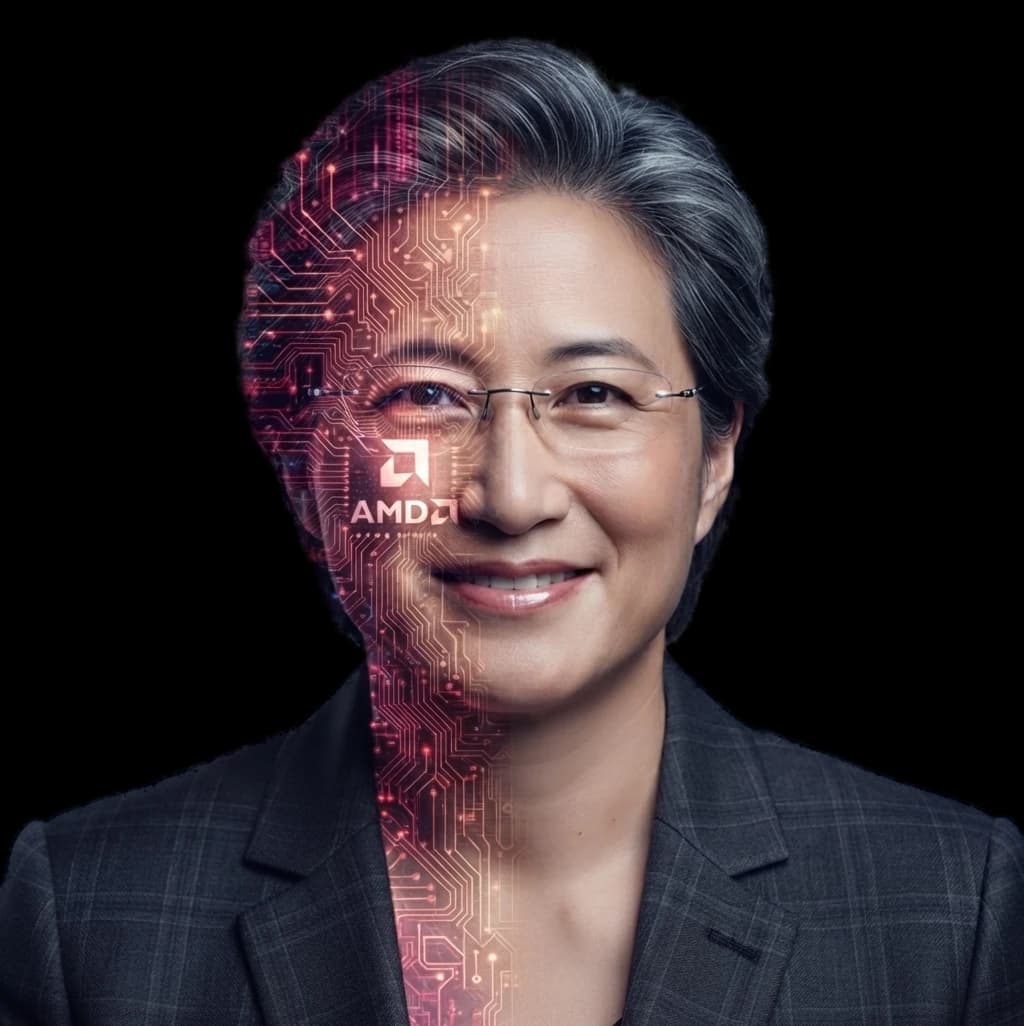
The Configuration
Six axes, scored against the cohort. The shape is the signal.
Scores are interpretive editorial assessments per the methodology rubric, not measured data. Facts throughout are grounded in named, published sources.
Origins
Where the system came from, and how it escalated.
Identity
Born in Taiwan and emigrated to the United States as a child; earned bachelor's, master's and PhD degrees in electrical engineering from MIT, and began her career as a semiconductor device researcher at Texas Instructions and IBM before moving into executive roles at Freescale Semiconductor. (Wikipedia, 2026)
The formation is deep-technical and credentialed to an unusual degree even within this cohort — a completed doctorate in the specific engineering discipline (semiconductor devices) her later company would depend on, preceded by years as a hands-on researcher rather than a manager.
Where Huang's formation combined engineering education with early chip-design employment, Su's is deeper still on the research side — a completed PhD in the exact technical domain, with published device research preceding any executive role.
Trajectory
Held senior engineering and business roles at IBM and Freescale Semiconductor before joining AMD in 2012; became AMD's president and CEO in 2014, at a point when the company faced severe financial distress and was widely questioned as a viable long-term competitor to Intel; led a multi-year turnaround culminating in the 2017 Ryzen CPU launch and a broad recovery in market position through the following decade. (Wikipedia, 2026; Wikipedia, 2026)
The defining feature is taking control of a company at its structural low point, not its founding or its stable growth phase — the trajectory is a rescue and rebuild executed from inside an already-existing, badly damaged organization.
Where Bezos and Huang built their companies from founding forward, and Buffett took control of a struggling but solvent business, Su took the CEO seat at a company whose near-term survival was genuinely in question — the turnaround itself is the trajectory, not a side effect of it.
The Machine
How the businesses are built — and what they did to their industries.
Business Model
Under Su, AMD narrowed a previously sprawling and underfunded product roadmap around a single unified "Zen" CPU microarchitecture used consistently across consumer, server and later data-center product lines, replacing multiple divergent, poorly resourced chip designs with one core architecture reused and scaled across markets. (Wikipedia, 2026; Wikipedia, 2026)
The model is architectural consolidation as strategy — rather than developing separate designs for each market segment, one core architecture is engineered once and adapted across consumer, server and data-center products, concentrating limited R&D resources instead of spreading them thin.
Where Huang's moat is a software layer (CUDA) sitting on top of the hardware, Su's moat is architectural discipline underneath the hardware itself — one design reused everywhere, chosen specifically because the company could no longer afford to fund multiple divergent roadmaps.
Impact
The Ryzen and subsequent data-center CPU lines are credited with restoring meaningful competition in a CPU market that had, for years prior, been dominated by a single supplier, and with re-establishing AMD as a credible second source for enterprise and cloud data-center customers. (Wikipedia, 2026; Wikipedia, 2026)
The impact is market-structural — restoring genuine competition to a near-monopolized category benefits the entire buyer ecosystem (cloud providers, enterprises, consumers) through pricing and innovation pressure that a single dominant supplier does not face.
Few executive turnarounds are measured by having single-handedly restored competitive balance to an entire category that had drifted toward effective monopoly before their arrival.
The Mind
How problems get decomposed and irreversible choices get made.
Cognition
Public accounts of AMD's turnaround describe an early, deliberate strategic choice under Su to exit or de-prioritize product lines and markets where AMD could not realistically compete for leadership, concentrating engineering resources on a smaller number of core bets — principally the unified Zen architecture — rather than defending market presence everywhere at once. (Wikipedia, 2026; Wikipedia, 2026)
This is resource-constrained triage reasoning: with limited capital and engineering headcount relative to larger rivals, the cognitive task is not choosing the best opportunity in the abstract but choosing the smallest set of bets the company could actually fund to completion.
Where Huang's platform bet was made from a position of relative stability, Su's architectural bet was made under genuine resource scarcity — the same instinct to concentrate on one long-term thesis, but forced by survival constraints rather than chosen from strength.
Behavior
Widely described in profiles as an engineering-first executive who engages directly with technical roadmap details rather than delegating architecture decisions entirely, and as maintaining a public communication style focused on specific, quantified execution milestones (product launch cadences, market-share figures) rather than broad visionary framing. (Wikipedia, 2026)
The behavioral signature is quantified execution discipline — public commitments are stated as specific, trackable milestones, which creates accountability pressure on the roadmap itself and signals confidence grounded in engineering specifics rather than aspiration.
Where Jobs's and Huang's public communication leans toward narrative and paradigm framing, Su's leans toward specific, numerically trackable execution commitments — the credibility mechanism is measurable delivery, not story.
Decision Architecture
AMD's turnaround under Su involved multi-year roadmap commitments to the Zen architecture announced publicly well before the resulting products shipped, a sequencing choice that concentrated financial risk on a single architecture succeeding rather than hedging across several parallel designs. (Wikipedia, 2026; Wikipedia, 2026)
The architecture accepts concentrated, sequenced risk as the necessary cost of a resource-constrained recovery — committing publicly to a multi-year roadmap before the first product ships removes the option to quietly hedge, which raises the cost of failure but also the credibility of the commitment to customers and investors.
Where Buffett's architecture is optimized around a high rejection rate to preserve capital, Su's is optimized around committing scarce capital to fewer, larger, sequenced bets — rejection wasn't a repeatable daily discipline so much as a one-time structural triage made early in the turnaround.
The Person
Temperament, influence and the values underneath the bets.
Personality
Described across business press coverage as measured and understated in public communication relative to some industry peers, with a reputation for direct, specific answers in interviews and public appearances rather than broad promotional framing, alongside recognition for the scale of the AMD turnaround she led. (Wikipedia, 2026)
The public personality is deliberately low-key relative to the scale of the underlying achievement — the turnaround itself is dramatic, but the public communication style stays specific and understated rather than matching that drama with equivalent public showmanship.
Unlike Huang's or Jobs's stagecraft-forward public presence, Su's public register stays close to specifics and understatement even while describing what is, by outcome, one of the more dramatic corporate turnarounds in the semiconductor industry's recent history.
Power & Influence
Her influence runs primarily through AMD's product roadmap announcements and investor communications, and through her standing as one of the most prominent women CEOs in the global semiconductor industry — a sector where senior technical executive roles have historically skewed heavily male. (Wikipedia, 2026; Wikipedia, 2026)
This is influence built on demonstrated execution inside a narrow, technically specialized industry rather than broad public-facing media presence — the audience that follows her closely is concentrated among investors, engineers and industry analysts rather than a general consumer public.
Where Buffett's and Jobs's influence runs through a recurring mass-audience public ritual, Su's runs through a narrower but highly technically credentialed channel — industry and investor attention earned through roadmap execution, not a mass-market keynote format.
Value System
Public remarks attributed to Su repeatedly emphasize long-term technology roadmap planning, treating engineering culture and talent retention as central to competitiveness in the semiconductor industry, and framing sustained, incremental execution over multiple product generations as more decisive than any single breakthrough product. (Wikipedia, 2026)
The stated hierarchy places roadmap continuity and engineering-culture durability above any single hit product — value compounds across generations of a shared architecture, not from one standout launch, which matches the actual mechanism of the AMD turnaround itself.
Where Huang's values center on tolerating unvalidated risk over long horizons, Su's center on sustained incremental execution across product generations — the emphasis is compounding delivery, not a single visionary bet held through uncertainty.
The Record
The frictions, the polarization, and what is already permanent.
Friction & Constraints
AMD continues to compete against much larger, better-capitalized rivals (Intel in CPUs, NVIDIA in AI accelerators), and remains reliant on external semiconductor foundries for manufacturing, a structural constraint shared across the fabless chip-design industry rather than unique to AMD. (Wikipedia, 2026)
The friction is competitive and structural rather than reputational — AMD's scale disadvantage against Intel and NVIDIA, and its dependence on external manufacturing capacity, are ongoing constraints inherent to its position in the industry rather than events tied to any specific decision.
Where Huang's central friction is geopolitical (export controls on a product he controls the full supply of), Su's is competitive scale — operating a smaller, fabless company against larger, often vertically-integrated or better-resourced rivals in every major product category.
Public Perception
· recency-sensitivePublic and industry perception shifted from widespread skepticism about AMD's viability in the early years of her tenure to broad recognition of the turnaround's success by the early 2020s, with her leadership frequently cited in business press as a case study in corporate recovery and semiconductor industry competition. (Wikipedia, 2026; Wikipedia, 2026)
The shift tracks demonstrated, multi-year execution results rather than a single announcement or event — perception moved gradually as each successive product generation delivered on the roadmap commitments made years earlier. This layer is recency-sensitive and should be re-sourced to current reporting before publishing.
Where several peers' perception shifts trace to a single event (an acquisition, a controversy), Su's traces to the cumulative, multi-year delivery of a roadmap that was publicly committed to well before results were visible.
Legacy Vector
Led AMD from a period of severe financial distress in 2014 to a position of renewed competitiveness against Intel in CPUs and a growing presence in AI accelerators by the mid-2020s, executed through a sustained, multi-generation commitment to a single unified chip architecture rather than a single breakthrough product. (Wikipedia, 2026; Wikipedia, 2026)
The legacy hypothesis is that disciplined architectural focus, sustained under genuine resource scarcity, can rebuild a company's competitive position from a near-failure state — a template for turnaround-by-consolidation rather than turnaround-by-acquisition or turnaround-by-pivot.
Most semiconductor-industry turnaround stories involve an acquisition or a market pivot; Su's is measured instead by architectural consolidation sustained across multiple product generations from a position of genuine near-insolvency — a narrower, harder path that took longer to validate.
Voice
“In the technology industry, we have to think about what's next, always.”
On roadmap planning · public remarks“Execution is everything.”
On AMD's turnaround · public remarks“I've always believed that if you focus on the innovation and the technology, the business follows.”
On engineering-first strategy · interviews“Do what you say you're going to do.”
Consistent with the configuration: multi-year roadmap commitments were made publicly, well before the resulting products shipped, at a point when AMD had little credibility buffer to spare if they failed. The discipline wasn't picking the boldest possible bet — it was picking a small enough set of bets the company could actually deliver on, then delivering.
Widely attributed · interviews and public remarksLisa in 2050
Speculative & for fun — extrapolated from the configuration, not a forecast we'd defend in court.
[Name] —
Wanted to put Lisa Su on your radar. Short version: she took the CEO seat at AMD in 2014 when the company's near-term survival was genuinely in question, and rebuilt it by concentrating everything on one unified chip architecture instead of defending every market at once.
The throughline isn't a single product — it's the discipline to say no to markets AMD couldn't realistically win and commit publicly, years in advance, to a roadmap the company could actually fund to completion.
Why it's worth your time: she thinks in multi-generation architecture roadmaps and delivers on public commitments made years before the payoff is visible. Bring a specific execution question. Skip the vision-statement pitch.
I'll let you two take it from here.
— [You]
What This Profile Is Built On
Every factual claim in the Record layers above cites one of these. Interpretation in the Reading layers is ours and is not attributable to any source below.
- Lisa Su — Wikipedia, 2026 · article
- AMD — Wikipedia, 2026 · article
- Ryzen — Wikipedia, 2026 · article
- Jensen Huang — Wikipedia, 2026 · article
- Graphics processing unit — Wikipedia, 2026 · article