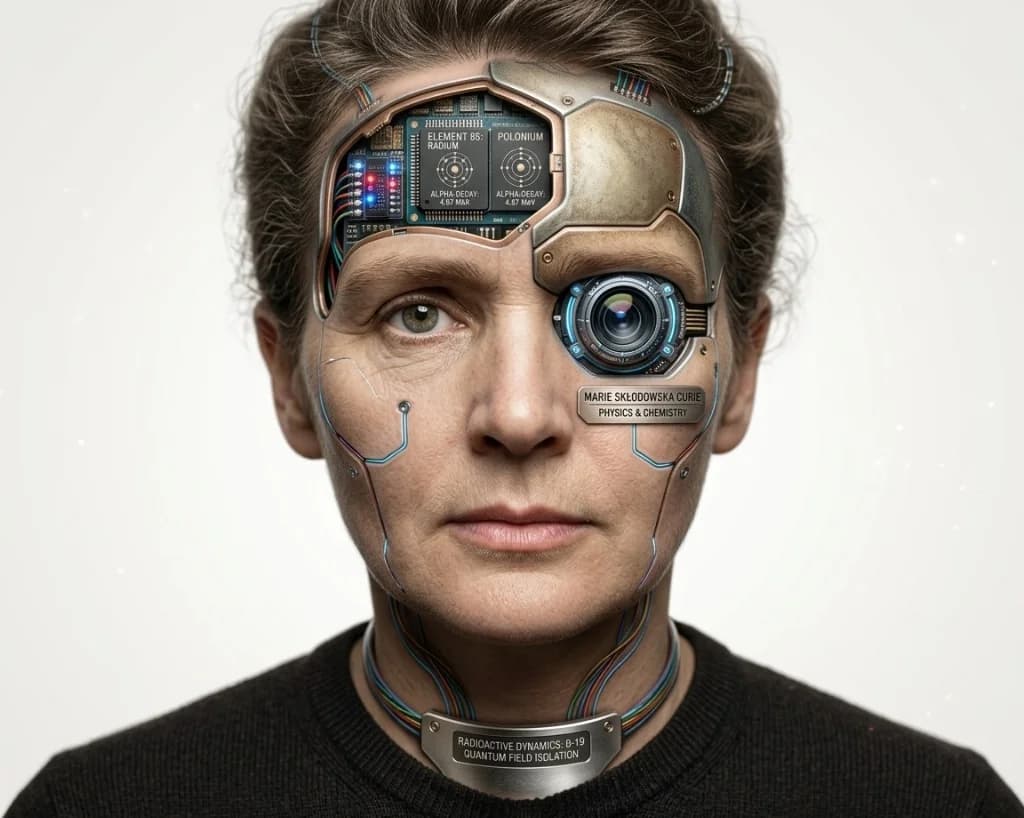

The Configuration
Six axes, scored against the cohort. The shape is the signal.
Scores are interpretive editorial assessments per the methodology rubric, not measured data. Facts throughout are grounded in named, published sources.
Origins
Where the system came from, and how it escalated.
Identity
Born in Warsaw in 1867 under Russian rule, to a family of teachers who had lost property and status through involvement in Polish national uprisings; women could not attend the University of Warsaw, so she studied at the clandestine Flying University and worked as a governess to fund first her sister's medical studies in Paris and then her own. (Wikipedia, 2026)
Three exclusions stack at the origin: nationality, gender and money. The response was a multi-year deferred plan — fund the sister, then be funded by the sister — executed without access to the institutions the plan was aimed at. The persistence that later processed tonnes of ore was first practised on her own education.
Alone in this series, the subject was barred from university by law in her own country and reached one only through a reciprocal financing arrangement with a sibling that took most of a decade.
Trajectory
She completed degrees in physics and mathematics at the Sorbonne, married Pierre Curie in 1895, and with him announced polonium and radium in 1898; she shared the 1903 Nobel Prize in Physics, succeeded to Pierre's chair after his death in 1906, received the 1911 Nobel Prize in Chemistry, and directed the Radium Institute from its opening in 1914 until her death in 1934. (Wikipedia, 2026; Wikipedia, 2026; Wikipedia, 2026)
The trajectory is a straight line through a sequence of barriers, each of which would normally have ended it: foreign, female, widowed at thirty-eight with two children and a laboratory to run. Each time the path narrowed she continued along it at the same pace, and the institutional recognitions are spaced almost evenly along the way.
Where Newton's output was front-loaded and Galileo's was a step function, Curie's is the only trajectory in this series that is close to linear — sustained, unbroken productivity from first publication to death.
The Machine
How the enterprise is built — and what it did to its field.
Business Model
The Curies deliberately declined to patent their radium isolation process, making it freely available; she lived on academic salary and prize money, and in 1921 toured the United States to raise funds for a single gram of radium for her institute, since the element she had isolated had become too expensive for her laboratory to afford. (Wikipedia, 2026; Wikipedia, 2026; Wikipedia, 2026)
This is the series' one explicit refusal of the capture mechanism. The process that created a global radium industry was released without a claim on it, and the inventor later had to fundraise to buy back a gram of her own discovery. The model maximized diffusion of the method at the direct expense of the person who built it.
Every commercial subject in this series built a moat; Curie had one handed to her by nature — a process nobody else possessed — and gave it away on principle, the only voluntary forfeiture of a monopoly in the cohort.
Impact
She coined the term "radioactivity", established that it was an atomic property of the element rather than a result of molecular arrangement, discovered polonium and radium with Pierre Curie, and isolated metallic radium in 1910; radium became the basis of early radiotherapy for cancer. (Wikipedia, 2026; Wikipedia, 2026; Wikipedia, 2026)
The decisive impact is conceptual rather than the famous elements: the claim that radiation comes from inside the atom. That single inference broke the assumption that atoms were indivisible and opened nuclear physics. The radium was the proof; the idea was the product.
Newton described forces between bodies and Galileo the motion of bodies; Curie is the only subject in this series whose central finding was that the body itself — the atom — had an interior.
The Mind
How problems get decomposed and irreversible choices get made.
Cognition
Using an electrometer developed by Pierre and his brother, she measured the ionizing effect of uranium compounds and found it depended only on the quantity of uranium present; noticing that pitchblende was more active than its uranium content could explain, she inferred the presence of an unknown, more active element. (Wikipedia, 2026; Wikipedia, 2026)
The characteristic move is to treat a measurement anomaly as a hypothesis rather than an error. The ore was slightly too radioactive; most observers would have recalibrated. She concluded something was in there and then committed years to finding it. Precision instrument, small discrepancy, total follow-through.
Where Galileo built instruments to see what authority denied, Curie used an instrument to notice what nobody had claimed at all — the discovery began as a residual in a table of numbers, not as an observation.
Behavior
To isolate radium she processed tonnes of pitchblende residue in a poorly ventilated shed over several years, stirring boiling vats with an iron rod and performing repeated crystallizations, eventually obtaining about a tenth of a gram of radium chloride from roughly a tonne of ore in 1902. (Wikipedia, 2026; Wikipedia, 2026)
The behavioral signature is manual, repetitive, physically punishing labour sustained for years toward a quantity almost too small to see. There is no shortcut in the record — no delegation, no automation, no funding that would have replaced the iron rod. The execution layer of this profile is literally physical.
No other subject in this series achieved their defining result through years of their own manual labour; Dell and Su built execution machines out of other people, Curie was the machine.
Decision Architecture
After Pierre's death in 1906 she accepted his professorship rather than a pension, continued the laboratory, and pursued the isolation of pure radium metal to settle remaining doubts about its elemental status; during the First World War she set aside research to equip and personally drive mobile radiography units to field hospitals. (Wikipedia, 2026; Wikipedia, 2026)
The architecture selects the option that keeps the work continuous and absorbs the cost personally. Widowhood, war and illness were each handled the same way: identify the task that must be done next, do it, do not renegotiate the commitment. There is no pivot in the record, only continuation under changed conditions.
Newton needed Halley to force publication and Galileo framed provocation as compliance; Curie's decision layer contains no strategy at all in that sense — only a sequence of next tasks executed without apparent deliberation about whether to continue.
The Person
Temperament, influence and the values underneath the bets.
Personality
Contemporaries describe her as reserved, austere and uninterested in fame; she raised two daughters after Pierre's death, one of whom, Irène Joliot-Curie, later shared a Nobel Prize in Chemistry, and she was subjected to a hostile press campaign in 1911 over her relationship with the physicist Paul Langevin. (Wikipedia, 2026)
The temperament is inward and unperformative — the opposite of Galileo's — and the one episode where the press turned on her was about her private life, not her science. She responded by going to Stockholm to collect the second Nobel anyway. The personality layer and the behaviour layer are the same trait: continue.
The only subject in this series to face a coordinated public scandal at the exact moment of a second Nobel Prize, and the only one whose response was to make no public defence and simply keep working.
Power & Influence
She was the first woman to win a Nobel Prize, the first person to win two, the first woman to become a professor at the University of Paris, and founded the Radium Institutes in Paris and Warsaw, which became major centres of research; she was refused membership of the French Academy of Sciences in 1911. (Wikipedia, 2026; Wikipedia, 2026; Wikipedia, 2026)
Influence was built entirely through results and institutions she created, because the existing institutions kept the door shut — the Academy rejected her in the same year Stockholm awarded her a second prize. She answered exclusion by building the room she was not allowed into.
Newton ran the Royal Society; Curie was refused entry to its French equivalent while holding two Nobels — and is the only subject here whose lasting institutional power came from founding laboratories rather than capturing existing ones.
Value System
She and Pierre chose not to patent the radium process on the grounds that it was contrary to the scientific spirit; she donated much of her prize money, kept her Polish identity prominent — naming polonium after her homeland — and devoted her wartime effort to medical radiography rather than research. (Wikipedia, 2026; Wikipedia, 2026; Wikipedia, 2026)
The value hierarchy is explicit and was acted on at every point where it cost something: science is a commons, the country of origin is not forgotten, and usefulness outranks discovery when people are dying. It is the least self-interested configuration in the series by a wide margin.
The only subject here who, presented with a clear path to wealth from her own discovery, declined it on stated principle and later had to solicit public donations to continue the work.
The Record
The frictions, the polarization, and what is already permanent.
Friction & Constraints
Years of unshielded handling of radioactive material and wartime X-ray exposure caused chronic illness, and she died in 1934 of aplastic anaemia; her laboratory notebooks remain radioactive and are stored in lead-lined boxes, and readers must sign a waiver to consult them. (Wikipedia, 2026; Wikipedia, 2026)
The binding constraint was the discovery itself. The element she isolated was destroying her while she isolated it, and the danger was invisible precisely because she was the person finding out what it was. The constraint could not have been known in advance and was paid in full regardless.
No other subject in this series was physically killed by their own principal discovery; the execution layer and the constraint layer are the same substance.
Public Perception
· recency-sensitiveShe is consistently ranked among the most influential scientists in history and is a widely used symbol of women in science; in 1995 she became the first woman interred on her own merits in the Panthéon in Paris, and her image appears on currency, stamps and institutions in Poland and France. (Wikipedia, 2026)
Perception has moved in one direction only — from resisted outsider to national symbol of two countries — and the 1995 Panthéon interment, sixty years late, is the French state completing the recognition the Academy refused in 1911. The reputation is stable because nothing in the record invites revision.
Newton's reputation has been complicated by his archive and Galileo's flattened into myth; Curie's is the only one of the three that has simply grown, without reassessment, since her death.
Legacy Vector
Her work founded the field of radioactivity, underpinned the development of nuclear physics and radiotherapy, and continued directly through her daughter Irène's Nobel-winning work on artificial radioactivity; the Curie Institute remains a leading cancer research and treatment centre, and the curie, a unit of radioactivity, is named for the Curies. (Wikipedia, 2026; Wikipedia, 2026; Wikipedia, 2026)
The legacy is a field, an institution and a method, propagated through people rather than patents — including her own daughter. Having refused to capture the value, she compounded it the only other way available: by training the people who would carry it. It is the series' best evidence that open release can outperform a moat over a long enough horizon.
The only legacy in this series transmitted through a second-generation Nobel laureate in the same family and an institution still operating in its original purpose — durability achieved without any ownership at all.
Voice
“Nothing in life is to be feared, it is only to be understood.”
Widely attributed“One never notices what has been done; one can only see what remains to be done.”
Letter to her brother, 1894“I was taught that the way of progress was neither swift nor easy.”
Pierre Curie, 1923 · autobiographical notes“Be less curious about people and more curious about ideas.”
Consistent with the configuration — the reserve, the indifference to fame, the refusal to answer the 1911 press campaign. It is also the advice of someone who processed a tonne of ore by hand and never once asked whether the effort was proportionate, which is both why it worked and why it killed her.
Widely attributedMarie in 2050
Speculative & for fun — extrapolated from the configuration, not a forecast we'd defend in court.
[Name] —
Wanted to put Marie Curie on your radar, with the caveat that she died in 1934 and would have found the introduction unnecessary.
Short version: a Polish governess who financed her way to the Sorbonne, noticed that a uranium ore was slightly more radioactive than it should have been, and spent four years in a leaking shed boiling down tonnes of it by hand to prove there was a new element inside. Two Nobels, two sciences, a field she named — and she refused to patent any of it.
Why it's worth your time: she is the series' purest execution profile. No strategy, no leverage, no capture — just a precise measurement, an anomaly taken seriously, and labour sustained past the point anyone else would stop. Bring her the problem everyone has dismissed as noise.
I'll let you two take it from here.
— [You]
What This Profile Is Built On
Every factual claim in the Record layers above cites one of these. Interpretation in the Reading layers is ours and is not attributable to any source below.
- Marie Curie — Wikipedia, 2026 · article
- Pierre Curie — Wikipedia, 2026 · article
- Radium — Wikipedia, 2026 · article
- Polonium — Wikipedia, 2026 · article
- Curie Institute (Paris) — Wikipedia, 2026 · article
- Nobel Prize in Physics — Wikipedia, 2026 · article