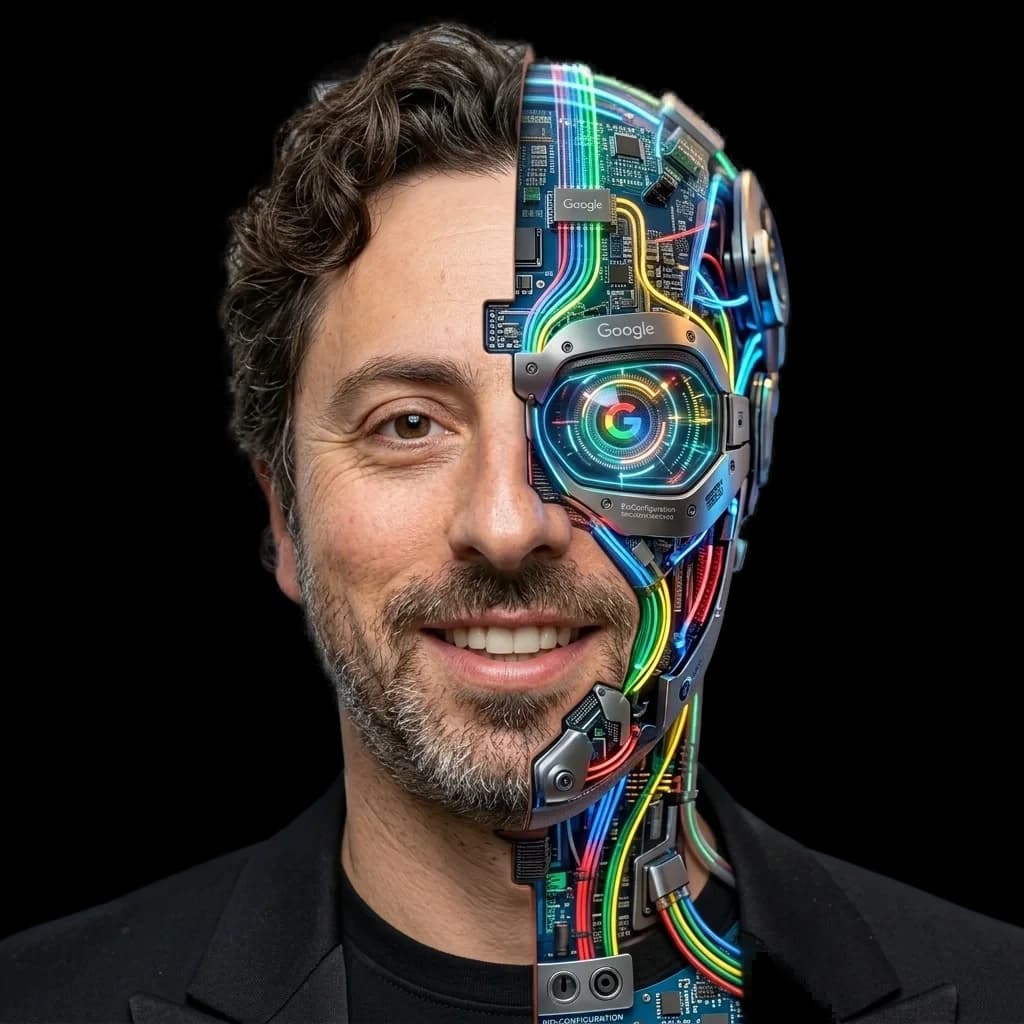
The Configuration
Six axes, scored against the cohort. The shape is the signal.
Scores are interpretive editorial assessments per the methodology rubric, not measured data. Facts throughout are grounded in named, published sources.
Origins
Where the system came from, and how it escalated.
Identity
Born in Moscow and emigrated to the United States with his family as a child; his father became a mathematics professor and his mother a research scientist, and he completed an undergraduate degree in mathematics and computer science before beginning doctoral study at Stanford. (Wikipedia, 2026)
Two formative structures compound here: a household organized around mathematics as a profession, and an emigration that made the family's prior standing non-transferable. The result is a formation where analytical ability was the portable asset and institutional position was demonstrably not.
Where Page inherited an academic-computing household inside a stable national context, Brin inherited the same intellectual apparatus after a discontinuity that invalidated his parents' professional standing — the mathematics transferred across the border, the credentials did not.
Trajectory
Co-founded Google with Page in 1998; over the following two decades took the research- and technology-facing side of the partnership rather than the operating-executive side, led the Google X moonshot division during the 2010s, and stepped down as Alphabet president in 2019 while remaining on the board. (Wikipedia, 2026; Wikipedia, 2026)
The trajectory consistently moves toward the unsolved and away from the operational. Each time the company matured into an institution, the position taken was the one furthest from running it — research, then moonshots, then departure from executive duty altogether.
Where Bezos and Dell moved steadily toward operating control as their companies grew, Brin moved steadily away from it, choosing the research frontier over the executive seat at every juncture where both were available.
The Machine
How the businesses are built — and what they did to their industries.
Business Model
Google Search monetizes through advertising placed against queries, a model in which the ranking of organic results and the sale of adjacent advertising inventory operate as distinct systems within the same product surface. (Wikipedia, 2026; Wikipedia, 2026)
The model separates the thing users came for from the thing that pays for it, which is why quality of ranking and revenue can be argued about independently. Brin's side of the partnership sat on the ranking side of that divide rather than the revenue side.
Where Bezos built a business whose revenue mechanism is identical to its user-facing purpose, the search model requires two coupled but distinct systems — and Brin's documented contribution concerns the one that does not directly earn.
Impact
The 1998 Anatomy paper he co-authored described a complete working architecture for large-scale web search — crawling, indexing, and link-based ranking — and was published openly rather than retained as proprietary method. (Page, 1998; Wikipedia, 2026)
Publishing the architecture openly before commercializing it is the impact that compounds twice: it seeded a field of academic work on web-scale retrieval, and it established a norm in which the company's technical claims were checkable by outsiders from the beginning.
Almost no comparable commercial advantage in this cohort was first given away in a peer-reviewed venue; the founding technical asset was published in full before it earned a single dollar.
The Mind
How problems get decomposed and irreversible choices get made.
Cognition
His pre-Google research at Stanford concerned data mining and pattern extraction from large datasets, and the Anatomy paper applies that orientation by treating the entire web as a dataset whose latent structure can be mined for relevance signals. (Wikipedia, 2026; Page, 1998)
The cognitive habit is to look for exploitable regularity in data nobody has treated as a dataset yet. The web was not obviously a corpus in 1996; seeing it as one, with minable structure, is the move that made the ranking insight available.
Where Page's characteristic act is re-specifying the problem, Brin's is re-specifying the corpus — recognizing that an unruly, unowned, constantly changing artifact could be treated as structured data at all.
Behavior
After stepping back from executive responsibility, he has been reported working directly on technical projects at the company rather than in a management capacity, and his public appearances remain infrequent relative to his prominence. (Wikipedia, 2026)
The behavior is unusually legible: given complete freedom and no obligation to work at all, the revealed preference is hands-on technical work at the company he already controls. That is a preference for the problem itself, not for the position or its visibility.
Where Page exercises control while absent entirely, Brin exercises little management while remaining technically present — the same withdrawal from executive duty, resolved in opposite directions.
Decision Architecture
Co-signed the 2004 founders' letter establishing a dual-class share structure that preserved founder control after the public offering, and subsequently concentrated his own effort on the Google X division, whose portfolio consisted of long-horizon projects with uncertain and distant commercial prospects. (Brin, 2004; Wikipedia, 2026)
The architecture pairs a one-time structural guarantee with a portfolio of deliberately uncorrelated bets. Control was secured once, permanently; the bets are then made loosely, cheaply, and in parallel, because the structure has already absorbed the cost of being wrong in public.
Where Su committed scarce capital to one sequenced architecture because she could fund nothing else, Brin ran the opposite architecture from abundance — many uncorrelated attempts, each individually expendable.
The Person
Temperament, influence and the values underneath the bets.
Personality
Described in press coverage as informal and intellectually restless in professional settings, with a documented association with unconventional projects and public demonstrations during the Google X period, including the Google Glass programme. (Wikipedia, 2026)
The temperament tolerates public failure of specific projects to a degree unusual at this level of prominence — attaching personally to speculative work means the failures are attributable, and that visibility was accepted rather than avoided.
Where Page removed himself from public association with Alphabet's bets entirely, Brin personally fronted several that did not work, absorbing the reputational cost of specific failed projects rather than delegating it.
Power & Influence
Retains, together with Page, controlling voting power over Alphabet through the dual-class structure established in 2004, despite holding no executive position since 2019. (Wikipedia, 2026; Brin, 2004)
The formal power is identical to Page's and derives from the same instrument, but is used differently — proximity to the technical work rather than distance from everything. Same lever, opposite application.
This is the rare case where two people hold structurally identical control of the same company: the variable under study is not how much power each has, but what each chose to do with an equal amount.
Value System
The 2004 founders' letter he co-signed states that the company will pursue projects with uncertain long-term payoffs, will not manage toward quarterly predictability, and is organized around long-term value rather than near-term earnings smoothness. (Brin, 2004)
The stated values put the unsolved problem above the running business, and his subsequent choices — research division, then technical work over management — are consistent with that ordering rather than merely rhetorical about it.
Many founders state a preference for research over operations; Brin is unusual in having acted on it repeatedly at moments when the operating role was his for the taking.
The Record
The frictions, the polarization, and what is already permanent.
Friction & Constraints
Alphabet faces continuing antitrust and privacy scrutiny across multiple jurisdictions relating to its search and advertising businesses, and several high-profile Google X projects, including Google Glass, did not reach sustained commercial adoption. (Wikipedia, 2026; Wikipedia, 2026)
The frictions are of two distinct kinds: institutional pressure on the core business he no longer runs, and the ordinary failure rate of a research portfolio, which is a designed feature rather than a malfunction.
The moonshot failures are the only constraint in this cohort that the configuration explicitly budgets for in advance — a portfolio built to be mostly wrong cannot be embarrassed by being mostly wrong.
Public Perception
· recency-sensitivePublic attention to Brin declined substantially after his 2019 departure from the Alphabet president role, with subsequent coverage focusing more on his technical involvement and philanthropic activity than on corporate leadership. (Wikipedia, 2026)
Perception has settled into researcher rather than executive, which matches the revealed preference and means that scrutiny of Alphabet as an institution largely bypasses him. This layer is recency-sensitive and should be re-sourced before republishing.
He is among the few in this cohort whose public identity has drifted back toward technical practitioner over time, rather than consolidating further into executive or investor.
Legacy Vector
Co-authored the openly published architecture behind Google Search, co-founded the company that commercialized it, and led the research division through which Alphabet pursued long-horizon technology projects during the 2010s. (Page, 1998; Wikipedia, 2026; Wikipedia, 2026)
The legacy hypothesis is that a founder can retain absolute structural control of a dominant company while declining nearly all authority over it, spending the proceeds on problems rather than power — an arrangement almost no one else in this cohort has both attempted and sustained.
Where every other subject here converted early technical work into durable executive authority, Brin converted it into permanent optionality and then declined the authority, repeatedly and by choice.
Voice
“Obviously everyone wants to be successful, but I want to be looked back on as being very innovative, very trusted and ethical and ultimately making a big difference in the world.”
On ambition · public remarks“Solving big problems is easier than solving little problems.”
On problem selection · public remarks“Technology is an inherent democratizer.”
On access · public remarks“Take risks now. If it fails, you can go back to whatever else you were doing.”
Consistent with the configuration, and honest about its own precondition: the advice works when failure is survivable. The 2004 share structure was the mechanism that made it survivable at Alphabet scale — the risk tolerance is downstream of a governance decision, not a personality trait.
Widely attributed · public remarksSergey in 2050
Speculative & for fun — extrapolated from the configuration, not a forecast we'd defend in court.
[Name] —
Wanted to put Sergey Brin on your radar. He co-founded Google with Larry Page out of their Stanford doctoral work, and co-authored the 1998 paper that described the whole search architecture in public before any of it made money.
The throughline is that he keeps choosing the unsolved problem over the running business — he took the research side of the partnership, ran the moonshot division through the 2010s, and after stepping down as Alphabet president reportedly went back to working on technical problems directly.
Why it's worth your time: he thinks in datasets and latent structure, and he is unusually willing to be publicly wrong about a specific project. Bring an unsolved technical problem. Do not bring an org chart.
I'll let you two take it from here.
— [You]
What This Profile Is Built On
Every factual claim in the Record layers above cites one of these. Interpretation in the Reading layers is ours and is not attributable to any source below.
- Sergey Brin — Wikipedia, 2026 · article
- The Anatomy of a Large-Scale Hypertextual Web Search Engine — Sergey Brin and Lawrence Page, 1998 · article
- Alphabet Inc. — Wikipedia, 2026 · article
- 'An Owner's Manual' for Google's Shareholders (2004 IPO founders' letter) — Larry Page and Sergey Brin, 2004 · other
- Google Search — Wikipedia, 2026 · article