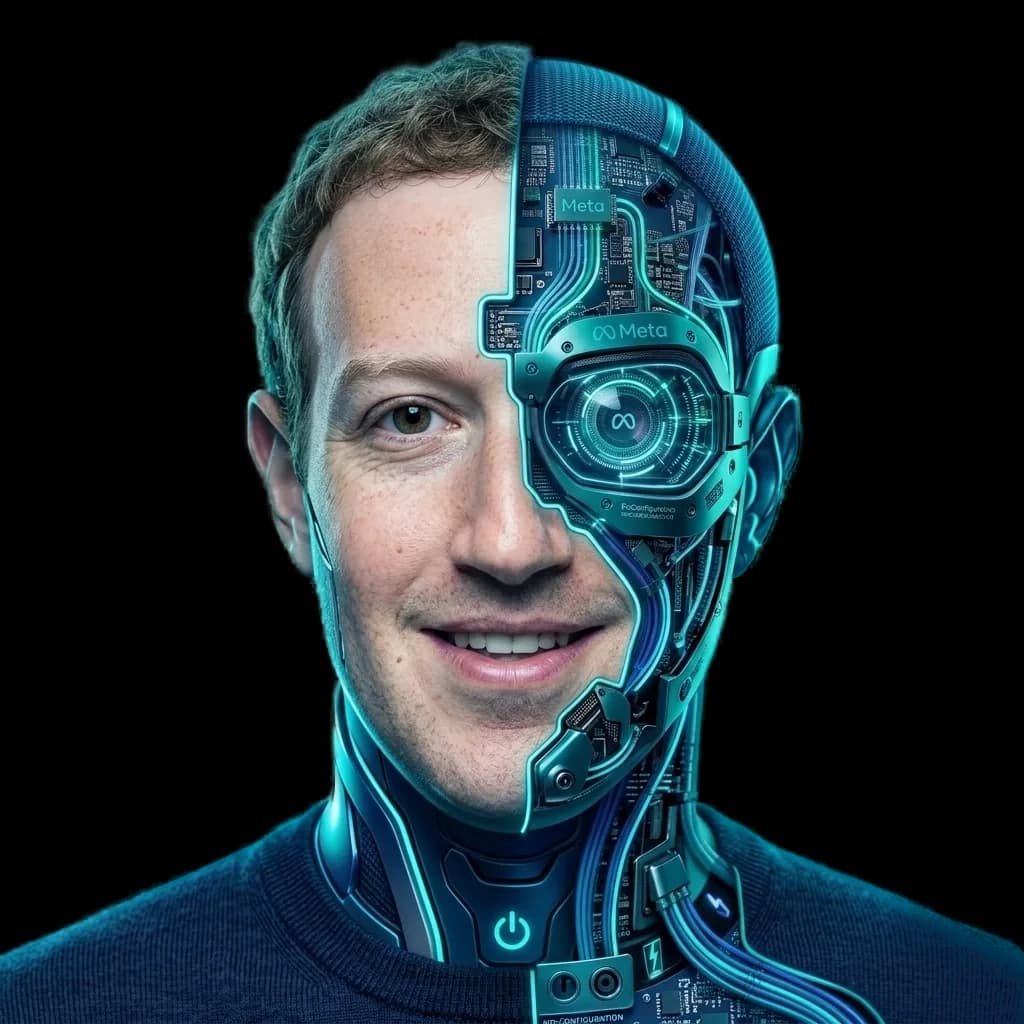
The Configuration
Six axes, scored against the cohort. The shape is the signal.
Scores are interpretive editorial assessments per the methodology rubric, not measured data. Facts throughout are grounded in named, published sources.
Origins
Where the system came from, and how it escalated.
Identity
Launched Facebook in 2004 while an undergraduate at Harvard University, having previously written software projects including a music-recommendation tool, and left the university without completing his degree to develop the company. (Wikipedia, 2026; Wikipedia, 2026)
The formation is a programmer who shipped working software repeatedly before any commercial framing existed. The company begins as one more built artifact among several, which is why the early decisions read as product decisions rather than business ones.
Where Dell's founding act was recognizing a distribution margin and Page's was a research question, Zuckerberg's was simply building and releasing a functioning product to an available audience — the commercial thesis arrived after the users did.
Trajectory
Grew Facebook from a university network to a global platform, took it public in 2012, acquired Instagram in 2012 and WhatsApp in 2014, and in 2021 renamed the parent company Meta Platforms to reflect a strategic emphasis on virtual and augmented reality. (Wikipedia, 2026; Wikipedia, 2026; Wikipedia, 2026)
The trajectory alternates between defensive consolidation and unilateral redirection — first absorbing the platforms most likely to displace the core, then spending the resulting security on a bet the market did not request.
Where Page created a holding structure so speculative bets could sit beside the core business, Zuckerberg renamed the entire company after his — the bet was not ring-fenced from the core, it was declared to be the core.
The Machine
How the businesses are built — and what they did to their industries.
Business Model
The company's revenue derives overwhelmingly from advertising sold against user attention across its platforms, with targeting informed by data collected from user activity, and it operates several distinct networks — Facebook, Instagram and WhatsApp — under common ownership. (Wikipedia, 2026; Wikipedia, 2026)
The model runs several independent attention pools on one advertising engine, so a decline in any single network does not threaten the revenue mechanism. Diversification happens at the surface layer while monetization stays centralized.
Where Google monetizes stated intent expressed in a query, Meta monetizes inferred interest derived from behaviour — a harder targeting problem that requires substantially more data about people who are not asking for anything.
Impact
Facebook, Instagram and WhatsApp together reach billions of users globally, and the company's platforms have become significant channels for personal communication, news distribution and political discourse in many countries. (Wikipedia, 2026; Wikipedia, 2026)
The impact is infrastructural and largely unlegislated: private ranking decisions determine what a substantial share of humanity sees of each other and of public events, with no equivalent of the editorial accountability the displaced institutions carried.
Where Page's ranking function decides which documents are authoritative, Zuckerberg's decides which people and events are visible to whom — a social graph rather than a citation graph, and consequently far harder to evaluate for neutrality.
The Mind
How problems get decomposed and irreversible choices get made.
Cognition
The 2012 Instagram and 2014 WhatsApp acquisitions brought fast-growing competing networks under common ownership at prices widely considered high relative to those companies' revenues at the time. (Wikipedia, 2026; Wikipedia, 2026)
The reasoning prices the threat rather than the asset. Judged on revenue, both purchases were expensive; judged as the cost of removing the most probable successor to your own network, they were cheap — the valuation question being answered was not "what does this earn" but "what does it cost if someone else owns it".
Where Buffett's discipline is refusing to overpay against intrinsic value, Zuckerberg's characteristic move is deliberately overpaying against intrinsic value to eliminate a competitive scenario — the opposite trade, made knowingly.
Behavior
Has publicly committed the company to successive long-horizon strategic priorities — mobile, then video, then virtual and augmented reality with the 2021 rename, then substantial artificial-intelligence infrastructure investment — reorganizing company resources around each in turn. (Wikipedia, 2026; Wikipedia, 2026)
The behavioral signature is total, rapid reallocation rather than hedged parallel investment. Each priority absorbs the organization, which produces fast pivots and correspondingly large stranded costs when a thesis does not land.
Where Brin ran many uncorrelated moonshots in a separate division, Zuckerberg redirects the whole company at one thesis at a time — higher variance, and no structural separation to absorb the failure.
Decision Architecture
Retains majority voting control of the company through a dual-class share structure, meaning strategic decisions including the 2021 rename and the sustained Reality Labs investment could proceed despite shareholder opposition or sustained losses in that division. (Wikipedia, 2026; Wikipedia, 2026)
The architecture converts conviction directly into action with no intermediate approval step. This is the same instrument Page and Brin hold, applied to a different end: not protecting a portfolio of small bets, but sustaining one very large one through years of visible losses.
Where Dell had to spend billions taking a company private to escape quarterly scrutiny, Zuckerberg achieves the same insulation for free — the control was structured before the offering, so the escape never has to be purchased.
The Person
Temperament, influence and the values underneath the bets.
Personality
Has appeared repeatedly before legislative committees in the United States and elsewhere to answer questions on privacy, content moderation and competition, and has remained chief executive continuously since founding the company in 2004. (Wikipedia, 2026; Wikipedia, 2026)
The temperament tolerates sustained adversarial public exposure without ceding the seat — repeated hostile testimony has been treated as a recurring operating cost of the position rather than as a signal to step back from it.
Where Page responded to institutional scrutiny of Alphabet by withdrawing from public life entirely, Zuckerberg has absorbed comparable scrutiny personally and in public, repeatedly, while continuing to run the company.
Power & Influence
Holds majority voting control of Meta Platforms while serving as its chairman and chief executive, giving him decision authority over platforms used by billions of people. (Wikipedia, 2026; Wikipedia, 2026)
This is the most concentrated combination in the cohort: ownership control, operating command, and a communications surface reaching a meaningful fraction of humanity, all held simultaneously by one person with no internal check.
Page and Brin hold comparable voting control but no executive authority; Dell holds both but over a company with no direct influence on public discourse. Only here do all three overlap.
Value System
Company communications under his leadership have consistently framed connecting people and building communications infrastructure as the central purpose, and Meta has released several of its large language models as open-weight rather than closed systems. (Wikipedia, 2026; Wikipedia, 2026)
The open-weight model releases are strategically coherent as well as ideological: commoditizing a layer that rivals hope to charge for weakens their position while strengthening a company that monetizes attention rather than model access.
Where Alphabet's and other rivals' frontier models are primarily accessed as closed services, Meta has released model weights openly — the only subject in this cohort to attack a competitive layer by giving it away.
The Record
The frictions, the polarization, and what is already permanent.
Friction & Constraints
The company has faced sustained regulatory scrutiny and legal action concerning privacy practices, competition and content moderation across multiple jurisdictions, and its Reality Labs division has recorded substantial ongoing operating losses. (Wikipedia, 2026; Wikipedia, 2026)
The frictions divide into external constraint the configuration cannot remove and internal cost it deliberately chooses to carry — regulators are not optional, but the Reality Labs losses continue only because the control structure permits them to.
Alone in this cohort, the largest single financial drag on the business is a voluntary bet the controlling shareholder could end at any time and has chosen not to.
Public Perception
· recency-sensitivePublic perception has moved through several distinct phases — early framing as a young founder, sustained criticism following privacy and misinformation controversies, scepticism during the metaverse repositioning, and renewed attention during the company's artificial-intelligence investment period. (Wikipedia, 2026; Wikipedia, 2026)
Perception has proven more volatile here than for any other subject in this cohort, and notably decoupled from financial performance — periods of strong results have coincided with severe reputational lows. This layer is recency-sensitive and should be re-sourced before republishing.
Where Su's and Dell's reputations track their companies' results closely, Zuckerberg's moves largely independently of them — the business can perform well while the perception deteriorates, and has.
Legacy Vector
Built and retained control of a group of communication platforms reaching billions of users, executed the Instagram and WhatsApp acquisitions that consolidated the social networking category, and directed the company into virtual reality and subsequently large-scale artificial-intelligence investment. (Wikipedia, 2026; Wikipedia, 2026; Wikipedia, 2026)
The legacy hypothesis is that founder voting control, established before public listing, is the decisive variable — it permitted the defensive acquisitions, the unilateral rename, and years of sustained losses on an unpopular thesis, none of which a conventionally governed company would have survived attempting.
Most legacies in this cohort rest on a product or an operating method; this one rests primarily on a governance structure and what it made possible for one person to do without asking anyone.
Voice
“The biggest risk is not taking any risk.”
On risk · public remarks“Move fast and break things.”
Early Facebook engineering motto · company culture“Done is better than perfect.”
On shipping · company culture“The biggest risk is not taking any risk. In a world that is changing quickly, the only strategy that is guaranteed to fail is not taking risks.”
Consistent with the configuration, but incomplete as stated. The risks here were taken from behind majority voting control — the losses could be absorbed and the objections overruled. The advice describes the disposition accurately while omitting the structure that made acting on it survivable.
Widely attributed · public remarksMark in 2050
Speculative & for fun — extrapolated from the configuration, not a forecast we'd defend in court.
[Name] —
Wanted to put Mark Zuckerberg on your radar. He launched Facebook from a Harvard dorm in 2004 and has been chief executive ever since, through the 2012 IPO, the Instagram and WhatsApp acquisitions, the 2021 rename to Meta, and the current AI infrastructure build-out.
The throughline is control. He holds majority voting power through a dual-class structure, which is what allowed him to overpay deliberately for the competitors most likely to replace him, and then to run a division at sustained losses for years without needing anyone to agree.
Why it's worth your time: he prices threats rather than assets, and he reallocates the entire company at one thesis at a time. Bring a structural question about competitive dynamics. Do not bring a proposal that needs consensus.
I'll let you two take it from here.
— [You]
What This Profile Is Built On
Every factual claim in the Record layers above cites one of these. Interpretation in the Reading layers is ours and is not attributable to any source below.
- Mark Zuckerberg — Wikipedia, 2026 · article
- Facebook — Wikipedia, 2026 · article
- Meta Platforms — Wikipedia, 2026 · article
- Alphabet Inc. — Wikipedia, 2026 · article