TheBestSI and the Road From AI Tools to Superintelligence
TheBestSI argues that understanding AI takes more than knowing which product is popular: it means examining what systems can do, how that is measured, and what their development could mean.
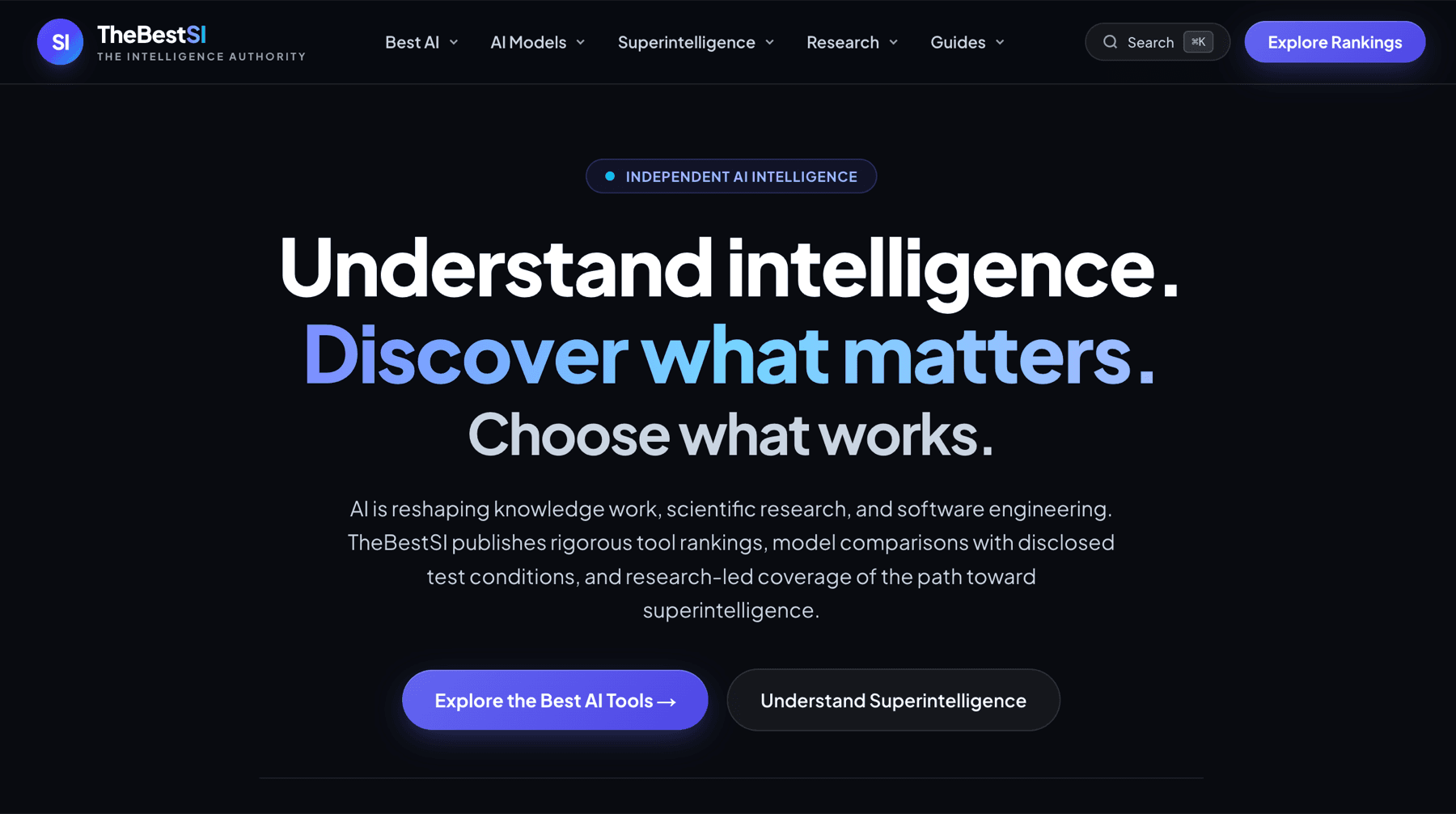
Artificial intelligence is no longer a single technology category. It is an expanding ecosystem of models, applications, coding agents, research assistants and increasingly autonomous software, and questions about artificial general intelligence (AGI) and artificial superintelligence (ASI) are moving from specialist circles into mainstream debates about science, economics and security. TheBestSI brings these subjects into one editorial platform: helping people choose AI tools, understand the models behind them, and investigate the longer-term evolution of machine intelligence.
Its premise is that choosing a useful application is a practical decision, understanding why one model outperforms another is a technical problem, and asking whether future systems could exceed human capabilities raises a different set of questions altogether. It treats them as related but distinct, with one rule across all three: evidence should matter more than hype. It is a sibling of the evidence-first approach we covered in our piece on BestSuperintelligent.com and in our review of that platform.
AI Overview
TheBestSI is an independent AI research and comparison platform built around three pillars: AI Tools and Rankings, AI Models and Research, and Superintelligence. It publishes tool rankings, model comparisons with disclosed test conditions, a benchmark audit, practical procurement guides, and coverage of AGI, ASI, intelligence explosions and alignment. It states that affiliate relationships do not influence its scores, and it separates hands-on testing, documented research and editorial analysis.
Key Facts
| Field | Detail |
|---|---|
| Category | Artificial intelligence, tool and model research |
| Difficulty | Beginner to intermediate |
| Read time | 13 minutes |
| Search intent | Informational and commercial investigation |
| Updated | October 18, 2026 |
The Three-Pillar Framework
One platform, three questions about intelligence. TheBestSI's defining idea is that AI cannot be understood through a single ranking or benchmark, so it splits the subject into three areas that each answer a different question.
| Pillar | Central question | What readers can explore |
|---|---|---|
| AI Tools and Rankings | Which products suit a particular task? | Directories, category rankings, reviews, practical comparisons |
| AI Models and Research | How do the underlying models differ in capability and limits? | Frontier, coding, reasoning and open-source model comparisons, benchmark analysis |
| Superintelligence | What would it mean for machine intelligence to exceed human capability? | AGI and ASI definitions, intelligence explosions, alignment, safety, scenarios |
The structure lets readers enter from either end. A developer can start with coding assistants, move to the models behind them, and then to the research on increasingly capable systems, while a reader curious about the future can start with superintelligence and work back to the tools available today. The connecting principle is that discovering a product, understanding its underlying intelligence and weighing the implications of future AI are different tasks that benefit from different evidence.
Finding the Right Tool Is Harder Than Finding the Popular One
The software market has a paradox at its center: more tools means more possibilities and a harder choice. A coding assistant built to understand an entire repository is not interchangeable with a general chatbot, and a research engine built on academic literature solves a different problem from an answer engine searching the live web. TheBestSI's tools pillar organizes products by use case and describes strengths, limitations and pricing considerations, on the view that usefulness depends on the task. Its homepage features three examples that show the kind of distinctions a good directory has to make.
Cursor: AI-assisted software engineering. It is presented as an AI-first code editor that works with frontier models, with repository indexing and multi-file editing as the relevant strengths. These matter because real engineering is more than isolated snippets: refactoring a feature across several files means understanding how they depend on each other and reviewing coordinated changes. The platform also flags trade-offs, including usage limits and the cost of adopting a separate editor.
Claude: reasoning, coding and knowledge work. It is presented for complex software engineering, technical writing and analysis, with code generation, debugging and its Artifacts workspace highlighted. Artifacts show how a product can extend beyond conversation into previewable code and interface components, which shortens the distance between an idea and something a team can inspect. A feature, though, does not prove the product beats every alternative; that still depends on the task and the quality of the output.
Consensus: research grounded in scientific literature. It searches academic papers and synthesizes findings, with source-linked answers and the Consensus Meter as the highlighted elements. For a researcher, the gap between a plausible answer and one supported by published studies is crucial, and linked sources give a route to check, although users must still confirm the cited papers support the synthesis.
Why limitations belong next to strengths
A coding tool may offer repository-level workflows but impose usage limits, a research tool may give sourced answers but lack a general assistant's flexibility, and an answer engine may search current sources yet still misattribute a claim. These are not footnotes; they decide whether a product fits a user. Presenting intended workload, strengths and material trade-offs together turns selection into a decision about requirements and compromises instead of a contest with one winner.
Model Comparisons: Looking Beneath the Interface
An application is not the model that powers it. The application shapes the interface, integrations and tools, while the model supplies language understanding, reasoning, code generation and multimodal processing, and the final experience depends on how they work together. That is why comparing models needs a different method from comparing apps. TheBestSI's models pillar has entry points for frontier, coding, reasoning and open-source models, and its comparisons include ChatGPT versus Claude and Claude versus Gemini, looking at reasoning, code editing, long-context handling and workflow fit. This builds on the field we describe under large language models.
A meaningful comparison first defines the capability under test, because a model for software engineering must handle a large codebase and pass tests, a research model must retain long documents and separate conflicting findings, and a mathematical model must solve unfamiliar problems and show its work. Performance on one workload does not establish performance on another. The platform names several evaluation dimensions:
| Dimension | What it examines | Why it matters |
|---|---|---|
| Coding and refactoring | Reliability of multi-file code changes | Suitability for real engineering |
| Mathematical reasoning | Solving demanding logical tasks | Technical problem-solving and research |
| Long-context handling | Whether information deep in long inputs stays usable | Document analysis, codebases, synthesis |
| Voice and multimodal | Audio, images, files and real-time interaction | Interactive and multimodal applications |
| Test conditions | Prompts, configuration, model version, environment | How results should be interpreted |
| Limitations | Where performance or fit stays constrained | Stops a narrow result becoming a broad claim |
The importance of test conditions
A comparison is only as informative as the conditions behind it. A credible one names the models and versions, describes the task, discloses configuration choices, explains the scoring and admits limitations. For coding tests that can mean recording whether tools could run commands, inspect files or retry failed steps, and for long-context tests it means defining input length and checking retrieval from different positions. The essential question is not which model scores highest but which performs adequately on the task that matters, under conditions that resemble the intended use.
AI Benchmarks Under the Microscope
Benchmarks matter in AI research but are not comprehensive measures of intelligence. A benchmark measures a defined set of tasks under particular conditions, and its worth depends on task quality, scoring, how closely it matches real work, and how far results generalize. TheBestSI's AI Benchmarks Audit looks at the assumptions behind benchmark claims. Several problems deserve attention:
- Narrow task coverage: a benchmark may test one skill and overlook others needed in practice.
- Contamination and data overlap: if a model saw benchmark material in training, the score may not show its ability on unfamiliar problems.
- Evaluation design: small changes to prompts, scoring, allowed tools or procedures can change how a result reads.
- Aggregation effects: a single overall score can hide large differences across task categories.
- Changing configurations: results from different versions or environments may not be comparable.
- Limited real-world validity: success on a controlled test does not prove reliability in a complex operation.
None of this makes benchmarks useless; it defines the questions to ask before drawing conclusions. A model that tops a programming benchmark may still struggle with one organization's codebase, test setup or conventions, and a strong reasoning score does not demonstrate general intelligence. A stronger approach combines relevant benchmark results, direct evaluation on representative tasks, technical documentation, documented failure cases, independent research and evidence on cost, reliability and deployment needs. This is the same logic as model evaluation as a discipline.
From Today's Tools to Superintelligence
The third pillar moves from choosing products to examining where machine intelligence may go. AGI and ASI are not just two more product categories; they concern the breadth of machine capability and what follows if it surpasses human performance, and they involve competing definitions and open questions that need a different style of analysis from a product review.
AGI generally refers to AI that can perform a broad range of cognitive tasks at a general rather than narrowly specialized level. There is no universally accepted operational definition, and researchers disagree on which capabilities and evidence would establish it. Doing well across many tasks does not settle the question, since evaluations must also consider breadth, autonomy, reliability and the ability to adapt to unfamiliar situations. ASI is a hypothetical level of machine intelligence that substantially exceeds human cognitive performance across a very broad range of important domains. It describes a possible future capability, not a verified class of available software.
| Concept | General meaning | Central question |
|---|---|---|
| AI | Systems performing tasks tied to perception, prediction, language or reasoning | What tasks can a system perform? |
| AGI | Proposed AI with broad, general-purpose cognitive ability | How widely can it learn, reason and perform across domains? |
| ASI | Hypothetical intelligence far exceeding human performance across most domains | What follows if machines substantially surpass human capability? |
These are conceptual distinctions, not an agreed sequence of milestones. The path from today's AI to AGI cannot be assumed to be single or predetermined, and ASI is not an inevitable consequence of reaching any particular benchmark. Responsible analysis keeps established findings, hypotheses and forecasts apart.
The intelligence explosion question
One of the most consequential ideas is recursive self-improvement: a system that helps improve its own capabilities, which could enable further improvements. It raises questions about feedback loops, forecasting and human oversight. But AI-assisted research and coding does not establish that an uncontrolled intelligence explosion will occur, because the outcome depends on unresolved factors such as autonomy, compute limits, how hard improvements are to evaluate, and whether gains in one area transfer to others. A careful examination separates five questions: whether a system can meaningfully improve the processes that produce it (capability), whether those improvements hold under independent evaluation (reliability), whether they carry across domains (generality), what technical, economic and physical limits apply (constraints), and whether developers can monitor and constrain the system as it changes (control). That an AI can help optimize code does not show it can autonomously improve every aspect of its own intelligence.
Alignment and safety
As systems grow more capable, keeping their behavior consistent with human intentions becomes more important. Alignment research covers goal specification, robustness to changing conditions, interpretability, evaluation that catches failure modes before deployment, human oversight, and resistance to manipulation and misuse. These overlap, but progress in one does not solve the others: a model that follows instructions reliably in ordinary use may still be vulnerable to adversarial inputs, and better understanding of a model's internals still calls for extensive testing before high-stakes use. The problem sharpens when models use external tools, hold broad permissions or work through long sequences of actions, which is the territory of AI agents. No single evaluation shows a system is safe under every condition, so a useful platform says what problem it studies, what evidence exists and where current approaches fall short.
Separating Evidence From Speculation
A publication that covers both current products and hypothetical superintelligence has an editorial challenge: keeping consistent standards of evidence across subjects with very different certainty. A product's performance can often be examined through testing, documentation and reproducible tasks, whereas a claim about future superintelligence rests on theory, assumptions, forecasts and competing readings of incomplete evidence. Treating the two as equally measurable would weaken both. TheBestSI says it distinguishes three kinds of work:
| Evidence type | Can establish | Cannot establish alone |
|---|---|---|
| Hands-on testing | How a product performed under documented conditions | That the result holds in every environment or future version |
| Documented research | What papers, documentation and disclosures report | That every conclusion is independently verified or accepted |
| Editorial analysis | How evidence can be interpreted for a question | That an interpretation equals a measurement or settled science |
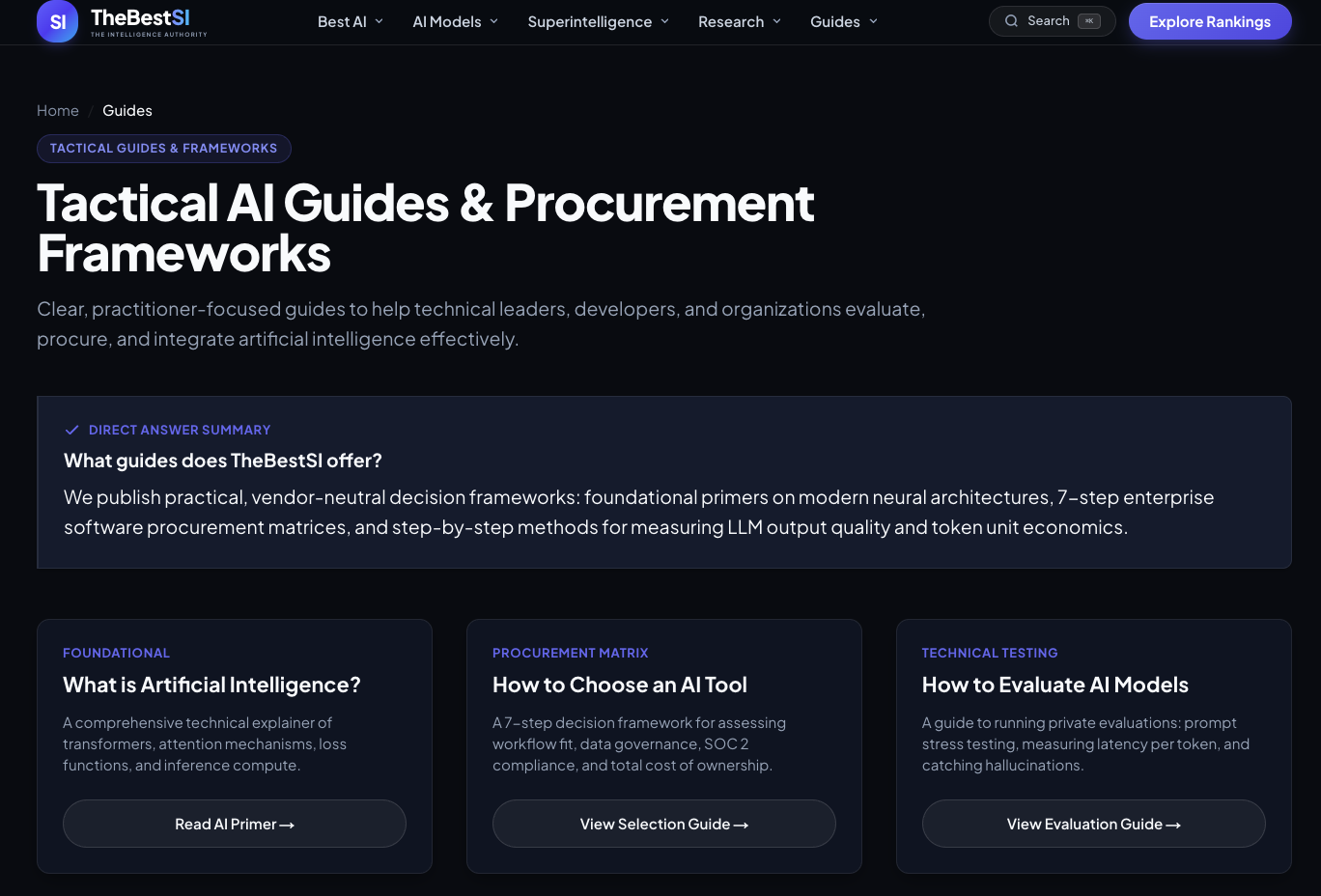
For software evaluation it describes five dimensions: domain task fidelity, contextual window integrity, data governance and privacy, workflow ergonomics, and cost predictability. Together they ask whether a tool can do the job, use the information the task needs, handle data acceptably, fit the workflow and keep costs predictable. How useful they are depends on how each is defined and applied in individual evaluations.
Editorial Independence in a Commercial Market
AI software discovery has an unavoidable commercial side: products compete for customers, providers promote capabilities, and publishers may earn revenue from affiliate links. That does not invalidate product research, but it makes transparency essential. TheBestSI states that affiliate partnerships and advertising do not determine its scores, rankings or editorial inclusion, and it publishes an editorial policy, an affiliate disclosure and a corrections register covering, respectively, its standards, its commercial relationships and its fixes. If a commission influenced a ranking, readers could not trust the ordering as an independent view of fit, so the separation has to apply across selection, testing, scoring, presentation and updates. A stated policy is also not proof of practice; the methodology, records and actual editorial decisions decide how much confidence readers can place in it.
Why It Matters
Understanding intelligence is becoming a practical necessity. A business choosing a coding assistant needs to grasp the limits of the underlying model, a researcher using AI on the literature must weigh generated answers against sources, and an organization adopting autonomous systems must consider governance, security and oversight as well as productivity. Meanwhile AGI and ASI raise broader questions about how intelligence is defined, measured and controlled. These questions connect but should not be confused: a useful product is not evidence of general intelligence, a strong benchmark result does not make a system safe for every deployment, and a superintelligence scenario is not a verified forecast. The value of an independent platform is helping readers hold these distinctions while seeing how the pieces fit, and for AI search, the same clarity (definitions, direct answers, traceable evidence, defined scope and explicit uncertainty) helps both people and answer engines, though no structure guarantees rankings or inclusion in AI answers.
Limitations
This article rests on the platform's own description and the pages visible in October 2026. It does not independently verify TheBestSI's rankings, testing process or commercial independence, and the product examples are described as the platform presents them. The platform's superintelligence coverage deals with open questions, so nothing here should be read as a forecast. Before relying on any specific page, check the live site, since products and policies change.
Related Articles
- BestSuperintelligent.com and the Case for Evidence Over Hype: another platform built on separating claims from evidence.
- Review of the BestSuperintelligent AI review site: how evidence labels work in practice.
- AI Coding Tools Landscape: the wider field of developer assistants.
- Model Evaluation and Generative AI: the underlying concepts.
References
- TheBestSI: homepage, guides, model comparisons and superintelligence coverage.
- Cursor, Claude and Consensus: official product pages for the three featured tools.
The Bottom Line
TheBestSI's ambition is wider than another list of AI recommendations: it connects the tools people choose today with the research needed to understand them and the questions that may define machine intelligence. Its authority will depend on reproducible evaluations, research quality that tracks the evidence instead of the popular narrative, and visible accountability through methodology, disclosures and corrections. If it delivers, it could serve everyone from first-time AI users to specialists, and its central question stays the right one: how do we understand intelligence when the systems are more capable, our measurements remain imperfect and the cost of misjudging may reach far beyond software? Explore TheBestSI, or see more in our Artificial Intelligence hub.
Explore Related Concepts
Frequently Asked Questions
What is TheBestSI?
An editorial and research platform covering AI software, model comparisons, evaluation methods and superintelligence, billed as The Intelligence Authority.
What are TheBestSI's three pillars?
AI Tools and Rankings, AI Models and Research, and Superintelligence. Each answers a different question: which product fits a task, how models differ, and what superintelligence would mean.
What is the difference between AGI and ASI?
AGI usually means AI with broad, general-purpose cognitive ability, while ASI is a hypothetical level of machine intelligence that substantially exceeds human performance across most important domains. Neither has an agreed operational definition.
Why are AI benchmark scores not enough?
A benchmark measures a defined set of tasks under particular conditions. Narrow coverage, data contamination, evaluation design and weak real-world validity mean a high score does not prove suitability for a specific deployment.
Does TheBestSI accept payment for rankings?
It states that affiliate partnerships and advertising do not determine its scores, rankings or editorial inclusion, and publishes an editorial policy, affiliate disclosure and corrections register.