The iPhone Lifecycle: From Strategy Room to Recycling Robot
An iPhone is decided years before it exists and returned years after it stops working. This guide walks all 20 stages, names the outside force at each one, and shows where Apple is most exposed.
AI Overview
The iPhone lifecycle runs through 20 stages in five phases: decide, prove, source and build, sell, and keep and return. Each phase meets a different outside force, from EU regulation at the design stage to tariffs, labor and memory prices at the build stage to repair law at the end. The pattern that matters is timing. A shock hurts in proportion to how early Apple committed to a supplier, site or material and how slowly that commitment can be replaced. Foundry capacity, memory, assembly sites and rare-earth magnets sit at the worst end of that gap. Apple's recent moves, including India assembly, Arizona chips, Kentucky glass and recycled cobalt, shorten replacement time without removing dependence. This guide documents each stage with dated, primary-source evidence through October 2026.
In Short
- What it is: a stage-by-stage map of the iPhone from corporate strategy to recycling, with the outside force that acts on each stage.
- Why it matters: iPhone sales were about half of Apple's revenue in the June 2026 quarter, so lifecycle shocks reach the whole company.
- The key idea: the Commitment-Substitution Matrix, a way to rate which stages are most exposed.
- Biggest takeaway: Apple is spending to make the expensive-to-replace stages faster to replace, and it now treats end-of-life as a supply source.
- Who benefits: operators, investors and analysts who need to read supply-chain news without a map.
Key Facts
| Fact | Value |
|---|---|
| Category | Business |
| Difficulty | Intermediate |
| Reading time | 27 min |
| Search intent | Informational |
| Stages covered | 20, in five phases |
| Evidence cut-off | 23 October 2026 |
| Updated | October 2026 |
On this page: The map in one view · Core concepts · Phase 1: Decide · Phase 2: Prove · Phase 3: Source and build · Phase 4: Sell · Phase 5: Keep and return · The Commitment-Substitution Matrix · Timeline · By the numbers · Common misconceptions · Future outlook · Limitations · Glossary · References
Introduction
Most explanations of the iPhone lifecycle describe a product: someone designs it, a factory builds it, a store sells it, a recycler takes it apart. That version is accurate and not very useful, because it hides the thing that decides outcomes. Outside forces do not hit every stage equally, and they do not hit on the same clock.
This guide treats the lifecycle as a chain of commitments. At each of the 20 stages, Apple has already promised money, capacity or design choices that are hard to reverse, and something outside Apple, such as a regulator, a foundry queue, a tariff schedule or a commodity market, can change what those promises are worth. Where the public record is thin, the guide says so instead of filling the gap.
The thesis is simple. A shock hurts in proportion to how early the commitment was made and how slowly it can be substituted. The rest of the article builds the evidence for that, stage by stage, and then turns it into a matrix you can reuse on the next headline.
Why It Matters
Financially, the iPhone is the business. In the quarter ended June 27, 2026, Apple reported iPhone revenue of $54.3 billion, up 22 percent year over year, out of $109.4 billion in total revenue. That is about half of the company, by my arithmetic from Apple's own figures. A problem anywhere in the chain is a problem for the whole income statement.
Operationally, the chain is long and concentrated. Apple says its supply chain includes thousands of supplier facilities in over 60 countries, yet some links have one or two practical sources. In the same June 2026 quarter, Tim Cook said supply constraints were "primarily driven by the availability of the advanced nodes" on which Apple's chips are made, and stressed that "this isn't a partner or supplier issue." Demand had outrun forecasts, and the foundry queue could not move.
Politically, the lifecycle is now a policy surface. The EU sets requirements for chargers, battery endurance, spare parts and software updates. The US tariff regime changed Apple's margin in both directions inside two years. Apple's response has been to turn the supply chain itself into a public commitment, with a $600 billion US investment pledge.
Core Concepts
Bill of materials (BOM) is the itemized list of every component and its cost in one phone. EVT, DVT and PVT are the standard hardware validation builds. EVT (engineering validation test) proves the core design works, DVT (design validation test) proves the finished design meets specifications and regulations, and PVT (production validation test) proves the factory can build it at volume. These are industry conventions, and Apple does not publish its own schedule.
Advanced node means the most miniaturized chip manufacturing process, which only a few fabs can run at volume. Mass balance is an accounting method for recycled content: a supplier tracks how much recycled input enters a process and claims that share of the output, even when the physical atoms are mixed. Apple's cobalt figures are stated on a mass-balance basis. Substitution time is the time it takes to replace a supplier, site or material with an equivalent one at the same volume and quality. That term does the most work in this guide.
The Map in One View
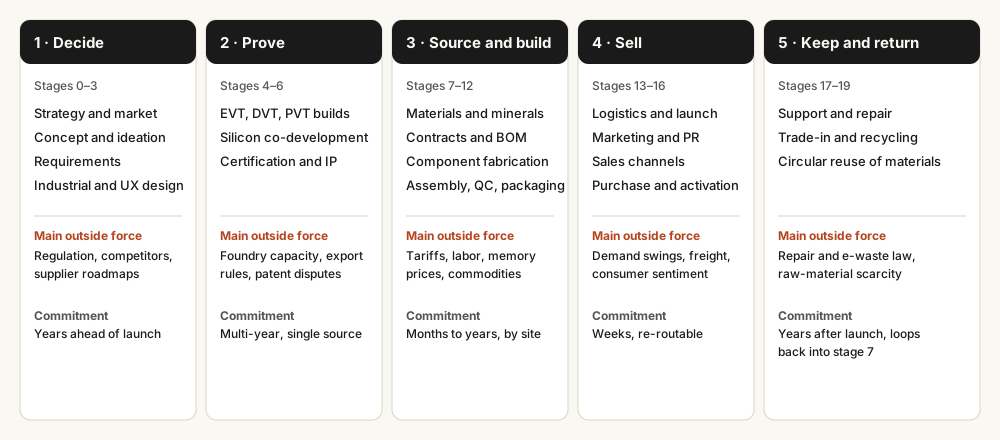
The diagram groups the 20 stages into five phases and names the main outside force on each. The phases are not a straight line: end-of-life materials return to stage 7, so the chain is a loop with a long tail.
Economic Framework
Two clocks run on every stage. The commitment clock measures how far ahead of launch the money, capacity or design was fixed. The substitution clock measures how long a replacement would take at the same volume and quality. When the second clock is longer than the time a shock leaves, the shock becomes a shortage or a margin hit.
Duplicate capacity is the price of shortening the second clock, and it is not free. Apple can pay for it because iPhone economics leave room: in the June 2026 quarter, Apple reported a 50.1 percent gross margin, and its CFO put the figure at 48.1 percent once the tariff refund was removed. That cushion is why the reshoring and recycling spending described below is affordable, and why a squeeze on it, such as the memory cycle in stage 8, gets so much attention from analysts.
Phase 1: Decide
Stages 0 to 3 produce no physical product, yet they fix most of what the phone will cost, weigh and be allowed to do. The outside forces here are slow and political: regulation, competitor moves and supplier roadmaps.
Stage 0: Corporate strategy and market mapping
Apple sets a multi-year direction for the iPhone and the services around it. What can be documented is how external rules rewrite that direction. On October 26, 2022, The Guardian reported that Apple would put USB-C connectors in iPhones to comply with the EU's common charger law. Marketing chief Greg Joswiak said, "Obviously we'll have to comply, we have no choice," while arguing it "would have been better environmentally and better for our customers to not have a government be that prescriptive."
The rule itself is now fully in force. The European Commission states that the common charger requirements apply to mobile phones from 28 December 2024 and to laptops from 28 April 2026, and estimates that discarded and unused chargers account for about 11,000 tonnes of e-waste a year. A proprietary connector had been Apple's own choice, and the EU turned it into a compliance requirement.
Stage 1: Product concept and ideation
This is the least documented stage in the chain, and a reliable guide should say so. Apple discloses almost nothing about early concepts. The only usable public evidence is indirect: what ships. When Apple's October 20, 2026 release describes iPhone Duo, the first foldable iPhone, with a grade 5 titanium enclosure, and an iPhone 18 Pro with a variable aperture system on a 48MP Fusion Main camera, it shows concepts that were chosen years earlier and then matched to suppliers able to build them. Our coverage of the fall event covers the products themselves.
Stage 2: Requirements and feature definition
Requirements turn ambitions into measurable targets, and outside rules now write some of them. The EU ecodesign rules for smartphones, applying from June 20, 2025, require batteries capable of at least 800 charge cycles while retaining at least 80 percent of initial capacity, spare parts supplied within 5 to 10 working days and kept available for at least 7 years after the model leaves the EU market, operating-system updates for at least 5 years, and a repairability score from A to E on the label.
These are requirements a phone must meet before it can be sold in the EU. They belong in the requirements document, not in marketing.
Stage 3: Industrial and UX design
Design is where materials meet physics. Hackaday's June 2024 account of Apple's durability labs describes a robot arm that performs repeatable spinning drops onto changing surfaces, with high-speed cameras recording how the titanium shell vibrates, a shake table tuned to frequencies such as a car engine or a subway train, and water tests that stand behind the IP68 claim. That is design validated by machine instead of opinion.
Design also decides what the supply chain must be able to do. The Ceramic Shield glass that Apple makes with Corning, the titanium for iPhone Duo supplied by Perryman, and the battery-removal process introduced on iPhone 16 are all design choices that created a supplier or a process. Apple's 2025 Environmental Progress Report says iPhone 16 debuted "a new, faster process for removing the battery from the enclosure," using low-voltage electricity, which is a design answer to repair rules arriving later in the chain.
Phase 2: Prove
Stages 4 to 6 test whether the design works, whether the chips exist to run it, and whether it is legal to sell. Commitments here are the longest and the least reversible.
Stage 4: Prototyping and engineering validation
Hardware programs move through EVT, DVT and PVT builds, as described in the core concepts. The durability work above sits mostly in this stage. The outside force is the schedule itself: a late component or failed test pushes the whole program, and the usual response is to cut a feature before delaying the launch. Public evidence of Apple's actual build schedule does not exist, so this guide does not invent one.
Stage 5: Silicon and technology co-development
This stage holds the sharpest dependencies. Apple designs its chips and relies on a foundry to make them. Two 2026 data points show how binding that is. First, Apple's October 2026 release says TSMC's Arizona operation is producing more than 100 million chips for Apple in 2026, and Apple's August 2025 release called Apple the fab's first and largest customer. Second, Cook's June-quarter remark that constraints come from "the availability of the advanced nodes" suggests that even a very large customer cannot buy its way past a capacity queue within a single quarter.
Other suppliers show the same pattern. In December 2022, Cook wrote publicly, "We've been partnering with Sony for over a decade to create the world's leading camera sensors for iPhone." Modems tell the longest story. In April 2019, Apple and Qualcomm settled their litigation with a payment from Apple (the amount undisclosed), a six-year license effective April 1, 2019 with a two-year extension option, and a multiyear chipset supply agreement. Six years later, on February 19, 2025, Apple introduced the iPhone 16e with C1, "the first modem designed by Apple," which it called "the most power-efficient modem ever on an iPhone." Replacing one component took roughly the length of a license term.
Our piece on AI chip supply economics explains why a handful of choke points govern the same foundry capacity that Apple depends on.
Stage 6: Regulatory compliance and IP protection
Before launch, each phone is certified for its markets, and legal exposure is part of the chain. The Qualcomm dispute is the cleanest example in the public record: a patent and licensing fight that ended in one package of a payment, a license and a chip supply agreement, which shows how closely legal exposure and component supply are tied. Regulatory exposure also runs forward in time. The EU's ecodesign label will now publish a repairability grade and battery lifetime for each phone, so compliance data is public and comparable.
Phase 3: Source and Build
Stages 7 to 12 are the physical core. This is where the commitment is largest, the outside forces are loudest, and the substitution gap shows most.
Stage 7: Material sourcing and strategic minerals
Apple has made recycled input a stated target, which changes what sourcing means. In April 2023, Apple announced a 2025 target to use 100 percent recycled cobalt in all Apple-designed batteries, with a note that cobalt figures are on a mass-balance basis, and 100 percent recycled tin soldering and gold plating in all Apple-designed printed circuit boards.
Apple's 2025 Environmental Progress Report gives the progress for 2024: approximately 99 percent of tungsten, 71 percent of aluminum, 53 percent of lithium, 40 percent of gold and 76 percent of cobalt in its products came from recycled sources, and 24 percent of all material shipped in products by weight came from recycled sources. In the iPhone 16 lineup, the battery used 100 percent recycled cobalt and over 95 percent recycled lithium.
Magnets show how far Apple has pushed and where it has not. On July 15, 2025, Apple committed $500 million to a multiyear deal with MP Materials for American-made neodymium magnets, produced at a Fort Worth, Texas facility, with a recycling line planned at Mountain Pass, California. Apple's own release says the magnets will ship only after the Texas factory is built. The report puts the recycled share of magnet rare earths at 99 percent. The pledge shortens substitution time for a part that few people think about and no phone can do without.
Stage 8: Supplier contracts and BOM finalization
Contracts convert strategy into obligations. Apple's U.S. program is the most visible set of them: on August 6, 2025, Apple raised its US commitment to $600 billion over four years and launched the American Manufacturing Program with an initial group of named partners, including Corning, Coherent, GlobalWafers America, Applied Materials, Texas Instruments, Samsung, GlobalFoundries, Amkor and Broadcom. The same day, Apple committed $2.5 billion to make all iPhone and Apple Watch cover glass at Corning's Harrodsburg, Kentucky plant. By October 2026, Apple said all iPhone cover glass sold worldwide would come from that facility by the end of 2026.
Memory is the contract that moved against Apple in 2026. On the July 2026 earnings call, Cook said Apple "reluctantly raised prices" because "we're in what I would characterize as a 100-year flood on the memory pricing, with exponential increases in memory prices." CFO Kevan Parekh said memory explained more than 100 percent of the sequential change in gross margin. Memory is a commodity with a few producers, so long-term commitment does not protect against a pricing cycle.
Stage 9: Component fabrication
Fabrication is where the lifecycle is both most global and most concentrated. Apple's supply-chain page describes thousands of supplier facilities in over 60 countries, 895 assessments of supplier facilities in 2025 (more than 20 percent unannounced), and 20-plus gigawatts of renewable energy sourced by suppliers. It also says Apple has removed 25 manufacturing supplier facilities and 232 smelters and refiners since 2009, which shows the compliance lever is real.
Silicon is the visible shift. Apple said in August 2025 that its US silicon supply chain was on track to produce more than 19 billion chips for Apple products in 2025. In October 2026, Apple said nearly 100 components in iPhone Duo and iPhone 18 Pro come from American companies across more than a dozen states, naming Coherent's laser technology for Face ID in Sherman, Texas, and Broadcom's radio-frequency components in Fort Collins, Colorado. These are real shifts, and they are partial: they reduce exposure to one geography without removing the foundry queue.
Stage 10: Assembly planning and automation
Assembly is the stage where a local event becomes a global shortage. On November 6, 2022, Apple said that COVID-19 restrictions had temporarily affected its primary iPhone 14 Pro and iPhone 14 Pro Max assembly facility, in Zhengzhou, China, which was "operating at significantly reduced capacity." Apple said it expected "lower iPhone 14 Pro and iPhone 14 Pro Max shipments than we previously anticipated" and that customers would "experience longer wait times." Apple described one site as the primary assembly facility for both models, so the shortfall showed up directly as longer waits for customers.
Since then, assembly has been spread out. Bloomberg reported, as relayed by Tech Wire Asia on March 10, 2026 that India assembled about 55 million iPhones in 2025, up 53 percent from about 36 million in 2024, roughly a quarter of Apple's 220 to 230 million annual output. The same report, as relayed by Tech Wire Asia, cites duties of around 55 percent on iPhones assembled in China and 10 percent on Indian-made devices. Tariff figures vary by report and change by rule, so treat them as a snapshot. The more durable point is scale: India's output grew 53 percent in a single year, and it still covers only about a quarter of the total. Automation is the other long-run hedge against labor shocks. The robotics concept page covers the technology, and this guide has no verified figures on how automated Apple's lines are.
Stage 11: Quality control and pre-market testing
Public evidence of device-level QC is thin: Apple does not publish defect or yield data. What is documented is process control over the chain. The 895 supplier assessments in 2025 are quality and compliance control at the supplier level. The durability labs are quality engineering before volume. Apple's QC outcome is visible only indirectly, through repair programs and recalls, so any claim about a specific defect rate would be a guess.
Stage 12: Packaging, serialization and security
Packaging is a logistics and carbon decision. Apple states that shipping the same product by ocean emits 95 percent fewer emissions than by air, and that transporting products makes up about 9 percent of Apple's comprehensive carbon footprint. Serialization and security measures exist but are not documented publicly in detail, so this guide leaves them there.
Phase 4: Sell
Stages 13 to 16 are the most flexible part of the chain. Commitments here last weeks, so shocks matter less, and many can be re-routed.
Stage 13: Global logistics and distribution
Logistics converts a factory output into launch-day availability. The documented constraint in 2026 was silicon, not shipping. On the July call, Cook said the constraints were "primarily driven by the availability of the advanced nodes that our SoCs are produced on," and Apple said it expected the impact of supply constraints to "increase significantly sequentially" in the September quarter, affecting iPhone, Mac and iPad. Freight mode still matters at the margin, given the 95 percent emissions gap between ocean and air noted under stage 12.
Stage 14: Marketing, PR and influencer seeding
The verifiable change is that supply-chain facts now serve as marketing. Apple's October 2026 release lists suppliers by state and city, quantifies chips and components, and names the new iPhones. That makes the manufacturing story part of the launch narrative, which suits a period in which tariff and reshoring politics shape how a global product is received.
Stage 15: Sales channels open
The June 2026 results show the channel working: iPhone revenue of $54.3 billion, up 22 percent, which Cook tied to demand for the iPhone 17 family. For the September quarter, Apple guided reported iPhone growth to mid-teens year over year. Details of channel inventory are not public, so the guide leaves them out.
Stage 16: Customer purchase and activation
Activation is where the hardware sale turns into a services relationship. Services revenue was $30.7 billion in the June 2026 quarter, up 12 percent. That is the economic reason the stage matters: each activated phone extends an installed base that carries recurring revenue. The platform economics concept and network effects concept explain why that base is sticky.
Phase 5: Keep and Return
Stages 17 to 19 run for years after the sale, and they are where regulation is now moving fastest.
Stage 17: Post-purchase support and repair
Repair policy changed under legal pressure. Apple's December 13, 2023 announcement cites a network of more than 5,000 Apple Authorized Service Providers, more than 4,500 Independent Repair Providers and Self Service Repair covering 35 Apple products in 33 countries. The 2025 Environmental Progress Report adds Repair Assistant, launched with iOS 18, which lets customers and repair professionals configure new and used Apple parts on the device.
The next step is a battery rule. The European Commission stated in August 2023 that from 2027 consumers will be able to remove and replace portable batteries at any point in a product's life. On April 28, 2026, the Commission opened a consultation on adding six product categories, including wearables such as smartwatches, to the list of exemptions. How the final rule applies to smartphones is the live question for iPhone design.
Stage 18: Trade-in, recycling and sustainability
At end of life, Apple uses disassembly machines. Apple says its robot Daisy can disassemble up to 1.2 million phones a year and has been expanded to take apart 23 iPhone models. Taz separates magnets from audio modules to recover rare earth elements, and Dave takes apart Taptic Engines to recover magnets, tungsten and steel. Apple's 2022 release gives a scale comparison: gold and copper recovered from one metric ton of iPhone components would otherwise require mining 2,000 metric tons of rock.
Stage 19: Circular impact and ecosystem reuse
This stage closes the loop and reaches back to stage 7. The report's numbers show the loop working in 2024: 24 percent of material shipped by weight was recycled, 99 percent of the rare earth elements in magnets were recycled, and more than 80 percent of all rare earths shipped in products came from certified recycled sources, up from 75 percent in 2023. Apple also reports cutting emissions across its value chain by more than 60 percent since 2015, with a goal of 75 percent by 2030.
The loop is incomplete by Apple's own numbers. Roughly three-quarters of the material by weight did not come from recycled sources in 2024, and the 100 percent targets apply to specific components, not whole phones. Still, a recovered magnet is a substitute that already sits inside Apple's own chain, which is the fastest kind of substitute.
The Commitment-Substitution Matrix
Everything above reduces to two questions that can be asked of any stage, and of any headline about the iPhone supply chain.
- Commitment lead time: how far ahead of launch was the money, capacity or design locked in?
- Substitution lead time: if the commitment fails, how long would it take to replace it at the same volume and quality?
A stage is most exposed when both are long, because the commitment cannot be unwound and the replacement cannot be built in time. A stage is least exposed when substitution is short, even if the commitment was early.
The ratings below are editorial judgment (low, medium, high), derived from the dated evidence beside each. They are ordinal, not measured.
| Phase | Commitment lead time | Substitution lead time | Exposure | Evidence |
|---|---|---|---|---|
| 1. Decide | High | High | Medium | USB-C: a design decision that took a legal deadline to change; shocks are rare but slow to answer |
| 2. Prove (silicon, modem, IP) | High | High | High | Qualcomm 2019: a six-year license; C1 modem 2025; July 2026: advanced-node availability sets supply |
| 3a. Memory and fabricated parts | Medium | High | High | July 2026: Cook's "100-year flood" on memory pricing; memory explained more than 100 percent of the margin change |
| 3b. Assembly sites | Medium | Medium to high | High | Nov 2022: one site was the primary assembly facility for two models; India reached about a quarter of output in 2025 |
| 3c. Rare-earth magnets | High | High, falling | Medium | July 2025: US magnets ship only after a factory is built; 99 percent recycled share cushions |
| 4. Sell | Low | Low | Low | Weeks-long commitments; freight and channels can be re-routed |
| 5. Keep and return | High | Medium | Medium, rising | EU rules from 2025 and 2027; Daisy capacity of 1.2 million phones a year |
Three patterns come out of it.
Exposure clusters in the middle of the chain. The expensive-to-replace stages are the ones that produce irreplaceable parts: leading-edge chips, memory, a few assembly campuses. The ends of the chain (selling and design) have more room to maneuver.
Apple's recent spending targets substitution time, not commitment. The India build-out, Arizona silicon, Kentucky glass and Texas magnets each create a second source. None removes the first. The matrix explains why Apple pays for duplicate capacity even at higher cost: substitution time is what turns a bad month into a bad year.
Recycling is the quietest substitution lever. A recovered magnet or cobalt cell enters the chain with no new mine and no new queue. That is why the end-of-life stage deserves a place in a supply-chain analysis, not just a sustainability report.
The matrix will not predict a specific shock. It tells you which news deserves your attention. A fire at a packaging site scores low. A change in advanced-node capacity or a memory price cycle scores high.
For the policy side of the same story, see our analysis of the tariff tug-of-war reshaping supply chains, and for the strategic logic of capturing value from suppliers, the Value Stick framework. The economic moats concept explains why duplicated capacity is itself a form of moat.
Timeline
| Date | Event | Stage affected |
|---|---|---|
| Apr 16, 2019 | Apple and Qualcomm settle; six-year license, multiyear chipset supply deal | 5, 6 |
| Oct 26, 2022 | Apple confirms USB-C for iPhone under EU rules | 0, 2 |
| Nov 6, 2022 | Apple says Zhengzhou restrictions cut iPhone 14 Pro supply | 10 |
| Apr 13, 2023 | Apple sets 2025 target for recycled cobalt, tin and gold in Apple-designed parts | 7 |
| Dec 13, 2023 | Self Service Repair expands; 5,000+ authorized and 4,500+ independent providers | 17 |
| Dec 28, 2024 | EU common charger rules apply to mobile phones | 0, 2 |
| Feb 19, 2025 | iPhone 16e launches with Apple's first in-house modem | 5 |
| Jun 20, 2025 | EU ecodesign rules for smartphones apply | 2, 17 |
| Jul 15, 2025 | $500 million US magnet deal with MP Materials | 7 |
| Aug 6, 2025 | $600 billion US pledge; American Manufacturing Program; $2.5 billion Corning commitment | 8, 9 |
| Mar 10, 2026 | Bloomberg: India about a quarter of iPhone assembly in 2025 | 10 |
| Apr 28, 2026 | EU consultation on battery-removability exemptions | 17 |
| Jul 2026 | June quarter: tariff refunds lift margin, memory costs rise, advanced nodes constrain supply | 8, 9 |
| Oct 20, 2026 | Apple names US suppliers behind iPhone Duo and iPhone 18 Pro | 9, 14 |
By the Numbers
| Metric | Figure | Source date |
|---|---|---|
| iPhone revenue, quarter ended June 27, 2026 | $54.3 billion (+22%) | Jul 2026 |
| Total revenue, same quarter | $109.4 billion (+16%) | Jul 2026 |
| Gross margin, same quarter | 50.1%, including about 2 points from tariff refunds | Jul 2026 |
| September-quarter gross margin guide | 47 to 48%, including about 1 point from tariff refunds | Jul 2026 |
| India's share of iPhone assembly, 2025 | About 25% (about 55 million units) | Mar 2026 |
| Chips from Apple's US silicon chain | 19+ billion expected in 2025 | Aug 2025 |
| TSMC Arizona chips for Apple, 2026 | 100+ million | Oct 2026 |
| Recycled share of material shipped, 2024 | 24% by weight | 2025 report |
| Recycled share of magnet rare earths | 99% | 2025 report |
| Emissions cut since 2015 | More than 60% (goal: 75% by 2030) | 2025 report |
| Daisy disassembly capacity | 1.2 million phones a year, 23 models | Apr 2022 |
| EU battery endurance rule | 800 cycles at 80% capacity | Jun 2025 |
Common Misconceptions
Myth: Apple's recycled-cobalt pledge covers every battery in every product. Reality: The 2025 target applies to "all Apple-designed batteries," on a mass-balance basis. The iPhone 16 lineup reached 100 percent recycled cobalt in the battery, but that is a statement about a lineup, not the whole industry.
Myth: Apple has moved out of China. Reality: India reached about a quarter of assembly in 2025 on a base of 220 to 230 million units. That is a major shift in a few years and still leaves most assembly elsewhere.
Myth: Tariffs only ever raise Apple's costs. Reality: In the June 2026 quarter, tariff refunds added about 2 points to gross margin and about $0.11 to earnings per share. Tariff policy is a swing factor in both directions.
Myth: Supply shortages mean a supplier failed. Reality: Cook was explicit in July 2026: "this isn't a partner or supplier issue." He described demand that went beyond Apple's expectations, against limited advanced-node capacity.
Myth: Recycling is a marketing layer on top of the real supply chain. Reality: Apple reports that 24 percent of the material it shipped in 2024 came from recycled sources, so recycling is now part of the real supply chain, although roughly three-quarters of the material by weight still came from other sources.
Future Outlook
This section is an editorial forecast, not a sourced fact.
Five things will test the matrix over the next twelve months. First, the September-quarter results, due soon, will show whether the guided 47 to 48 percent gross margin holds as memory costs rise and refunds fade. Second, the end of 2026 is Apple's stated date for all iPhone cover glass to come from Kentucky, a checkable milestone. Third, MP Materials magnet shipments depend on the Texas factory being built, so the date is the thing to watch, not the pledge. Fourth, the EU's 2027 battery-replaceability rule and the outcome of the April 2026 exemption consultation will show how much of the iPhone's internal design must change. Fifth, the next published estimate of India's share of assembly will show whether the quarter-of-output milestone was a step or a plateau.
Under the matrix, the most important single variable remains advanced-node capacity. The June 2026 quarter showed that demand can exceed it even when everything else works.
Limitations
The analysis is bounded in six ways. First, the matrix ratings are editorial judgment. They are ordinal, built from dated evidence, and another analyst could rate a stage differently. Second, Apple discloses little. It publishes no unit volumes, supplier shares, bill of materials or defect rates, so several stages (concept, device QC, packaging security) are described as thin rather than detailed.
Third, India figures are secondary. They come from a Bloomberg report relayed by Tech Wire Asia, and the tariff rates quoted in that coverage vary across reports and change with policy. Fourth, recycled-content figures are self-reported and, for cobalt, stated on a mass-balance basis. Fifth, some sources could not be verified because they blocked automated access, including Reuters and SEC filings, so claims that rest only on them were left out. Widely repeated figures such as bill-of-materials teardown estimates, per-phone margin estimates and daily factory output were left out for the same reason.
Sixth, EVT, DVT and PVT describe industry convention, not a published Apple schedule. The evidence cut-off is October 23, 2026, and Apple's next results will change the financial figures.
Glossary
Advanced node: the most miniaturized chip process, available at volume from very few fabs. AMP: Apple's American Manufacturing Program, launched August 6, 2025. BOM: bill of materials, the itemized component list for one phone. DVT: design validation test, the build that proves the design meets specifications. EVT: engineering validation test, the first build that proves the core design works. Mass balance: an accounting method that credits recycled input to output even when materials are mixed. PVT: production validation test, the build that proves the factory can run at volume. Substitution time: how long it takes to replace a supplier, site or material at equal volume and quality.
Explore Related Concepts
Economic Moats · Robotics · Platform Economics · Network Effects
Related Analysis
- Business hub — the parent topic hub
- Business Strategy: the Value Stick — the pillar on capturing value from suppliers and customers
- The Tariff Tug-of-War — how supply chains re-route around US-China trade fracturing
- The AI Chip Supply Chain — the choke points behind advanced silicon
- Everything Apple Announced at Its Fall iPhone Event — the products behind this supply chain
References
- Apple. "Qualcomm and Apple agree to drop all litigation." April 16, 2019.
- Apple. "Update on supply of iPhone 14 Pro and iPhone 14 Pro Max." November 6, 2022.
- Apple. "Apple expands the use of recycled materials across its products." April 2022.
- Apple. "Apple will use 100 percent recycled cobalt in batteries by 2025." April 13, 2023.
- Apple. "Apple unveils its first carbon neutral products." September 12, 2023.
- Apple. "Apple expands Self Service Repair and introduces new Diagnostics process." December 13, 2023.
- Apple. "Apple debuts iPhone 16e." February 19, 2025.
- Apple. "Apple expands U.S. supply chain with $500 million commitment." July 15, 2025.
- Apple. "Apple increases U.S. commitment to $600 billion, announces ambitious program." August 6, 2025.
- Apple. "Apple, Corning to manufacture all iPhone, Apple Watch cover glass in Kentucky." August 6, 2025.
- Apple. "Apple announces American Manufacturing Program partners for latest iPhone lineup." October 20, 2026.
- Apple. "Apple reports third quarter results." July 2026.
- Apple. 2025 Environmental Progress Report.
- Apple. Supply Chain Innovation.
- Apple Q3 2026 earnings call transcript (Motley Fool).
- The Guardian. "Apple to put USB-C connectors in iPhones to comply with EU rules." October 26, 2022.
- The Verge. "Tim Cook admits that iPhones use Sony camera sensors." December 13, 2022.
- Hackaday. "A Peek Inside Apple Durability Testing Labs." June 10, 2024.
- European Commission. "EU common charger rules: power all your devices with a single charger." December 28, 2024.
- European Commission. "New EU rules for durable, energy-efficient and repairable smartphones and tablets start applying." June 20, 2025.
- European Commission. "New law on more sustainable, circular and safe batteries enters into force." August 17, 2023.
- European Commission. "Commission seeks views on battery removability exemptions." April 28, 2026.
- Tech Wire Asia. "Apple iPhone production in India hits 25% of global output." March 12, 2026 (citing Bloomberg, March 10, 2026).
Final Thoughts
The lifecycle view changes what a headline means. A factory shutdown, a memory price spike, a new EU rule and a magnet plant that is not built yet look like four unrelated stories. Under the matrix they are one question asked at four stages: how long was the commitment, and how long would a replacement take? Apple's answer, visible in 2025 and 2026, is to buy second sources at the stages where the answer is "years," and to turn its own retired phones into one of them.
That reframes recycling too. A recovered magnet is a part that exists, in Apple's hands, with no queue. If the company reaches its 100 percent targets for the components it designs, the end of the lifecycle becomes a hedge against the middle. The next time a supply-chain story breaks, ask the two questions before reading the rest.
Explore Related Concepts
Frequently Asked Questions
What are the stages of the iPhone lifecycle?
This guide breaks it into 20 stages in five phases. Decide: strategy, concept, requirements, design. Prove: prototyping, silicon co-development, regulatory and IP clearance. Source and build: materials, contracts, component fabrication, assembly, quality control, packaging. Sell: logistics, marketing, channels, activation. Keep and return: support and repair, trade-in and recycling, and reuse of recovered materials.
How long does it take to develop an iPhone?
Apple does not publish a development timeline. What is documented is the lead time of individual commitments: foundry capacity, custom glass and magnet supply chains are arranged years before launch, which is why a single launch reflects decisions made well before the previous model shipped.
Where are iPhones made?
Apple says its supply chain spans thousands of supplier facilities in over 60 countries. Final assembly is concentrated in Asia. Bloomberg reported in March 2026 that India assembled about 55 million iPhones in 2025, roughly a quarter of Apple's 220 to 230 million annual output.
Does Apple recycle old iPhones?
Yes. Apple takes devices back through trade-in and recycling, and its disassembly robot Daisy can take apart up to 1.2 million iPhones a year across 23 models. Apple reported that 24 percent of the material in products it shipped in 2024 was recycled, and 99 percent of the rare earth elements in its magnets.
Did the EU force Apple to use USB-C on the iPhone?
Yes. The EU common charger rules apply to mobile phones from 28 December 2024. Apple marketing chief Greg Joswiak said in 2022, "Obviously we'll have to comply, we have no choice," and Apple confirmed that iPhones would move to USB-C.
How are tariffs affecting Apple?
Tariffs cut both ways in Apple's latest results. For the quarter ended June 27, 2026, Apple reported a 50.1 percent gross margin that included roughly 2 percentage points from tariff refunds, and it guided the next quarter to 47 to 48 percent including about 1 point from refunds.